Cold-weather time-lapse and astrophotography demand more than a basic shutter release. The right intervalometer should match your camera, remain easy to operate with limited dexterity, and provide dependable timing when temperatures drop.
We selected 10 wired and wireless options for Canon, Nikon, and Sony cameras, focusing on compatibility, interval controls, power design, and practical outdoor usability.
Best 10 Camera Intervalometers for Cold Weather Picks for 2026
Best Wireless Multi-Camera Pick
Rechargeable Canon Timer Intervalometer

- Rechargeable transmitter and receiver with USB-C charging
- Wireless range up to approximately 60 m/200 ft
- Supports bulb, delay, interval, and shot-count modes
Best For: Canon users needing long-range wireless control outdoors
Best Advanced Time-Lapse Controller
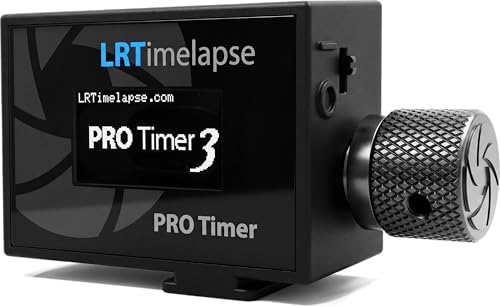
- 0.1-second interval adjustments and interval ramping
- High-contrast OLED display works with gloves or mittens
- Rechargeable battery and flashlight function
Best For: Advanced time-lapse and astrophotography work
Best Simple Wired Option
JJC Sony Intervalometer Timer Remote
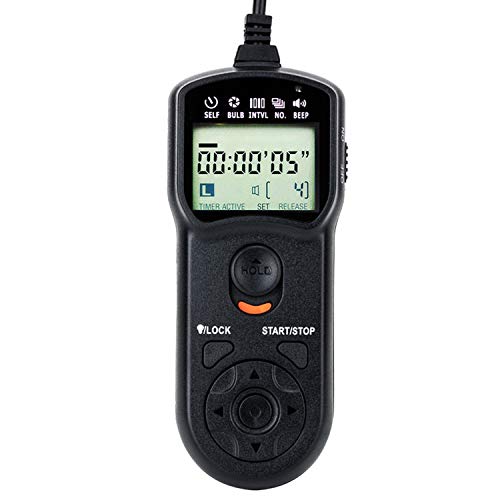
- Self-timer, interval, long-exposure, and count settings
- Backlit LCD with lock function for low-light use
- Compact wired design with a 90 cm cable
Best For: Sony users wanting straightforward tripod-based control
Best Dual-Control Canon Pick
AODELAN Wireless Rechargeable Shutter Remote

- Wireless range up to approximately 60 m/200 ft
- Supports both wireless and wired shutter control
- Rechargeable battery with USB-C charging
Best For: Canon users wanting flexible control for long exposures and time-lapse
Best Wired Canon Pick
- Backlit display for low-light setup
- Wide interval and long-exposure timer range
- Compact wired Canon-compatible design
Best For: Canon users shooting time-lapses and long exposures
Nikon Cold-Weather Time-Lapse Pick

- Up to 99 hours, 59 minutes, 59 seconds
- Supports 399 shots or unlimited shooting
- Backlit display and included clip holder
Best For: Nikon shooters planning extended time-lapse sessions
Canon Cold-Weather Starter
- Self-timer, interval, long-exposure, and count modes
- One second to 99 hours, 59 minutes, 59 seconds
- Compact backlit controller with 90cm cable
Best For: Canon users wanting a compact wired timer
Multi-System Cold-Weather Choice
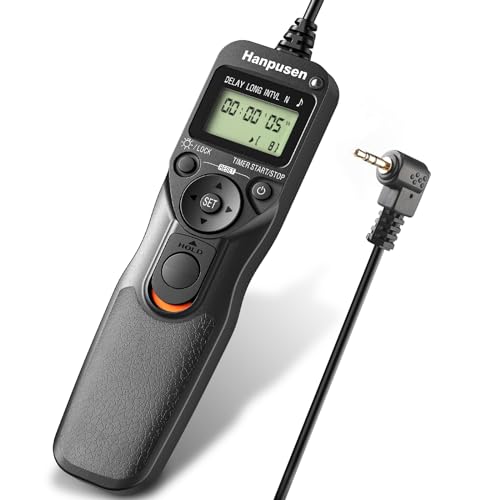
- Supports Canon, Fujifilm, Olympus, Pentax, and more
- Up to 99 hours, 59 minutes, 59 seconds
- 399 shots or unlimited shooting with backlit display
Best For: Multi-brand camera users planning long outdoor sequences
Best Wireless Multi-Camera Pick – Rechargeable Canon Timer Intervalometer
For photographers comparing camera intervalometers for cold weather, the AODELAN rechargeable remote is a practical wireless option when you want fewer disposable batteries to manage outdoors. It supports delay, bulb, long-exposure, interval, and shot-count settings, with an LCD screen that can be read in bright or dark conditions.
Best For: Canon users and photographers who need wireless control, broad camera compatibility, and rechargeable operation for extended outdoor shoots.
Pros:
- Built-in rechargeable battery with USB-C charging and claimed multi-day operating times.
- 2.4GHz wireless control reaches up to approximately 60 m/200 ft and does not require directional aiming.
- Supports multiple timer modes and includes two connecting cables for compatible camera systems.
- LCD display helps with setting verification in daylight or darkness.
Cons:
- Compatibility depends on using the correct included camera cable and model.
- The supplied notes describe the unit as supporting one camera at a time.
This is a strong choice for cold-weather interval shooting when wireless range and rechargeable power matter more than a minimalist wired setup. Confirm your exact camera model before buying.
Best Advanced Time-Lapse Controller – LRT PRO 3.5 Interval Timer
LRTimelapse PRO Timer 3.5 Camera Interval Timer for Time-Lapse and Astrophotography
Check Price On AmazonThe LRT PRO 3.5 is aimed at demanding time-lapse and astrophotography users seeking camera intervalometers for cold weather. Its high-contrast OLED display and rotary control are designed for operation with gloves or mittens, while interval ramping and 0.1-second adjustments provide detailed control over a sequence.
Best For: Serious time-lapse and astro photographers who want precise interval control, ramping, and glove-friendly operation.
Pros:
- Intervals can be adjusted in 0.1-second steps, with interval ramping for smoother transitions.
- High-contrast OLED display and rotary knob are intended for use with gloves or mittens.
- Rechargeable Li-Ion battery and flashlight function add useful field features.
- Can operate two cameras at once according to the supplied product notes.
Cons:
- The required camera release cable is not included and must be purchased separately.
- Its advanced controls may be more than casual interval shooting requires.
Choose this model when timing precision and cold-weather usability are priorities. Budget for the separate release cable and verify the connection required by your camera.
Best Simple Wired Option – JJC Sony Intervalometer Timer Remote
For Sony photographers looking at camera intervalometers for cold weather, the JJC wired timer keeps the setup straightforward and avoids wireless pairing. It offers self-timer, interval, long-exposure, and exposure-count settings, with timing adjustable from one second to 99 hours, 59 minutes, and 59 seconds.
Best For: Sony camera owners who prefer a compact wired controller with broad timing ranges and a backlit display.
Pros:
- Supports self-timer, interval, long-exposure, and exposure-count settings.
- Timing range extends from one second to 99 hours, 59 minutes, and 59 seconds.
- Backlit LCD, lock function, and two-stage release button improve operation in low light.
- Compact 12.1 cm body with a 90 cm cable is easy to carry.
Cons:
- It is wired, with a listed maximum range of only 0.9 m.
- Uses two AAA alkaline batteries rather than a rechargeable battery.
- Compatibility is focused on the listed Sony models.
This is a sensible low-complexity choice for a tripod-based cold-weather setup, especially when you want reliable direct control without wireless components. Check the model list carefully before ordering.
Best Dual-Control Canon Pick – AODELAN Wireless Rechargeable Shutter Remote
This AODELAN remote combines wireless and wired operation, making it a flexible option among camera intervalometers for cold weather. Its rechargeable design removes the need for disposable batteries, while the LCD shows battery level, mode, and timer settings for long-exposure, time-lapse, star-trail, and night photography.
Best For: Canon photographers who want rechargeable wireless control with a wired fallback and multiple shooting modes.
Pros:
- Supports wireless operation up to approximately 60 m/200 ft and can also work as a wired shutter remote.
- Built-in lithium battery charges by USB-C in about two hours according to the notes.
- Offers single-shot, continuous, bulb, two-second delay, interval, long-exposure, and shot-count modes.
- Broad compatibility includes many Canon models plus selected Fujifilm, Olympus, Pentax, Hasselblad, and Samsung cameras.
Cons:
- Exact compatibility depends on the camera model and the appropriate connecting cable.
- The supplied package description is truncated after “2× Connecting Cable…,” so confirm included accessories before purchase.
The dual-control design is useful for outdoor photographers who want wireless flexibility but still value a direct wired option. Its rechargeable power and clear display make it particularly practical for extended cold-weather sessions.
Best Wired Nikon Pick – JJC TM-F2 Intervalometer
For photographers looking for camera intervalometers for cold weather, the JJC TM-F2 is a straightforward wired option for compatible Nikon cameras. Its backlit LCD, long timer range, and simple battery-powered design make it practical for time-lapse work and long exposures, though the wired connection requires staying within its 0.9-meter range.
Best For: Nikon shooters who want a compact wired intervalometer for time-lapses, long exposures, and shake-free triggering.
Pros:
- Supports self-timer, interval timer, long-exposure timer, and exposure-count settings.
- Timer settings range from 1 second to 99 hours, 59 minutes, and 59 seconds.
- Backlit LCD helps with viewing settings in dark conditions.
- Uses two standard AAA alkaline batteries.
Cons:
- Wired design limits operating distance to 0.9 meters.
- Requires compatible Nikon camera connectivity.
- AAA batteries may be less convenient than a rechargeable design in very cold conditions.
The JJC TM-F2 is a practical, uncomplicated choice when reliable wired control matters more than wireless range. Its backlight and broad timer settings are useful for dark outdoor shooting, while spare batteries are advisable for cold-weather sessions.
Best Wireless Nikon Option – AODELAN Rechargeable Intervalometer
Among camera intervalometers for cold weather, this AODELAN model stands out for its rechargeable design and wireless flexibility. It combines a clear LCD, interval timing, and wired or wireless operation, making it useful when you want to reduce camera shake without remaining beside the camera.
Best For: Nikon users who need wireless triggering, interval shooting, and a rechargeable remote for outdoor photography.
Pros:
- Supports wireless operation up to 60 meters, or about 196 feet.
- Built-in rechargeable battery reduces reliance on disposable batteries.
- Clear LCD displays interval, count, and delay settings.
- Supports interval shooting, single shooting, continuous shooting, and bulb mode when the camera is set appropriately.
Cons:
- Video recording is not supported through the intervalometer.
- Compatibility is limited to the listed Nikon cameras.
- Wireless use adds a receiver and transmitter to manage outdoors.
This is the most flexible option of the three for remote Nikon shooting. Its rechargeable battery can simplify field setup, but cold-weather users should plan around battery performance and keep the unit protected when temperatures drop.
Best Wired Canon Pick – JJC TC-80N3 Intervalometer
The JJC TC-80N3 is a compact wired choice for Canon users comparing camera intervalometers for cold weather. It provides interval, long-exposure, and exposure-count functions, plus a backlit display for setting the remote in low-light conditions.
Best For: Canon photographers who want a simple wired controller for time-lapses, long exposures, and shake-free shutter release.
Pros:
- Offers self-timer, interval timer, long-exposure timer, and exposure-count settings.
- Timer can be set from 1 second to 99 hours, 59 minutes, and 59 seconds.
- Backlit LCD improves visibility in darkness.
- Compact 90-centimeter wired remote uses two AAA alkaline batteries.
Cons:
- Maximum wired range is 0.9 meters.
- Requires two AAA batteries.
- Compatibility is limited to supported Canon cameras.
The TC-80N3 is a sensible Canon-focused intervalometer when you prefer a lightweight wired setup over wireless convenience. Its backlight and extensive timer range suit nighttime and long-exposure work, while cold-weather users should carry spare batteries.
Nikon Cold-Weather Time-Lapse Pick – JJC TM-M Intervalometer
For photographers comparing camera intervalometers for cold weather, the JJC TM-M offers a wired, battery-powered control layout with a backlit display for checking settings in darker conditions. It supports self-timer, long-exposure, interval-timer, and exposure-count functions, making it practical for planned landscape, sunrise, sunset, and night-sky sessions.
Best For: Nikon shooters who need long timing ranges, a clip holder, and a backlit controller for extended time-lapse work.
Pros:
- Sets exposure and interval times from one second up to 99 hours, 59 minutes, and 59 seconds.
- Supports up to 399 shots or unlimited shooting.
- Includes a clip holder and backlit LCD for convenient hands-free and low-light use.
- Offers a keyboard lock to help prevent accidental schedule interruption.
Cons:
- Uses two AAA batteries, which need to be monitored during long outdoor sessions.
- Compatibility is camera-specific, so users should verify their Nikon model before buying.
- The wired controller has a 90cm cable rather than a wireless connection.
Its extensive timer range and low-light display make the TM-M a capable choice for deliberate cold-weather sequences. The main consideration is confirming camera compatibility and carrying spare AAA batteries.
Canon Cold-Weather Starter – JJC TM-C Intervalometer
The JJC TM-C is a compact wired option for photographers seeking camera intervalometers for cold weather without a bulky controller. Its backlit LCD, AAA-battery power, and timer functions cover self-timed, interval, and long-exposure shooting for time-lapse and shake-reduction work.
Best For: Canon users who want a straightforward, compact intervalometer with long programmable delays and exposure counts.
Pros:
- Supports self-timer, interval timer, long-exposure timer, and exposure-count settings.
- Timer settings span from one second to 99 hours, 59 minutes, and 59 seconds.
- Backlight helps make the display readable in dark conditions.
- Compact 90cm wired design weighs about 76g and uses two AAA batteries.
Cons:
- It is a wired controller with a 90cm cable and no stated wireless operation.
- Compatibility depends on the specific Canon camera connection.
- The notes do not specify a clip holder or unlimited-shot setting.
The TM-C keeps the controls simple while providing the timing range needed for long outdoor exposures and interval sequences. Its compact format is convenient, but camera compatibility should be checked before purchase.
Multi-System Cold-Weather Choice – Hanpusen TR-90 Timer
For photographers comparing camera intervalometers for cold weather across multiple camera brands, the Hanpusen TR-90 provides wired timer control with a digital backlit display. It supports delay, bulb, interval, and exposure-count settings, with one-second programming for sequences lasting nearly 100 hours.
Best For: Canon, Fujifilm, Olympus, Pentax, Contax, or Sigma users who need broad listed compatibility for night-sky, wildlife, macro, or time-lapse photography.
Pros:
- Supports delay, long-exposure, interval, and exposure-count control.
- Sets delay, exposure, and intervals from one second up to 99 hours, 59 minutes, and 59 seconds.
- Offers 1 to 399 shots or unlimited shooting.
- Backlit digital display and active indicator support operation in darker settings.
Cons:
- The listed maximum range is about 2.79 feet, limiting remote placement.
- Uses two AAA batteries, so extended cold-weather sessions may require spares.
- Its broad compatibility list still requires checking the exact camera and connector.
The TR-90 stands out for its expansive camera-brand coverage and flexible shot-count controls. It is especially useful for photographers working across systems, provided the exact camera connection is confirmed before heading outdoors.
How We Picked These Camera Intervalometers for Cold Weather
We compared the listed remotes by camera compatibility, intervalometer functions, connection type, power source, and suitability for extended outdoor sessions. Priority goes to models that support programmable delays, exposure intervals, shot counts, and long time-lapse sequences. Rechargeable designs can reduce disposable-battery dependence, while wired remotes may offer simpler setup and fewer wireless connection concerns.
Cold-weather performance also depends on the camera and batteries, so no remote should be treated as fully weatherproof unless the manufacturer explicitly says so. Use a protective cover, keep spare power warm, and confirm the connector before ordering.
Quick Comparison
| Best For | Recommended Options | Why Consider Them |
|---|---|---|
| Canon compatibility | AODELAN, JJC, Hanpusen, Canon-compatible wireless models | Multiple connector and camera-generation options |
| Nikon compatibility | JJC Nikon models, Nikon-compatible rechargeable remotes, MC-DC2 replacement | Useful coverage for DSLR and Z-series bodies |
| Sony compatibility | JJC Sony intervalometer | Designed for selected A6000, A6400, and A7 cameras |
| Astrophotography | PRO Timer 3.5 | Built around timed exposures and repeatable sequences |
| Reduced cable clutter | Wireless rechargeable models | Convenient when the camera is mounted or difficult to reach |
Key Buying Factors for Camera Intervalometers for Cold Weather
Camera and Connector Compatibility
Check the exact camera model and remote socket, not just the brand. Similar-looking Canon, Nikon, and Sony bodies can use different connectors or require different control interfaces. Pay attention to model revisions such as Canon EOS R generations and Nikon Z-series variants.
Timing Range and Controls
For time-lapse work, look for programmable delay, interval, exposure duration, and number of shots. Astrophotographers may also value long exposure support and repeat scheduling. A clear display and tactile buttons are especially useful when wearing gloves.
Power and Cold-Weather Handling
Rechargeable remotes are convenient, but cold reduces battery capacity. Choose a model you can recharge reliably before a shoot, and keep the remote insulated when it is not in use. Wired units can be attractive for simpler, lower-maintenance setups.
Wireless Reliability and Cable Management
Wireless models provide flexibility but add pairing, range, and battery considerations. Wired intervalometers generally offer a direct connection and predictable operation, although the cable should be protected from snagging and moisture.
Who Should Buy Which Camera Intervalometers for Cold Weather?
Canon owners should begin with the option specifically matched to their EOS model and connector; the JJC, AODELAN, Hanpusen, and other Canon-compatible choices cover different generations. Nikon users should select between a Z-series or DSLR-specific JJC remote and an MC-DC2 replacement based on the camera socket. Sony users should verify that their A6000, A6400, or A7-series body appears in the compatibility list. For dedicated astrophotography and complex sequences, the PRO Timer 3.5 is the most specialized choice. If minimizing cables matters most, choose a compatible wireless rechargeable remote, but carry a backup plan for long or especially cold sessions.