Finding the right monitors for a small room is about balance: enough clarity to make good mix decisions, but not so much bass or output that the space works against you.
This roundup focuses on compact, practical options that suit home studios, desktop setups, and tight recording spaces.
Best 10 Studio Monitors for Small Recording Rooms Picks for 2026
Compact Entry-Level Pick
PreSonus Eris E3.5 for Small Rooms

- 3.5-inch woven drivers in a compact pair
- Acoustic tuning controls for room adjustment
- Front-panel aux, headphone jack, and volume
Best For: Small home studios and desktop music production
Compact Reference Choice
Yamaha HS4 for Small Recording Rooms

- 4.5-inch woofer and 1-inch dome tweeter
- Room control and high-trim tuning
- XLR/TRS, RCA, and stereo mini inputs
Best For: Compact recording desks and nearfield reference listening
Flexible Desktop Favorite
Mackie CR3.5 for Small Studios

- Tone knob for adjustable sound shaping
- Location switch for desktop or bookshelf use
- TRS, RCA, and 3.5 mm connectivity
Best For: Mixed-use small rooms and desktop setups
Step-Up Nearfield Pick
PreSonus Eris E5 for Small Recording Rooms
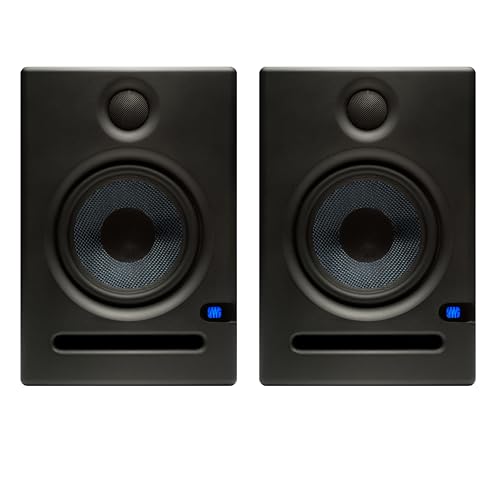
- 5.25-inch woofer with front-firing acoustic port
- 80-watt Class AB amplification
- XLR, 1/4-inch, and RCA inputs
Best For: Small studios that want more low-end and headroom
Compact Bluetooth Monitor Pick
Edifier MR3 Powered Studio Monitor Speakers

- Hi-Res Audio certified with 52Hz–40kHz response
- Balanced TRS, RCA, AUX, headphone out, and Bluetooth
- App-based Monitor, Music, and Custom modes
Best For: Small home studios and desktop creators who want flexible input options
Desktop Budget Monitor Pair
M-AUDIO BX3 Pair 3.5" Wired Studio Monitors

- Zero-latency wired monitoring for desktop use
- 3.5-inch Kevlar woofers with silk dome tweeters
- Rear 1/4-inch, 1/8-inch, and RCA inputs
Best For: Small desks, podcasting, and entry-level recording setups
True Reference Choice
Edifier MR4 Powered Studio Monitor Speakers
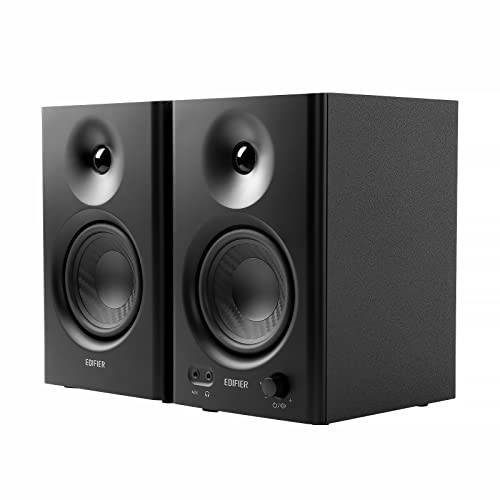
- Almost flat tuning for more reference-style monitoring
- 4-inch woofer with 1-inch silk dome tweeter
- TRS, RCA, AUX, and front headphone output
Best For: Home studios and computer-based mixing that need a neutral sound
Compact 3-Way Tuning
Edifier MR5 for Home Studio Flexibility

- 3-way active design with dedicated woofer, mid, and tweeter
- Room compensation controls help in tricky small rooms
- XLR, TRS, RCA, AUX, and Bluetooth 6.0 inputs
Best For: Small studios and desktop setups that need detailed sound plus easy room tuning.
Desktop Near-Field Pair
PreSonus Eris 3.5 for Tight Spaces

- Compact 3.5-inch powered monitors for desktop setups
- Built-in high/low tuning helps adjust for room acoustics
- Front aux and headphone jack add easy everyday convenience
Best For: Budget-friendly desktop monitoring in tight home studio setups.
Boundary-Aware 5-Inch Monitor

- Boundary EQ helps manage desk and wall placement
- Broad sweet spot supports off-axis listening
- Updated 5-inch transducers improve transient response
Best For: Near-field mixing in compact rooms where wall and desk placement matter.
Compact Entry-Level Pick – PreSonus Eris E3.5 for Small Rooms
If you need studio monitors for small recording rooms, the PreSonus Eris E3.5 is a practical nearfield option that keeps the footprint small while still aiming for accurate monitoring. Its 3.5-inch woven composite drivers and 1-inch silk-dome tweeters are tuned for balanced sound, and the front-panel acoustic tuning controls can help you adapt the monitors to tighter spaces.
Best For: Small home studios, desktop production setups, and creators who want an affordable nearfield pair with room tuning.
Pros:
- 3.5-inch woven composite drivers for compact nearfield use
- Acoustic tuning controls help tailor sound to different rooms
- Front-panel aux input, headphone jack, volume, and power are easy to reach
- Includes Studio One Prime and Studio Magic plug-in suite
Cons:
- Small woofer size limits deep bass output
- Lower power than larger monitor options
- Best suited to close-range listening, not bigger control rooms
The E3.5 is a sensible starter monitor if your room is tight and you want simple controls, included software, and a compact design. It prioritizes convenience and nearfield accuracy over size and low-end extension.
Compact Reference Choice – Yamaha HS4 for Small Recording Rooms
The Yamaha HS4 is a strong fit for studio monitors for small recording rooms when you want a compact, two-way design with straightforward input options. Its 4.5-inch woofer, 1-inch dome tweeter, and room control plus high-trim response controls make it geared toward practical monitoring in tighter spaces.
Best For: Small recording rooms, editing desks, and users who want a compact monitor with flexible connections.
Pros:
- 4.5-inch woofer and 1-inch tweeter in a compact pair
- Room control and high-trim controls help adapt to placement
- XLR/TRS combo, RCA, and stereo mini inputs offer broad compatibility
- Includes speaker cable, mini-to-RCA cable, and anti-slip pad
Cons:
- 26 W output is modest compared with larger studio monitors
- Small cabinet size limits low-end extension
- Best for nearfield use rather than larger spaces
For compact production spaces, the HS4 gives you the basic tools you need: nearfield sizing, room controls, and versatile connectivity. It is a clean, practical monitor choice when desk space matters.
Flexible Desktop Favorite – Mackie CR3.5 for Small Studios
For studio monitors for small recording rooms, the Mackie CR3.5 stands out as a flexible desktop option with built-in sound shaping. The 3.5-inch woven woofer, silk dome tweeter, tone knob, and location switch let you keep it simple for studio work or adjust the sound for casual listening and gaming.
Best For: Small home studios, mixed-use desktops, and users who want a monitor that can switch between reference and casual listening.
Pros:
- Tone knob lets you shape the response from neutral to more boosted sound
- Location switch helps optimize desktop or bookshelf placement
- TRS, RCA, and 3.5 mm connectivity cover many devices
- Built-in headphone output adds convenient private listening
Cons:
- 3.5-inch woofer is compact and not meant for deep bass
- Best results still depend on close listening distance
- More of a hybrid monitor than a strictly purist studio pick
The CR3.5 is a smart choice if your small room doubles as a work, play, and listening space. Its tuning controls and flexible inputs make it easier to live with than many bare-bones monitors.
Step-Up Nearfield Pick – PreSonus Eris E5 for Small Recording Rooms
If your small room needs a bit more low-end reach, the PreSonus Eris E5 is a useful step up among studio monitors for small recording rooms. Its 5.25-inch woven composite woofer, 1-inch silk-dome tweeter, and front-firing acoustic port are designed to deliver solid monitoring with less bass distortion and more headroom.
Best For: Small studio spaces that need stronger low-end monitoring and more output than compact 3.5-inch speakers.
Pros:
- 5.25-inch woofer offers more low-end than smaller desktop monitors
- 80-watt Class AB amplification provides solid headroom
- Acoustic tuning controls help adapt the sound to your room
- XLR, 1/4-inch, and RCA inputs make setup flexible
Cons:
- Larger cabinets take more desk or stand space
- More output may be unnecessary in very tight rooms
- Best for nearfield monitoring, not larger-room coverage
The E5 is the most capable low-end option in this group, making it a good fit when a small room still needs more monitoring authority. It balances compact monitoring with added power and connectivity.
Compact Bluetooth Monitor Pick – Edifier MR3 Powered Studio Monitor Speakers
If you want studio monitors for small recording rooms with flexible connectivity, the Edifier MR3 is a practical all-rounder. Its balanced TRS, RCA, AUX, and Bluetooth inputs make it easy to connect an interface, computer, or mobile device, while the near-flat response and app-based tuning help you dial in a more accurate listening setup.
Best For: Small home studios, desktop production setups, and creators who want wired monitoring plus Bluetooth convenience.
Pros:
- Hi-Res Audio certified with a flat response from 52Hz to 40kHz
- Balanced TRS, RCA, AUX, headphone out, and Bluetooth with multi-point support
- Monitor, Music, and Custom modes with EQ control in the EDIFIER ConneX app
- MDF cabinet helps reduce distortion for production and near-field use
Cons:
- 3.5-inch drivers and 18W x 2 RMS are better suited to compact rooms than larger spaces
- Bluetooth is convenient, but serious monitoring will still rely on wired inputs
Overall, the MR3 is a versatile choice if your room is tight and you want one speaker pair that can handle monitoring, casual playback, and quick device switching without much fuss.
Desktop Budget Monitor Pair – M-AUDIO BX3 Pair 3.5" Wired Studio Monitors
The M-AUDIO BX3 pair fits studio monitors for small recording rooms where desktop space is limited and a wired, zero-latency setup matters. With 3.5-inch Kevlar woofers, silk dome tweeters, and rear EQ controls, these monitors are built to give you a straightforward monitoring chain for recording, streaming, and everyday multimedia work.
Best For: Small desks, podcasting, beat-making, and entry-level recording setups that need compact wired monitors.
Pros:
- Zero-latency wired monitoring for recording and streaming
- 3.5-inch Kevlar woofers plus silk dome tweeters for clear stereo imaging
- MDF cabinet and bass reflex design help reduce vibration and add low-end depth
- Rear 1/4-inch, 1/8-inch, and RCA inputs with front headphone access
Cons:
- Small 3.5-inch drivers are more about desktop clarity than full-range room filling
- EQ controls are rear-mounted, so fine-tuning is less convenient during use
If your room is tight and you need a no-nonsense wired pair, the BX3 offers a practical balance of compact size, flexibility, and studio-style monitoring for the desk.
True Reference Choice – Edifier MR4 Powered Studio Monitor Speakers
The Edifier MR4 is a strong fit for studio monitors for small recording rooms when you want a more reference-style sound. Tuned to an almost flat curve and built around a 4-inch woofer with a silk dome tweeter, it gives you the kind of controlled response that helps when mixing, editing, or working in a compact space.
Best For: Home studios, music production, and computer-based mixing where a more neutral monitor sound is the priority.
Pros:
- Professionally tuned to an almost flat curve for creator-focused monitoring
- 4-inch woofer and 1-inch silk dome tweeter for clear, smooth sound
- TRS balanced, RCA, AUX, and front headphone output for flexible hookups
- Monitor mode and Music mode let you switch between reference and casual listening
Cons:
- Best suited to near-field use in smaller rooms rather than larger tracking spaces
- Wired connectivity only, so no Bluetooth convenience here
For a compact studio where accuracy matters more than big-room output, the MR4 is the most reference-oriented option in this group and a sensible pick for serious desk work.
Compact 3-Way Tuning – Edifier MR5 for Home Studio Flexibility
If you need studio monitors for small recording rooms, the Edifier MR5 is built to give you more control without taking up much desk space. Its 3-way active design, room compensation tools, and multiple input options make it a flexible choice for home studios, especially when your room acoustics are less than ideal.
Best For: Small studios and desktop setups that need detailed sound plus easy room tuning.
Pros:
- 3-way active crossover with 5″ woofer, 3.75″ mid driver, and 1″ silk dome tweeter for detailed playback.
- Room tuning via rear controls or the EDIFIER ConneX app, including low cut-off, desktop control, and acoustic space presets.
- Multiple connections including XLR, TRS, RCA, AUX, Bluetooth 6.0, and front headphone output.
- Compact cabinet design with MDF construction to help reduce resonance.
Cons:
- At 110W RMS, they are powerful enough for near-field use but still aimed more at small to mid-sized spaces than large rooms.
- App-based tuning may be more than some buyers need if they want a very simple setup.
The MR5 stands out if you want a monitor that can adapt to a small room instead of fighting it. It offers strong connectivity and practical acoustic controls in a compact, studio-friendly package.
Desktop Near-Field Pair – PreSonus Eris 3.5 for Tight Spaces
The PreSonus Eris 3.5 is a practical pick for studio monitors for small recording rooms when you need a compact pair that fits right on the desk. With built-in tuning controls, balanced inputs, and a straightforward near-field design, it’s well suited to smaller production spaces where placement options are limited.
Best For: Budget-friendly desktop monitoring in tight home studio setups.
Pros:
- Compact 3.5″ powered monitors that are easy to place in small rooms.
- High- and low-frequency tuning controls help tailor the sound to your space.
- 50W built-in amplification provides clear, distortion-free sound for near-field listening.
- Front aux input and headphone jack make them convenient for everyday desktop use.
Cons:
- The 3.5″ woofer size and 80 Hz–20 kHz range make them better for close listening than full-range low-end checking.
- They are designed more for desktop monitoring than for filling larger rooms.
For small recording rooms, the Eris 3.5 makes sense when desk space and simplicity matter most. It gives you basic room shaping tools and reliable near-field performance without adding extra complexity.
Boundary-Aware 5-Inch Monitor – JBL 305P MkII for Small Rooms
If your goal is studio monitors for small recording rooms, the JBL 305P MkII is a strong near-field option with tools designed for tricky placement. Its Boundary EQ is specifically meant to help when the speakers sit on a work surface or close to walls, and the broad sweet spot makes mixing easier from a desk position.
Best For: Near-field mixing in compact rooms where wall and desk placement matter.
Pros:
- Boundary EQ helps restore neutral low-frequency response near walls and on a desk.
- Updated 5″ transducers are designed for better transient response and lower harmonic distortion.
- Broad sweet spot supports more consistent listening across a wider area.
- Sleek near-field design fits a desktop or small studio environment.
Cons:
- Sold individually, so you need to buy a pair separately.
- Wired-only setup may be less convenient if you want wireless playback.
The 305P MkII is a smart choice when room boundaries are part of the problem, not just the size of the room. It balances practical placement tools with the kind of neutral response small-studio users usually want.
How We Picked These Studio Monitors for Small Recording Rooms
We prioritized compact cabinets, near-field performance, and models that are easier to place in confined spaces. We also looked for useful controls, sensible low-end extension for the size, and options that work well at modest listening distances.
For small rooms, the best choice is usually a monitor that stays controlled rather than one that simply plays louder. That means cleaner mids, predictable imaging, and less boom from room reflections.
Quick Comparison
Smaller 3.5-inch and 4-inch monitors are typically the easiest fit for desktop setups and very tight rooms. They save space and often sound balanced at short range, though they may need a subwoofer if you want deeper bass. 5-inch models usually give you more full-range reach and can be better for music production, but they demand smarter placement and more room treatment.
Key Buying Factors for Studio Monitors for Small Recording Rooms
Driver Size and Low-End Control
Smaller drivers usually make placement easier and reduce bass buildup in untreated rooms. If your room is especially cramped, start with compact models and consider whether you actually need extended low end or just accurate mids and highs.
Room Placement and Connectivity
Front-panel volume controls, rear EQ switches, and flexible inputs can make setup much easier. In small rooms, a monitor that lets you tame the highs or lows by a few dB can be more useful than raw power.
Listening Distance
Near-field monitors are designed for close-range listening, which is ideal when your desk is only a few feet from the speakers. That short distance helps reduce the effect of room reflections and gives you a clearer stereo image.
Who Should Buy Which Studio Monitors for Small Recording Rooms?
If you mainly need an affordable desktop setup for editing, content creation, or casual production, compact 3.5-inch monitors are often the easiest fit. If you record and mix more seriously, a well-placed 4-inch or 5-inch pair may deliver the extra detail and low-end extension you need.
For the most accurate results in small rooms, choose the smallest monitor that still meets your workflow, then spend the rest of your budget on stands, isolation pads, and basic room treatment. That combination often matters more than chasing the biggest speaker available.