Ambient light can wash out projected images, but the right screen can preserve contrast and color without requiring a completely dark room. This roundup compares 10 ambient light rejecting projector screens for portable viewing, fixed-frame theaters, and ultra-short-throw projectors.
Use the buying guide below to match screen material, size, gain, installation style, and projector compatibility to your room and viewing habits.
Best 10 Ambient Light Rejecting Projector Screens Picks for 2026
Best Portable ALR Screen
80-Inch Projector Screen with Stand

- Rejects over 90% of ambient light with 1.5 gain
- Two-minute setup with tripod or wall mounting
- Adjustable, portable 16:9 screen for indoor or outdoor use
Best For: Portable movie nights and flexible indoor/outdoor viewing
Best DIY ALR Material
130-Inch Ambient Light Rejecting Fabric

- Large 69-by-118-inch material for up to 130 inches
- Black backing and 0.85-gain matte gray surface
- Designed for DIY fixed-frame front projection
Best For: Large custom home-theater screen builds
Best Large UST ALR Screen

- 132-inch seamless screen for ultra-short-throw projectors
- Claims 95% ambient ceiling-light rejection
- Supports 4K, 8K, 3D, and HDR content
Best For: Large fixed-frame UST home theaters
Best Flexible 100-Inch Screen
Portable Ambient-Light Projection Screen

- 100-inch 16:9 screen for indoor or outdoor use
- Designed for brighter rooms and reduced ambient-light impact
- Can hang from a wall, car trunk, or separate tripod
Best For: Flexible movie nights, presentations, and travel use
Best Large UST Screen

- 120-inch 16:9 UST screen
- Claims up to 95% ambient-light rejection
- 170° viewing angle and included kit
Best For: Large UST home theaters and multipurpose rooms
Best DIY Standard-Throw Screen
100-Inch High-Gain Gray Material

- Up to 2.6x center-seat gain
- Trimmable wall or frame installation
- Designed for standard-throw projectors, not UST
Best For: Custom standard-throw installations
Best Compact UST Screen

- 100-inch UST fixed-frame design
- Claims up to 85% ambient-light rejection
- 160° viewing angle with 4K and 3D support
Best For: Bright-room UST setups with limited wall space
Bright-Room Long-Throw Pick
Valerion 120-Inch Fresnel ALR Screen

- 1.8 gain with up to 85% overhead and side-light rejection
- Large 120-inch 16:9 format for home cinema viewing
- Designed for long-throw projectors, not UST models
Best For: Large bright-room theaters using long-throw projectors
UST Convenience Pick
NothingProjector 100-Inch Motorized ALR Screen

- Designed for ultra-short-throw projectors in bright rooms
- Motorized floor-rising screen with remote and app control
- 170-degree viewing angle with 4K/8K UHD support
Best For: Retractable UST setups in living rooms and basements
Compact Long-Throw Pick
Valerion 100-Inch Fresnel ALR Screen
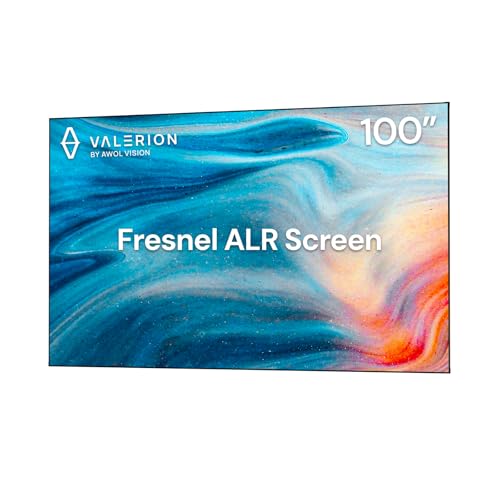
- 100-inch Fresnel screen for bright-room long-throw viewing
- 1.8 gain with up to 85% overhead and side-light rejection
- De-speckle, scratch-resistant surface supports 4K/8K projection
Best For: Medium-size rooms using a long-throw projector
Best Portable ALR Screen – 80-Inch Projector Screen with Stand
This VISULAPEX model is a practical option if you want ambient light rejecting projector screens for both indoor and outdoor movie viewing. Its gray 80-inch screen is designed to reject over 90% of ambient light, while the included tripod, adjustable height, and carrying bag support flexible setup.
Best For: Portable movie nights, outdoor viewing, presentations, and buyers who need both tripod and wall-mount installation.
Pros:
- Claims over 90% ambient-light rejection with 1.5 gain.
- Sets up in about two minutes and supports tripod or wall mounting.
- Adjustable height, sturdy tripod structure, and included carrying bag.
- 16:9, 80-inch screen with a 160-degree viewing angle.
Cons:
- The screen requires an indoor space wider than 70 inches and taller than 89 inches.
- Its portable tripod design may be less suitable for a permanent fixed-frame installation.
Choose this screen when portability and quick setup matter as much as ambient-light performance. The adjustable stand is especially useful when viewing locations and sightlines change.
Best DIY ALR Material – 130-Inch Ambient Light Rejecting Fabric
This Yandood fabric is aimed at DIY builders looking for ambient light rejecting projector screens rather than a ready-to-hang display. The 69-by-118-inch gray, three-layer material has a black backing, 0.85 gain, and a matte surface designed for front projection in fixed-frame applications.
Best For: DIY fixed-frame screens, large home-theater installations, and projects requiring material that can be stretched onto a frame or attached to a smooth surface.
Pros:
- Large material size supports up to a 130-inch diagonal 16:9 screen.
- Black backing helps prevent light transmission and reflection interference.
- Matte, diffuse-reflective surface offers a viewing angle above 160 degrees.
- Three-layer EVA polymer construction is described as durable and environmentally friendly.
Cons:
- This is DIY material only and cannot be hung directly.
- It is not suitable for rear, side, ultra-short-throw, or short-throw projection.
- The manufacturer does not recommend it for projectors below 2,000 ANSI lumens.
This material makes sense for experienced DIY installers who can build and tension a fixed frame. It is not the right choice if you need a complete portable or ready-to-mount screen.
Best Large UST ALR Screen – 132-Inch Seamless Fixed Frame
This NothingProjector screen is designed specifically for ultra-short-throw systems in bright rooms. Among ambient light rejecting projector screens, it stands out for its 132-inch seamless HBSP surface, 95% ambient ceiling-light rejection claim, and support for 4K, 8K, 3D, and HDR content.
Best For: Large smart home theaters using an ultra-short-throw projector or laser TV.
Pros:
- 132-inch seamless 16:9 display exceeds the common 120-inch size limit noted by the manufacturer.
- Designed to reject ambient ceiling light in brighter environments.
- Supports 4K, 8K, 3D, and HDR content according to the supplied specifications.
- 170-degree viewing angle and 0.4-inch ultra-thin bezel create a nearly borderless presentation.
Cons:
- It is intended for wall mounting rather than portable use.
- The supplied notes specify compatibility with ultra-short-throw projectors, so it is not a general-purpose screen choice.
- The large 132-inch format requires substantial wall space.
This is the strongest fit for viewers prioritizing screen size and a polished fixed installation. Confirm your projector is ultra-short-throw and measure the wall carefully before buying.
Best Flexible 100-Inch Screen – Portable Ambient-Light Projection Screen
This GAINVANE screen offers a flexible approach to ambient light rejecting projector screens for home, office, and travel use. Its 100-inch 16:9 polyester surface is designed to maintain vivid images in brighter rooms, and it can be hung from a wall, car trunk, or a user-supplied tripod.
Best For: Buyers who want a large screen for movie nights, presentations, sports, or gaming with flexible hanging options.
Pros:
- 100-inch diagonal 16:9 display provides a large viewing area.
- Designed to reduce the impact of ambient light and support use in well-lit rooms.
- Portable design can be stored in a bag and used with wall hooks, rope, or a separate tripod.
- 160-degree viewing angle supports group viewing.
Cons:
- A tripod is not included; the supplied notes indicate you can use your own.
- Its glossy polyester finish may not suit shoppers specifically seeking a matte surface.
- The stated warranty is 90 days.
This screen is a convenient choice when you need a big display that can move between rooms or locations. Its mounting flexibility is useful, but plan to supply your own tripod or hanging hardware as needed.
Best Large UST Screen – 120-Inch 95% ALR Fixed Frame
For shoppers seeking ambient light rejecting projector screens for a bright living room or multipurpose space, this 120-inch fixed-frame model is designed specifically for ultra-short-throw projectors. Its black-grid material claims up to 95% ambient-light rejection while supporting 4K/8K UHD and active 3D content.
Best For: Large home theaters, classrooms, conference rooms, and UST laser-TV setups with medium ambient light.
Pros:
- Large 120-inch, 16:9 viewing area with 170° viewing angle.
- Designed for UST projection with black-grid ALR material and a multilayer optical structure.
- Slim 0.4-inch aluminum fixed frame and included installation kit.
Cons:
- Requires at least two people for installation.
- Its large size needs substantial wall space.
- Optimized for medium ambient light rather than unrestricted daylight conditions.
This is a strong choice when screen size and wide-angle viewing matter most. Confirm your wall dimensions and plan for two-person installation before choosing this large UST screen.
Best DIY Standard-Throw Screen – 100-Inch High-Gain Gray Material
This SilverMagic material is a flexible option among ambient light rejecting projector screens for standard-throw projectors. The gray surface is designed to suppress 30% of ambient light and provide up to 2.6x gain from center seating, making it useful when you want a brighter image without buying a complete fixed-frame screen.
Best For: DIY wall-mounted or framed standard-throw projector installations where brightness and customization are priorities.
Pros:
- Up to 2.6x gain from center seats for a brighter image.
- Can be trimmed to fit and installed with wall-safe tape in about 10 minutes.
- Designed to reduce light bleed for sharper, more saturated images than a normal white screen.
Cons:
- Not compatible with ultra-short-throw projectors.
- Its listed 30° viewing angle favors centered seating.
- Installation requires creating or supplying your own frame or wall-mount setup.
This screen material makes the most sense for a standard-throw setup with a central viewing position. It offers installation flexibility, but UST projector owners should choose a UST-specific screen instead.
Best Compact UST Screen – 100-Inch 85% ALR PET Crystal
For a smaller UST setup, this 100-inch fixed-frame screen uses PET Crystal technology and claims up to 85% ambient-light rejection. It is built for 4K UHD and 3D content, with a multilayer surface intended to preserve contrast and detail in daylight or bright rooms.
Best For: UST home theaters, classrooms, and offices that need a wrinkle-free 100-inch screen with broad seating coverage.
Pros:
- 85% claimed ambient-light rejection for brighter-room viewing.
- 160° viewing angle with a 4K/8K UHD and active 3D-ready design.
- Wrinkle-free PET Crystal surface and slim 10mm frame.
Cons:
- Smaller than the 120-inch alternative for viewers seeking a larger image.
- Fixed-frame wall mounting requires dedicated installation space.
- Its ambient-light rejection claim is lower than the 120-inch model in this roundup.
This model balances UST compatibility, wide viewing coverage, and a more manageable 100-inch footprint. It is a practical fit when you want a fixed-frame screen without moving up to a very large installation.
Bright-Room Long-Throw Pick – Valerion 120-Inch Fresnel ALR Screen
For shoppers comparing ambient light rejecting projector screens, this 120-inch Valerion model is designed for long-throw projectors and bright-room viewing. Its Fresnel surface combines 1.8 gain with up to 85% rejection of overhead and side light, while supporting 4K and 8K projection.
Best For: Large home theaters using a long-throw projector in rooms with daytime or overhead lighting.
Pros:
- Fresnel ALR structure helps reduce overhead and side-light interference.
- Large 120-inch 16:9 screen with 1.8 gain and a 90-degree viewing angle.
- Scratch-resistant, easy-to-clean surface supports regular use.
- Supports detailed 4K and 8K projection.
Cons:
- Not compatible with ultra-short-throw projectors.
- Its 39.7-pound size may require careful wall installation.
- Manual operation does not provide motorized raising or lowering.
This is a strong choice when screen size and daytime visibility matter more than compact storage or automated operation. Confirm that your projector is long-throw before buying.
UST Convenience Pick – NothingProjector 100-Inch Motorized ALR Screen
Among ambient light rejecting projector screens, this NothingProjector model stands out for ultra-short-throw compatibility and automated floor-rising operation. Its ST Carbon Black surface is designed for bright rooms, with claimed 95% ceiling-light rejection, 4K/8K support, and a wide 170-degree viewing angle.
Best For: Living rooms, basements, and home theaters using an ultra-short-throw projector where retractable operation is useful.
Pros:
- Designed specifically for ultra-short-throw projection and bright-room use.
- Motorized floor-rising design can be controlled by remote or app.
- Adjustable height retracts when not in use and requires no wall mounting.
- Wide 170-degree viewing angle and support for 4K/8K UHD content.
Cons:
- Floor-mount design needs clear floor space in front of the viewing area.
- The supplied details list operation mode as manual despite the electric retractable features.
- Its 100-inch size is smaller than the included 120-inch Valerion option.
This screen is the most convenient fit for UST setups that need to disappear after viewing. Its automated controls and broad viewing angle are especially practical for shared living spaces.
Compact Long-Throw Pick – Valerion 100-Inch Fresnel ALR Screen
This 100-inch Valerion is a practical option for shoppers seeking ambient light rejecting projector screens without moving to the larger 120-inch format. It uses an eight-layer Fresnel design, 1.8 gain, and up to 85% rejection of overhead and side light for long-throw projection in brighter rooms.
Best For: Medium-size home theaters and daytime viewing spaces using a compatible long-throw projector.
Pros:
- Fresnel ALR finish is designed to improve contrast and clarity in illuminated rooms.
- 1.8 gain and a 90-degree viewing angle support bright, consistent images.
- De-speckle, scratch-resistant, and easy-to-clean surface features add everyday practicality.
- Supports 4K and 8K projection and is supplied as a wall-mount screen.
Cons:
- Not compatible with ultra-short-throw projectors.
- Manual operation lacks the convenience of a motorized screen.
- Its 90-degree viewing angle is narrower than the UST model in this roundup.
Choose this model when a 100-inch image better suits your room than a 120-inch screen. It preserves the key bright-room and high-resolution features of the larger Valerion while taking up less viewing space.
How We Picked These Ambient Light Rejecting Projector Screens
We focused on screens and screen materials designed to improve image visibility in rooms with windows, lamps, or other competing light sources. The selection includes portable screens, fixed-frame Fresnel models, motorized options, and DIY-friendly materials. We also considered screen size, aspect ratio, stated gain, claimed light rejection, installation flexibility, and compatibility with standard-throw or ultra-short-throw projectors.
Specifications such as gain and ambient-light-rejection percentages are manufacturer claims, so real-world performance depends on projector brightness, viewing angle, wall color, and the direction of incoming light.
Quick Comparison
- Best for portability: An 80- or 100-inch freestanding screen is easier to move between rooms or take outdoors.
- Best for UST projectors: Choose a screen specifically labeled for ultra-short-throw projection, especially a Fresnel or other rigid directional design.
- Best for a dedicated theater: A fixed-frame ALR screen provides a taut surface and a clean, permanent installation.
- Best for custom installations: ALR fabric or material lets you build a DIY frame or mount the screen directly to a suitable wall.
- Best for convenience: A motorized model can retract when not in use and integrate neatly into a living space.
Key Buying Factors for Ambient Light Rejecting Projector Screens
Projector Type and Throw Distance
Match the screen to your projector. UST screens are engineered for light arriving from a steep angle near the bottom of the screen, while standard-throw ALR material is designed around a different light path. Using the wrong type can produce hotspots, uneven brightness, or reduced contrast.
Screen Size and Viewing Distance
Larger screens create a more immersive image but require enough projector brightness and seating distance. Measure the available wall or mounting area, then confirm the screen’s actual viewable dimensions rather than relying only on the diagonal size.
Gain and Viewing Angle
Higher gain can make the image appear brighter, but it may narrow the ideal viewing cone and increase the risk of hotspots. A lower- or moderate-gain surface can be preferable when viewers sit spread across a wide room.
Installation and Screen Tension
Portable screens prioritize flexibility, while fixed-frame models generally provide a flatter, more consistent projection surface. Motorized screens offer easy storage but need secure mounting, power access, and adequate clearance. For DIY material, plan carefully for stretching, seams, borders, and wall flatness.
Light Direction and Room Conditions
ALR screens do not eliminate all ambient light. They work best when the screen’s rejection pattern matches the room’s lighting. Check whether the product is intended to reject light from above, the sides, or both, and reduce direct light striking the screen whenever possible.
Who Should Buy Which Ambient Light Rejecting Projector Screens?
Choose a Portable Screen for Flexible Viewing
Portable models suit renters, multipurpose rooms, backyard movie nights, and users who pack away their setup after watching. Prioritize a stable stand, quick assembly, a durable case, and a size your projector can illuminate evenly.
Choose a UST ALR Screen for Laser TV Setups
If your projector sits close to the wall, select a dedicated UST screen. Fresnel fixed-frame designs are particularly suitable for bright living rooms, provided the installation is precise and seating stays within the recommended viewing area.
Choose Fixed-Frame or Motorized for a Dedicated Room
Fixed-frame screens are a strong choice for consistent image geometry and a theater-like appearance. Choose motorized if you need the screen to disappear when the room serves other purposes.
Choose ALR Material for a Custom Build
DIY material makes sense when you already have a frame, want a nonstandard size, or need to control the final installation. Confirm the material’s throw-distance compatibility before cutting or mounting it.