The best compact audio mixers make it easier to combine microphones, instruments, playback devices, and computers without taking over your desk or stage setup.
We compared these 10 models across channel count, connectivity, controls, portability, effects, and intended use so you can choose the right mixer for recording, streaming, podcasting, or live audio.
Best 10 Compact Audio Mixers Picks for 2026
Best Broadcast-Ready Pick

- Two Onyx mic preamps with phantom power
- Four-channel desktop mixer
- Lightweight 2.5-pound design
Best For: Podcasts, small studios, and broadcast setups
Best for USB Streaming

- Eight-input analog mixer
- Stereo USB audio interface
- Mixes PC and gaming audio
Best For: Streaming, podcasting, and computer-based recording
Best Simple Desktop Mixer

- Five-channel compact analog design
- Phantom-powered mic/line input
- RCA playback and recording connections
Best For: Basic desktop mixing and small analog setups
Best for Gaming Features

- XLR input with 48V phantom power
- Individual channel volume controls
- Built-in mute, effects, and RGB lighting
Best For: Gaming, live streaming, and XLR-mic creators
Balanced Analog Control

- Six-channel analog mixer with D-PRE preamps
- EQ, high-pass filters, and one-knob compressors
- Rugged metal chassis; no USB connectivity
Best For: Small performances, lectures, and analog recording
Ultra-Compact Routing
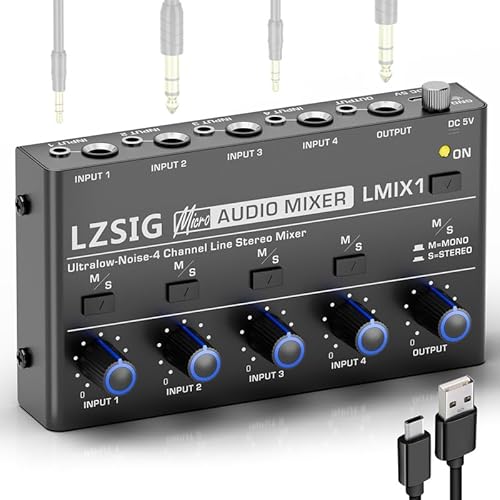
- Four inputs combine sources into one output
- Supports 3.5mm and 6.35mm cables
- Mono/stereo switching for flexible routing
Best For: Desktop sub-mixing and compact audio setups
Feature-Packed Streaming Console

- Four XLR inputs with 48V phantom power
- Bluetooth, USB playback, and USB interface
- 16 DSP effects plus three-band EQ
Best For: Karaoke, streaming, recording, and small live shows
Ultra-Compact Sub-Mixing

- Four channels with independent volume controls
- Stereo/mono switching with appropriate cables
- Low-noise design for simple line-level sub-mixes
Best For: Keyboards, guitars, bass, drum setups, and small venues
Effects-Ready Portable Setup

- Six channels with 99 built-in DSP echo presets
- USB-B interface for playback and recording
- Bluetooth, U-disk, and mobile-device compatibility
Best For: Streaming, podcasting, karaoke, parties, and portable recording
Connected Recording Hub

- Three XLR inputs with switchable 48V phantom power
- USB recording, Bluetooth, and USB-drive playback
- EQ, gain, effects, LED metering, and headphone monitoring
Best For: Streaming, podcasting, small events, and condenser microphones
Best Broadcast-Ready Pick – Mackie 402VLZ4
The Mackie 402VLZ4 is one of the most compact audio mixers for buyers who want a straightforward desktop setup with two microphone inputs. Its Onyx preamps, phantom power, and flexible main outputs suit podcasting, small studios, and broadcast work.
Best For: Podcasts, small studio setups, and broadcast applications needing two mic inputs.
Pros:
- Two Onyx mic preamps with phantom power and improved RF rejection.
- Four-channel design with four line inputs plus two mic inputs.
- Lightweight 2.5-pound build and included external power adapter.
Cons:
- Requires an external power adapter rather than a built-in power connection.
- Offers only four channels.
Choose this model when clean microphone amplification and a light desktop footprint matter more than extensive routing or channel count. Its 1/4-inch and RCA main outputs add useful connection flexibility.
Best for USB Streaming – Behringer XENYX 802S
Behringer XENYX 802S Premium Analog 8-Input Mixer with USB Streaming Interface
Check Price On AmazonThe Behringer XENYX 802S is a practical choice among compact audio mixers for streaming, podcasting, and recording with a computer or mobile device. It combines analog mixing and equalization with stereo USB connectivity for integrating digital audio.
Best For: Streamers, podcasters, and home recordists who want USB computer or mobile-device connectivity.
Pros:
- Eight-input design provides more room for multiple audio sources.
- Stereo USB audio interface connects to a computer or mobile device.
- Supports direct mixing of PC and gaming sounds into the streaming output.
Cons:
- At 1.6 kg, it is heavier than some smaller desktop mixers.
- Its supplied notes do not specify built-in effects or software support.
This is the stronger fit when USB integration and PC or gaming audio are central to your workflow. Its eight inputs also make it more adaptable than basic four- or five-channel options.
Best Simple Desktop Mixer – Mackie Mix5
The Mackie Mix5 keeps the essentials simple for buyers comparing compact audio mixers. It provides one mic/line input, two stereo 1/4-inch line inputs, dedicated RCA playback and recording connections, and a compact 1.4-pound chassis.
Best For: Small desktop audio setups, basic playback and recording, and users who need a simple five-channel mixer.
Pros:
- Compact 5-channel layout with high-headroom, low-noise performance.
- Mic/line input includes phantom power and two-band EQ.
- Dedicated stereo RCA inputs and outputs support playback or recording.
Cons:
- Only one mic/line input is provided.
- Does not include USB connectivity in the supplied specifications.
The Mix5 makes sense for straightforward analog mixing rather than computer-centered production. It is especially appealing when a small footprint, RCA connectivity, and basic tone shaping are the priorities.
Best for Gaming Features – FIFINE Ampligame SC3
The FIFINE Ampligame SC3 stands out among compact audio mixers for gaming and live streaming. It combines an XLR mic input with individual controls for microphone, line input, headphones, and line output, plus mute, monitoring, sound effects, and RGB lighting.
Best For: Game streamers, live creators, and beginners using XLR microphones with Mac or Windows.
Pros:
- XLR microphone input includes built-in 48V phantom power for condenser microphones.
- Independent controls manage mic, line-in, headphone, and line-out levels.
- Includes mute and monitor controls, four customizable sound buttons, voice effects, and RGB lighting.
Cons:
- Not compatible with USB microphones.
- XLR cable is not included.
- Its feature set is focused on streaming rather than general-purpose multi-mic mixing.
Pick the SC3 when hands-on streaming controls and built-in voice effects are more valuable than a traditional multi-channel mixer layout. The USB-C computer connection and plug-and-play support make it accessible for Mac and Windows users.
Balanced Analog Control – Yamaha MG06
The Yamaha MG06 is a practical choice among compact audio mixers for users who want straightforward analog control, reliable construction, and useful channel processing without USB features. Its six-channel layout, D-PRE preamps, EQ, high-pass filters, and one-knob compressors suit small recording, lecture, and performance setups.
Best For: Small live performances, lectures, and analog recording setups that prioritize sound shaping over computer connectivity.
Pros:
- Six-channel analog design with studio-grade D-PRE preamps
- Three-band EQ and high-pass filters help refine each mix
- One-knob compressors simplify control of guitars, bass, snare, and vocals
- Rugged powder-coated metal chassis
Cons:
- No USB connectivity or built-in digital interface
- Offers fewer channels than larger mixing consoles
The MG06 is a strong fit when you need dependable hands-on mixing in a compact format. Choose it for analog workflows and durable build quality, but look elsewhere if direct USB recording is essential.
Ultra-Compact Routing – LZSIG Mini Audio Mixer
The LZSIG Mini Audio Mixer is one of the most compact audio mixers for combining several line-level sources into one output. Its four-input design supports 3.5mm and 6.35mm connections, while mono/stereo switching makes it useful for basic sub-mixing, audio routing, and compact entertainment setups.
Best For: Combining keyboards, electronic drums, guitars, computers, CD players, or gaming consoles in a small desktop audio system.
Pros:
- Four inputs route multiple sources to a single stereo or mono output
- Accepts both 1/8-inch and 1/4-inch TRS/TS cables
- Mono/stereo switching supports flexible routing configurations
- Ultra-compact design with a USB-C cable included
Cons:
- Power adapter is sold separately
- Designed for line mixing rather than full microphone-channel processing
This LZSIG model makes sense when space and simple source combining matter most. It is a convenient sub-mixer, though users needing preamps, EQ, or comprehensive live-mixing controls should consider a larger console.
Feature-Packed Streaming Console – 6-Channel Bluetooth Mixer
This six-channel console is a versatile option among compact audio mixers, adding Bluetooth, USB playback and recording, 48V phantom power, and built-in DSP effects. Four XLR inputs and 1/4-inch connections support microphones and instruments, making it suited to karaoke, streaming, recording, and small live performances.
Best For: Users who need microphone inputs, wireless playback, USB functionality, phantom power, and onboard effects in one mixer.
Pros:
- Four XLR inputs support microphones with selectable 48V phantom power
- Bluetooth and USB interface support wireless streaming and USB playback
- Built-in 16-effect DSP processor with reverb and delay options
- Three-band EQ and independent faders provide hands-on control
Cons:
- Heavier and larger than the other compact options listed
- Manufacturer warranty is listed as 90 days
- Operation may require careful setup to avoid no-sound issues
This mixer offers the broadest feature set of the three, particularly for karaoke, streaming, and small performance rigs. Its added connectivity and effects are useful, but the larger footprint and shorter listed warranty are worth considering.
Ultra-Compact Sub-Mixing – Moukey 4-Channel Mini Mixer
If you need compact audio mixers for combining a few line-level sources, the Moukey Mini Audio Mixer keeps the setup straightforward. Its four channels have individual volume controls, and it supports stereo or mono operation with the appropriate TRS or TS cables.
Best For: Small clubs, bars, keyboards, guitars, bass, drum setups, and simple sub-mixes.
Pros:
- Four independent channels with individual volume controls.
- Supports stereo or mono mixing for flexible signal routing.
- Compact, low-noise design suited to quick line-level mixing.
- Uses a DC 5V power supply for more flexible placement.
Cons:
- TRS and TS cables are not included.
- Requires a suitable CE- or UL-certified external power supply.
- Designed for line-level sub-mixing rather than a feature-heavy live console.
The Moukey is a practical choice when you want a small mixer with minimal controls and a focused job: combine four sources into a manageable output. Confirm your cable types and power arrangement before buying.
Effects-Ready Portable Setup – MW-6 6-Channel DJ Mixer
The MW-6 is one of the more feature-oriented compact audio mixers in this group, combining six channels with USB connectivity, Bluetooth, and built-in digital effects. Its portable design is aimed at users who want playback, recording, and live-use functions in one console.
Best For: Live streaming, podcasting, karaoke, family parties, music recording, and portable DJ-style setups.
Pros:
- Six-channel configuration supports multiple audio sources.
- Includes 99 DSP echo presets for added vocal or performance effects.
- USB-B recording sound card supports computer or phone playback and recording.
- Supports U-disk playback or recording and works with iOS, Android, tablets, and MP3 players.
Cons:
- Its listed 220V AC power specification may require attention to local power compatibility.
- The 30-day return and exchange policy is relatively limited.
- Its broader feature set may be unnecessary for users needing only basic sub-mixing.
The MW-6 makes sense when connectivity and effects matter as much as channel count. It offers a versatile portable control surface, but check the power requirements and decide whether its streaming and DSP features match your workflow.
Connected Recording Hub – Aveek 5-Channel Audio Mixer
For buyers seeking compact audio mixers with recording and wireless playback, the Aveek 5-channel mixer offers a broad set of connections. It combines three XLR inputs, stereo line inputs, USB recording, Bluetooth streaming, headphone monitoring, and basic channel shaping in one small mixing board.
Best For: Live streaming, podcasting, small band shows, meetings, weddings, and condenser-microphone setups.
Pros:
- Three XLR inputs include switchable 48V phantom power for condenser microphones.
- Built-in USB-B recording interface enables plug-and-play computer recording.
- Supports Bluetooth streaming plus USB-drive playback and recording.
- Provides two-band EQ, gain controls, echo or delay, LED peak indication, and headphone monitoring.
Cons:
- Bluetooth, USB, and the 4/5-channel functions cannot be used simultaneously.
- Bluetooth works within a stated range of about 15 feet.
- Outputs are intended for active speakers or power amplifiers, not passive speakers directly.
The Aveek is a flexible all-in-one option for creators and small-event users who need microphones, playback, effects, and recording. Its simultaneous-use limitation is important, so review your intended signal flow before choosing it.
How We Picked the Best Compact Audio Mixers
We selected mixers that suit practical small-format audio setups, from basic line-level sub-mixing to USB recording, live streaming, DJ use, and microphone-based production. Our comparison considers the number and type of inputs, output flexibility, control layout, preamp features, phantom power, onboard effects, USB connectivity, and overall portability.
Because compact mixers vary widely, we also considered their intended audience. A simple four-channel line mixer is not directly comparable to a USB-equipped console with microphone preamps and DSP effects. The right choice depends on the sources you need to connect and how much control you want during a performance or recording session.
Quick Comparison
- Best for straightforward analog mixing: Mackie Mix5 or Yamaha MG06.
- Best for flexible home and streaming setups: Behringer XENYX 802S or Aveek 5 Channel Mixer.
- Best for gaming and desktop streaming: FIFINE Ampligame SC3.
- Best for portable DJ and live-performance features: the MW-6 or six-channel DSP mixer.
- Best for basic sub-mixing: LZSIG Mini Audio Mixer or Moukey Mini Audio Mixer.
Key Buying Factors for Compact Audio Mixers
Inputs and Channel Layout
Count your microphones, instruments, computers, phones, and playback devices before buying. Check whether the mixer uses XLR microphone inputs, 1/4-inch line inputs, stereo channels, or combinations of these. Stereo line channels are useful for keyboards, media players, and other sources that do not need a microphone preamp.
USB and Computer Connectivity
A USB interface can send audio to a computer for recording, streaming, or calls, but implementation varies. Confirm whether USB provides stereo input and output, multitrack recording, monitoring, or only playback. If you only need to combine analog sources, a USB connection may not be necessary.
Phantom Power, Effects, and Monitoring
Condenser microphones may require +48V phantom power. Built-in reverb, echo, or DSP effects can be helpful for live vocals and streaming, while a clean headphone output and usable level meters make monitoring easier. Look for independent control of headphones, main output, and connected sources when possible.
Size, Power, and Noise
Compact mixers are valuable when desk space and portability matter, but smaller controls can be harder to adjust quickly. Check the power requirements, especially for mobile setups, and prioritize reputable low-noise designs for microphones, headphones, and quiet recording environments.
Who Should Buy Which Compact Audio Mixers?
Choose the Mackie Mix5 or Yamaha MG06 if you want a dependable, uncomplicated analog mixer for rehearsals, small presentations, instruments, or basic home use. The Mackie 402VLZ4 is a stronger fit when you want compact construction and higher-quality microphone preamp performance.
For computer-based recording and streaming, consider the Behringer XENYX 802S, Aveek mixer, or FIFINE SC3 according to your source needs. The FIFINE is especially suited to gaming and desktop control, while the Behringer offers a more traditional mixer layout.
Choose the LZSIG or Moukey models for simple line-level sub-mixing, provided your sources do not require advanced microphone processing. For live streaming, DJ-style operation, or creative effects, the six-channel DSP models offer more features, but they may involve a steeper learning curve. Before ordering, verify connector types, power requirements, and whether the advertised interface supports the workflow you plan to use.