The right lighting controller can make a band’s live setup easier to run, more consistent, and better suited to changing venues. From compact 12-channel units to larger 384-channel consoles, the best choice depends on your fixtures, show complexity, and crew.
This roundup compares 10 DMX controllers for bands across wired and wireless operation, scene programming, MIDI support, rack mounting, and portability. Use the guide below to narrow the options before buying.
Best 10 Dmx Controllers for Bands Picks for 2026
Reliable Scene Programming

- 384 DMX channels for up to 12 intelligent lights
- Stores 240 scenes in 30 banks
- Six programmable chases with fade and speed settings
Best For: Bands needing dependable wired scene control
Wireless Show Control
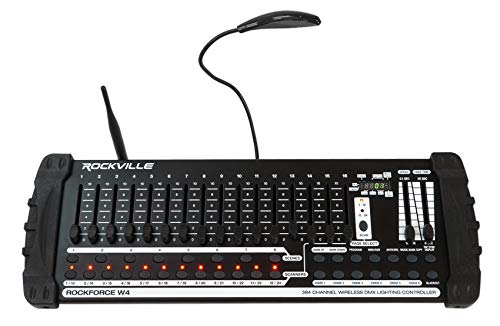
- 384 channels control up to 24 intelligent lights
- Built-in 2.4GHz wireless transmitter
- Adds MIDI, music trigger, and manual override
Best For: Bands needing wireless and MIDI-ready control
Accessible Fixture Mixing

- Controls 12 fixtures with 192 channels
- Stores up to 240 scenes
- Adds voice control and three-pin connections
Best For: Amateur bands and small venue setups
Compact Fog-and-Light Control
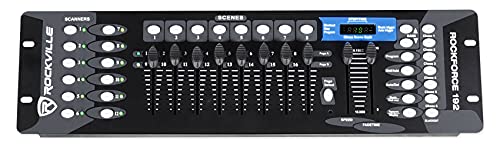
- 192-channel control for 12 scanners
- Supports scenes, chases, and music trigger
- Works with DMX-512 lighting and fog systems
Best For: Bands combining lighting and fog effects
Best High-Capacity Pick
384-Channel DMX Stage Controller

- 384 channels for complex fixture control
- 30 banks with eight scenes each
- Compact console with gooseneck light
Best For: Bands programming multiple fixtures and layered live-show scenes
Best Wireless Option
Lixada 2.4G DMX Wireless Controller

- Wireless standard DMX512 transmission
- 126 frequency channels and 16 group IDs
- Four adjustable transmission power levels
Best For: Bands reducing cable runs between consoles and lights
Best Easy-Operation Pick
Mini 192-Channel DMX Controller

- Controls up to 12 16-channel smart lights
- 240 scenarios and six chase sets
- Includes sound, MIDI, tap-sync, and auto modes
Best For: Bands and DJs running smaller 3-pin DMX lighting setups
Compact 12-Channel Dimmer

- Controls up to 12 DMX512 channels
- Portable aluminum construction
- One-key blackout and manual faders
Best For: Small stages and simple band lighting rigs
Programmable 192-Channel Console
192 DMX Stage Light Controller
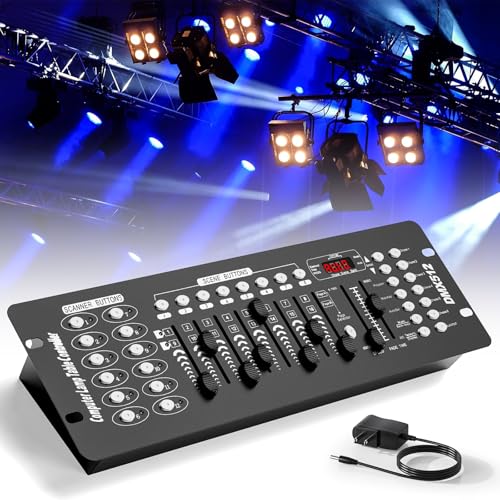
- Controls 12 devices with 16 channels each
- Stores scenes and programmable chases
- Includes faders, cable, and power adapter
Best For: Small concerts and bands using programmed lighting looks
192-Channel Chase Board
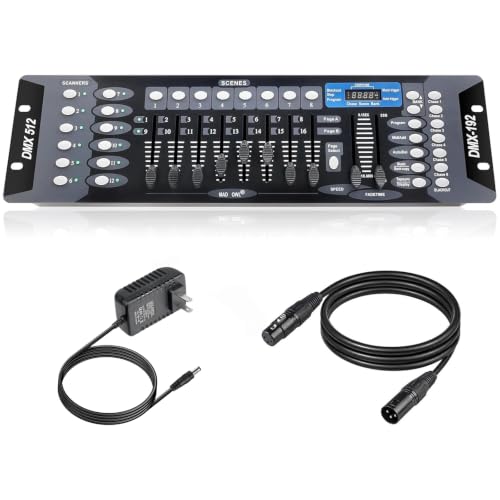
- Controls 12 fixtures with up to 16 channels each
- Programs scenes and six lighting chases
- Includes a 6.6-foot DMX cable
Best For: Bands needing programmable stage and club lighting
Reliable Scene Programming – CHAUVET DJ Obey 70
For bands seeking dependable dmx controllers for bands setups, the CHAUVET DJ Obey 70 offers straightforward programming for multiple intelligent fixtures. It provides 384 DMX channels, supports up to 12 lights with as many as 32 channels each, and includes programmable scenes and chases for repeatable performances.
Best For: Bands that need a conventional, rack-mountable controller for programmed stage-light scenes.
Pros:
- Controls up to 12 intelligent lights with up to 32 channels each.
- Stores up to 240 scenes across 30 banks.
- Includes six chases and lets you program fade and speed times into each step.
Cons:
- Uses corded power rather than a battery-powered design.
- Its feature set is focused on programmed control rather than wireless operation.
The Obey 70 is a practical choice when reliable wired control and organized scene programming matter more than wireless features or advanced automation.
Wireless Show Control – Rockville ROCKFORCE W4
The Rockville ROCKFORCE W4 stands out among dmx controllers for bands because it combines 384-channel wired control with a built-in 2.4GHz wireless transmitter. Its programmable banks, chases, MIDI support, music trigger, and manual override give performers several ways to manage a live lighting setup.
Best For: Bands and mobile production teams wanting wireless fixture control alongside MIDI and wired DMX connections.
Pros:
- Controls up to 24 intelligent lights with 16 channels each.
- Wireless transmitter supports up to seven groups and 25 receivers.
- Offers MIDI, music-synced effects, manual override, and 16 sliders.
- Rugged 4U rack-mountable design includes wired DMX in/out.
Cons:
- Wireless compatibility is specifically described for Rockville, Chauvet, and American DJ lights.
- The larger feature set may be more than a small band needs.
Choose the W4 if flexible routing and live interaction are priorities. Its wireless and MIDI features make it particularly adaptable for changing stage configurations and performance cues.
Accessible Fixture Mixing – CO-Z 192 DMX Controller
The CO-Z 192 is a user-friendly option for dmx controllers for bands, with controls arranged for light selection, scene switching, channel adjustment, speed, and timing. It can manage up to 12 fixtures with up to 16 channels each and supports up to 240 scenes for different songs or show segments.
Best For: Amateur bands, small venues, and users who want hands-on controls with voice-activated scene changes.
Pros:
- Controls up to 12 fixtures with 192 channels.
- Supports up to 240 scenes for more complex shows.
- Includes voice control for switching lighting scenes.
- Three-pin connectivity supports compatible lighting and fog-machine equipment.
Cons:
- Supports up to 16 channels per fixture, less than some higher-capacity controllers.
- The plastic construction may be less rugged than an all-metal console.
Its clearly divided control layout and voice-control feature make the CO-Z 192 approachable for bands building their first programmable lighting rig or managing varied effects on a budget.
Compact Fog-and-Light Control – Rockville ROCKFORCE 192
The Rockville ROCKFORCE 192 is designed for bands that want one console for lighting and fog effects. This 3U rack controller manages 192 channels across 12 scanners, provides 23 banks of eight scenes, and includes a built-in microphone for sound-activated effects.
Best For: Bands, DJs, and small productions needing integrated DMX lighting and fog control with music-triggered operation.
Pros:
- Controls 192 channels across 12 scanners with 16 channels each.
- Stores 23 banks of eight scenes and six chases of 240 scenes.
- Built-in microphone enables sound-activated lighting effects.
- Compatible with most DMX-512 lighting and fog systems.
Cons:
- Provides fewer channels than 384-channel alternatives.
- Its 3U rack format requires suitable rack space.
The ROCKFORCE 192 is a sensible middle-ground controller for live acts that want simple scene programming, music response, and fog-system compatibility without moving to a more complex console.
Best High-Capacity Pick – 384-Channel DMX Stage Controller
For bands seeking dmx controllers for bands with room to build detailed stage looks, this 384-channel console offers control for up to 24 fixtures, 30 programmable banks, and eight scenes per bank. Its compact design and included LED gooseneck light suit live-show operation.
Best For: Bands and live performers programming multiple fixtures and layered lighting scenes.
Pros:
- 384 DMX channels provide substantial fixture-control capacity.
- Includes 30 banks with eight programmable scenes each.
- LED gooseneck light and side handles support console use onstage.
Cons:
- Its larger channel and scene layout may take time to learn.
- It requires wired DMX512 connections to compatible lighting equipment.
This is the strongest option here for bands planning more involved lighting programming. Choose it when channel capacity and scene organization matter more than keeping the setup especially small.
Best Wireless Option – Lixada 2.4G DMX Wireless Controller
For bands wanting to reduce cable runs, this Lixada wireless DMX system transmits standard DMX512 data between compatible lighting equipment. Its 126 frequency channels, 16 group IDs, and adjustable transmission power are designed for reliable real-time operation.
Best For: Bands and mobile performers that need wireless DMX links between a console and lights or between fixtures.
Pros:
- Wireless transmission removes the need for a DMX cable between linked equipment.
- 126 frequency channels and 16 group IDs help separate nearby systems.
- Four selectable power levels offer transmission flexibility.
Cons:
- It is a wireless transmitter/receiver solution rather than a full scene-programming console.
- Wireless compatibility and placement still need to be considered for each setup.
This compact unit is a practical choice when stage layout or fast setup makes long DMX cable runs inconvenient. It is best paired with equipment that already handles the desired lighting control functions.
Best Easy-Operation Pick – Mini 192-Channel DMX Controller
For bands looking for a straightforward console for LED and stage lights, this 192-channel DMX controller supports up to 12 smart lights with 16 channels each. It also includes programmed scenarios, chases, sound activation, MIDI beat activation, tap synchronization, and automatic operation.
Best For: DJs, bands, bars, and small live setups using compatible 3-pin DMX lights.
Pros:
- 192 channels can control up to 12 16-channel smart lights.
- Offers 240 scenarios and six sets of chases.
- Built-in microphone, MIDI beat activation, tap sync, and automatic operation support hands-off effects.
Cons:
- Lower channel capacity than the 384-channel console in this roundup.
- It is designed for compatible 3-pin DMX cable connections.
This controller balances core programming with beat-responsive and automatic modes, making it a useful fit for bands that want repeatable lighting effects without moving to a higher-capacity console.
Compact 12-Channel Dimmer – MAD OWL Mini DMX Controller
For bands seeking compact dmx controllers for bands, the MAD OWL 12 Channel DMX Dimming Controller offers straightforward hands-on control for smaller lighting setups. Its six sub-control faders and one master fader manage up to 12 DMX512 channels through a standard 3-pin XLR output.
Best For: Small stages, travel setups, and bands using DMX fixtures with 12 channels or fewer.
Pros:
- Simple layout with six sub-control faders, a master fader, and one-key blackout.
- Compact, lightweight aluminum design for portable setups.
- Standard 3-pin DMX output supports compatible DMX512 equipment.
Cons:
- Cannot control stage lighting equipment requiring more than 12 channels.
- Designed primarily for manual dimming rather than advanced scene programming.
This is a practical choice when a band needs basic, direct dimmer control without carrying a larger console. Check the channel requirements of every fixture before buying.
Programmable 192-Channel Console – 192 DMX Stage Light Controller
This 192-channel console is a flexible option for bands comparing dmx controllers for bands with programmable show features. It controls up to 12 devices with 16 channels each, stores scenes and chases, and includes sliders for manual adjustments.
Best For: Bands running small concerts, parties, festivals, or themed shows with multiple DMX fixtures and programmed looks.
Pros:
- Provides 192 channels across 12 fixtures, with up to 240 scenes.
- Supports 23 banks of programmable scenes and six programmable chases.
- Includes manual sliders, automatic speed controls, a 3-pin cable, and a power adapter.
- Designed with beginner-friendly sections for fixture selection, scenes, channels, and programming.
Cons:
- The control layout may require practice for users new to scene and chase programming.
- Its 16-channel-per-device structure may not suit fixtures needing more channels.
With substantially more programming capacity than a basic dimmer board, this console suits bands that want repeatable lighting sequences while retaining hands-on fader control.
192-Channel Chase Board – DMX512 Console with Cable
For bands that need programmable dmx controllers for bands, this 192-channel DMX512 board combines real-time faders with scene and chase programming. It can control up to 12 fixtures with 16 channels or fewer and includes a 6.6-foot DMX cable.
Best For: Stage, club, and performance setups needing custom lighting sequences and simultaneous fixture control.
Pros:
- Controls 192 channels across up to 12 lighting fixtures.
- Offers 23 banks of eight programmable scenes.
- Supports 240-step scenes across six programmable chases.
- Faders and buttons allow real-time adjustments, and a 2-meter DMX cable is included.
Cons:
- Fixture support is limited to units using 16 channels or fewer.
- The larger 22.44-inch-wide chassis is less portable than a compact mini controller.
This board is a strong fit when a band wants more detailed show programming than a simple manual dimmer provides. Its scene and chase capacity is especially useful for repeatable performance cues.
How We Picked These Dmx Controllers for Bands
We focused on the features that matter during rehearsals, club shows, tours, and small production work: channel capacity, fixture support, scene and chase programming, control layout, portability, and setup flexibility. The selection includes simple consoles for straightforward LED rigs, midrange boards for multiple fixtures, and higher-capacity options for more elaborate shows.
We also considered practical features such as wireless DMX, MIDI compatibility, fog-machine control, LCD displays, rack-ready construction, and included cables or receivers. Because band lighting varies widely, no single controller is ideal for every setup.
Quick Comparison
| Best For | Look For |
|---|---|
| Small bands and basic LED rigs | 12 to 192 channels, direct faders, simple scene storage |
| Growing stage setups | 192 to 384 channels, more fixtures, programmable banks and chases |
| Wireless stage layouts | 2.4G wireless transmission, receiver compatibility, reliable range |
| Computer-assisted or hybrid control | MIDI support and flexible program editing |
| Installed or touring racks | Rack-mount construction and durable controls |
Key Buying Factors for Dmx Controllers for Bands
Channel and Fixture Capacity
Count the DMX channels used by each fixture, then leave room for expansion. A basic RGB fixture may use only a few channels, while moving heads and advanced effects can require many more. A controller that barely meets today’s needs may become limiting after one upgrade.
Programming and Live Operation
Look for scene banks, programmable chases, fixture controls, and easy blackout access. Bands using preplanned songs may prefer substantial memory and repeatable sequences; performers who improvise may value accessible faders and quick manual adjustments more.
Wired Versus Wireless DMX
Wireless operation can reduce cable runs and speed up setup, but it adds another point to configure and troubleshoot. For dependable touring use, confirm that the transmitter, receiver, fixtures, and operating range are compatible. Wired DMX remains a practical choice when reliability and simplicity take priority.
Physical Design and Connectivity
Check dimensions, power requirements, mounting options, connector types, and whether a suitable DMX cable is included. A compact controller is convenient for transport, while a rack-mount model can protect the system and keep a permanent rig organized.
Who Should Buy Which Dmx Controllers for Bands?
Choose a compact 12-channel controller if your band uses a small number of simple fixtures and wants minimal programming. A 192-channel console is a sensible middle ground for typical club stages with several LED fixtures, pars, and effects. Choose a 384-channel model if you operate moving heads, multiple fixture groups, or more complex programmed shows.
Wireless models suit stages where cable runs are difficult or fixtures are spread across the room. MIDI-equipped controllers are worth considering when lighting cues need to work alongside a keyboard, playback system, or other MIDI hardware. Before ordering, map every fixture’s channel count and confirm that the controller’s programming workflow matches the way your band performs.