Choosing the right lighting controller can make a small venue easier to operate, more consistent during shows, and ready for more fixtures as your production grows. The best DMX controllers for small venues balance channel capacity, hands-on control, programming flexibility, and a manageable footprint.
This roundup compares 10 options ranging from simple 12-channel dimmers to 192-channel consoles and software-oriented systems. Consider your fixture count, operator experience, and whether you need wired, wireless, fog-machine, or MIDI support before choosing.
Best 10 Dmx Controllers for Small Venues Picks for 2026
Versatile Scene Programmer

- Controls up to 384 DMX channels
- Stores 240 scenes and six chase sets
- Rack-mount design for installed setups
Best For: Small venues and mobile DJs running multiple intelligent lights
Sound-Responsive Rack Controller
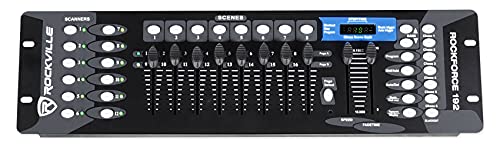
- Controls 192 DMX channels
- Includes music-triggered lighting effects
- Stores scenes in 23 banks
Best For: DJs and event venues using lighting and fog effects
Compact Light-and-Fog Control

- Controls 192 DMX channels
- Stores 240 scenes and six chases
- Adds fog, strobe, and MIDI support
Best For: Small venues using lighting alongside fog or strobe effects
Software-Integrated Performance Controller

- Provides two DMX universes
- Adds tactile controls for SoundSwitch
- Works with compatible Engine DJ devices
Best For: DJs and live performers using software-based light shows
Best Programmable Pick

- 48-channel DMX-512 control
- 96 patchable DMX channels
- Programmable chases and fade times
Best For: Small venues needing programmable lighting sequences
Best Simple Control

- 12 channel faders plus master fader
- 3-pin and 5-pin DMX outputs
- Portable 2-pound design
Best For: Demos and small, straightforward lighting systems
Best Compact Dimmer

- Controls up to 12 DMX512 channels
- Compact aluminum construction
- Six sub-faders and master fader
Best For: Small stages with basic 12-channel-or-fewer dimming needs
Best Overall Control

- Controls up to 12 fixtures
- 30 scene banks and six chases
- Eight real-time control sliders
Best For: Small venues needing versatile manual and programmed lighting control
Best Rack-Mount Option
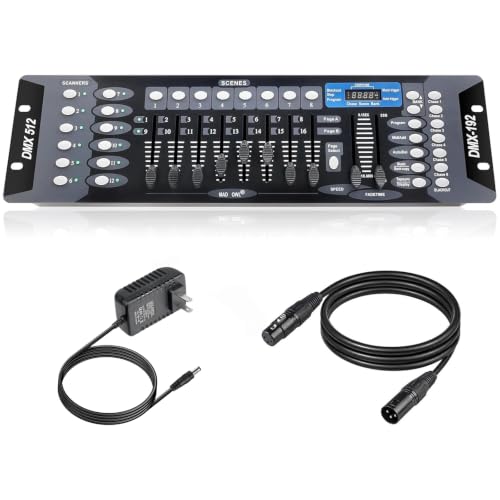
- Metal rack-mount construction
- 23 banks of eight scenes
- Includes a 6.6-foot DMX cable
Best For: Clubs and stages wanting organized, rack-mounted scene control
Best for Automated Shows
Wireless 192-Channel DMX Controller
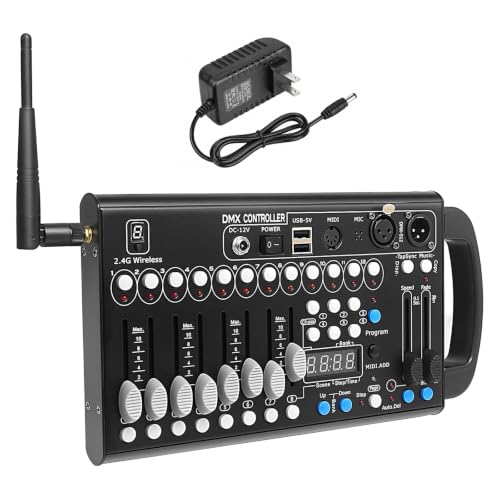
- Built-in microphone and MIDI activation
- Tap synchronization and auto operation
- Compact aluminum housing
Best For: DJs and small venues running beat-synchronized light shows
Versatile Scene Programmer – CHAUVET DJ Obey 70
For small venues needing hands-on dmx controllers for small venues, the CHAUVET DJ Obey 70 offers substantial scene and chase capacity in a rack-mount format. It controls up to 12 intelligent lights, with up to 32 channels per fixture and 384 DMX channels overall.
Best For: Small venues, mobile DJs, and operators managing multiple intelligent fixtures with programmed scenes.
Pros:
- Stores up to 240 scenes across 30 banks of eight.
- Provides six chase sets containing up to 240 scenes.
- Includes programmable fade and speed times for each step.
- Rack-mount design suits installed control setups.
Cons:
- Its 6.9-pound chassis may be more than needed for very basic setups.
- Requires corded power and is specified for 230 volts.
The Obey 70 is a strong choice when your lighting system needs more programming headroom than a basic controller. Its broad channel count and extensive scene storage support repeatable shows in compact performance spaces.
Sound-Responsive Rack Controller – Rockville ROCKFORCE 192
The Rockville ROCKFORCE 192 is one of the more approachable dmx controllers for small venues, combining 192-channel control with music-triggered effects. Its 3U rack format and straightforward controls make it suitable for lighting and fog systems in event spaces.
Best For: DJs, parties, concerts, and venues that want sound-activated lighting and fog control without a complicated interface.
Pros:
- Controls 12 scanners with 16 channels each.
- Offers 23 banks of eight scenes and six chases.
- Built-in microphone enables music-synced effects.
- Power-failure memory helps preserve programmed settings.
Cons:
- Its 3U, 22-inch-wide chassis requires substantial rack space.
- Provides fewer total channels than controllers rated for 384 channels.
- Specified for 240-volt AC operation.
Choose the ROCKFORCE 192 if quick access, sound activation, and fog compatibility matter more than maximum channel capacity. The LED display and manual sliders also provide a practical starting point for newer operators.
Compact Light-and-Fog Control – CHAUVET DJ Obey 40
The CHAUVET DJ Obey 40 gives small venues a focused option among dmx controllers for small venues, with 192 channels for up to 12 fixtures. It adds fog and strobe controls, MIDI compatibility, and reversible sliders for flexible operation.
Best For: Small performance spaces and DJs that need structured scene playback plus dedicated fog and strobe control.
Pros:
- Controls up to 12 fixtures with 16 channels each.
- Stores up to 240 scenes in 30 banks.
- Supports six chases containing up to 240 scenes.
- Includes fog, strobe, MIDI, and reversible-slider features.
Cons:
- Its 192-channel capacity is lower than the Obey 70’s 384 channels.
- It is an older model, listed with a 2010 model year.
- USB and MIDI features may require compatible external devices or software.
The Obey 40 is a practical middle ground for operators who want extensive scene storage without moving to a higher-capacity controller. Dedicated effect controls make it especially useful for compact shows using fog and strobe fixtures.
Software-Integrated Performance Controller – SoundSwitch Control One
The SoundSwitch Control One takes a software-centered approach to dmx controllers for small venues, offering tactile control over SoundSwitch light shows. It supports two DMX universes, Engine DJ hardware, selected AlphaTheta setups, and live audio BPM detection.
Best For: DJs and live performers who want hands-on lighting control, software integration, and real-time effects during sets.
Pros:
- Provides two DMX universe inputs and outputs with a thru option.
- Works directly with compatible Engine DJ devices without a computer.
- Offers touch-strip, encoder, and RGB performance-pad controls.
- Supports live audio BPM detection from bands, DAWs, and DJ software.
Cons:
- Many features depend on SoundSwitch software or compatible hardware.
- Some AlphaTheta PRO DJ LINK Bridge configurations require a laptop.
- It is a performance interface rather than a standalone scene console.
Control One is best suited to modern DJ and live-performance workflows built around SoundSwitch. Its compact 1.76-pound design and responsive controls make on-the-fly intensity, color, strobe, and moving-head adjustments accessible from the booth.
Best Programmable Pick – CHAUVET DJ DESIGNER50
For small venues that need more than basic fader control, the CHAUVET DJ DESIGNER50 offers a 48-channel DMX-512 control surface with programmable chase functionality. Its patchable channels and adjustable timing make it a flexible option among DMX controllers for small venues.
Best For: Small venues needing programmable chases, adjustable fade times, and expanded DMX channel flexibility.
Pros:
- Provides 48-channel DMX-512 control.
- Offers 96 patchable DMX channels.
- Includes 10 programmable and 5 non-programmable chases.
- Supports up to 4,200 programmable steps with adjustable chase and fade times.
Cons:
- Its 20.32 x 12.68 x 5.35-inch size may require dedicated setup space.
- At 6.68 pounds, it is less portable than smaller basic controllers.
The DESIGNER50 is the strongest fit here when lighting scenes and chase programming matter more than minimizing console size or weight.
Best Simple Control – ADJ Products SDC12
ADJ Products SDC12, 12 Channel Basic DMX Controller, Easily Fade and Dim Multiple Lights
Check Price On AmazonThe ADJ SDC12 keeps lighting control straightforward with 12 channel faders and a master fader for fading and dimming multiple fixtures. Its compact, lightweight design makes it a practical choice for small venues seeking uncomplicated DMX controllers for small venues.
Best For: Demos, simple lighting rigs, portable setups, and installations that need direct fader-based control.
Pros:
- Provides 12 channel faders plus one master fader.
- Supports standard 3-pin and 5-pin DMX outputs.
- Weighs 2 pounds and can operate as a handheld device with a 9V battery.
- Includes wall-mounting brackets for a permanent setup.
Cons:
- Its 12-channel layout is intended for simpler systems.
- The 9V battery is not included.
The SDC12 is a sensible pick when portability and easy manual operation are more important than extensive programming features.
Best Compact Dimmer – MAD OWL 12-Channel DMX
The MAD OWL 12 Channel DMX Controller is a compact manual console for DMX512 fixtures using 12 or fewer channels. With six sub-control faders, a master fader, and a black-field function, it suits small-stage applications where space and basic dimming control are priorities.
Best For: Small stages and portable setups using DMX512 lighting fixtures with no more than 12 channels.
Pros:
- Controls up to 12 DMX512 channels.
- Uses six sub-control faders and one master fader.
- Compact 7.09 x 3.94 x 1.38-inch aluminum design.
- Provides a standard 3-pin DMX output and corded 12-volt power.
Cons:
- It cannot be used with stage lighting equipment requiring more than 12 channels.
- It does not list programmable chase functions in the supplied specifications.
- It requires corded electric power.
The MAD OWL is a space-saving option for basic dimming, but its 12-channel ceiling makes it best suited to focused, uncomplicated lighting rigs.
Best Overall Control – 192-Channel DMX Controller
For small venues that need hands-on control without moving to a larger console, this 192-channel model offers a practical balance of programming capacity and manual adjustment. It can control up to 12 intelligent lights with up to 16 channels each, making it a flexible choice among DMX controllers for small venues.
Best For: DJs, small stages, weddings, churches, and venues running multiple intelligent lights and effects.
Pros:
- Controls up to 12 fixtures with up to 16 channels each.
- Includes 30 banks of 8 programmable scenes and six programmable chases.
- Eight sliders provide real-time manual channel control.
- Supports auto programs with adjustable speed and fade time.
Cons:
- Uses a corded electric power source.
- Its feature-rich layout may require learning the seven control sections.
- The supplied notes do not specify software-update support.
This controller is a strong all-purpose option when you want scene programming plus immediate fader access. Its 3-pin XLR connectivity and included cable support common fixtures such as fog machines, par lights, strobes, and moving effects.
Best Rack-Mount Option – WK-192 DMX Lighting Console
This metal 192-channel console is suited to small venues that want programmable lighting control in a rack-mount design. It handles up to 12 fixtures with 16 channels or fewer and includes a 2-meter DMX cable for connecting compatible equipment.
Best For: Stages, clubs, and performance spaces that value a durable metal console and organized scene programming.
Pros:
- Provides 192 channels for comprehensive fixture control.
- Stores 23 banks of eight programmable scenes.
- Supports six programmable chases with up to 240 step scenes.
- Includes a 6.6-foot DMX cable.
Cons:
- Controls up to 12 fixtures, which may limit larger setups.
- Its rack-mount form factor may be less convenient for portable use.
- The supplied notes do not mention built-in audio or MIDI activation.
Choose this model if your priority is structured programming and a metal, rack-mountable build. The faders and buttons are designed for quick programming and real-time adjustments during performances.
Best for Automated Shows – Wireless 192-Channel DMX Controller
Small venues that want more automated operation may prefer this portable 192-channel controller. It manages up to 12 smart lights with up to 16 channels each and adds a built-in microphone, MIDI beat activation, tap synchronization, and automatic operation.
Best For: DJs, bands, bars, clubs, house parties, and weddings using beat-synchronized or automated lighting.
Pros:
- Controls up to 12 fixtures with up to 16 channels each.
- Offers 23 banks of eight scenes and six programmable chases.
- Supports built-in microphone activation, MIDI beat control, and tap sync.
- Compact aluminum body measures 11.42 by 6.3 by 1.77 inches.
Cons:
- Its 192-channel capacity may be limiting for larger installations.
- The supplied notes identify it as corded electric despite the wireless designation.
- It uses a 9-volt power specification and 500-milliamp rating, so venue compatibility should be checked.
This is the most automation-focused choice in the group. Its compact format and beat-triggered features make it useful when a DJ or operator wants lighting to respond to music with less manual intervention.
How We Picked the Best Dmx Controllers for Small Venues
We focused on controllers suited to clubs, small theaters, houses of worship, mobile DJs, rehearsal spaces, and event venues. The selection includes compact manual dimmers, traditional fader-based consoles, lighting-and-fog controllers, rack-friendly units, and systems designed for more advanced programming.
Our comparison emphasizes practical factors: DMX channel capacity, fixture and scene control, physical size, learning curve, connectivity, portability, and the type of show each controller can manage comfortably. Channel count is only one consideration; a simple controller may be the better choice when fast, hands-on operation matters more than extensive programming.
Quick Comparison
- Best for straightforward manual control: 12-channel controllers with dedicated faders and dimmer controls.
- Best for growing lighting rigs: 48- to 192-channel consoles with programmable scenes and chases.
- Best for DJ and mobile use: portable units with intuitive controls, broad fixture support, or wireless capability.
- Best for lighting and effects: controllers that include fog-machine functionality or dedicated auxiliary controls.
- Best for software-based workflows: systems that integrate with a computer, MIDI, or a more visual programming environment.
Key Buying Factors for Dmx Controllers for Small Venues
Channel Capacity and Fixture Compatibility
Count the DMX channels required by every fixture, not just the number of lights. A basic RGB fixture may use a few channels, while moving heads can require many more. Leave room for expansion so you do not outgrow the controller after adding a few fixtures.
Programming and Live Operation
Faders and buttons are useful for quick manual adjustments, while scenes, chases, banks, and playback controls help create repeatable shows. Beginners often benefit from a straightforward layout; experienced operators may prefer deeper programming options.
Size, Mounting, and Portability
Measure the available control surface and consider how the unit will travel. A compact controller works well in a booth or fixed venue, while a rack-compatible or lightweight model may be better for mobile production.
Connectivity and Effects
Check the DMX output format, MIDI or computer support, wireless requirements, and compatibility with fog machines or other effects. Confirm that your existing fixtures use standard DMX connections and that any needed adapters are available.
Who Should Buy Which Dmx Controllers for Small Venues?
Choose a compact 12-channel controller if you run a small, predictable rig and want simple dimming without a steep learning curve. Pick a 48- or 70-channel console when your venue uses several LED fixtures, static lights, or basic scenes and chases. A 192-channel model is more suitable for mobile DJs, event spaces, and venues using multiple fixture types or planning future expansion.
For shows that combine lighting with fog effects, select a controller with dedicated effect support. If portability, MIDI, or computer-assisted programming is central to your workflow, prioritize a compatible software-oriented or wireless model. Before buying, verify channel requirements, connector type, programming needs, and operator comfort—those details usually matter more than headline features alone.