The right DMX controller can turn a collection of fixtures into a coordinated lighting system that is easier to program, trigger, and operate during a live show. This roundup compares 10 options across channel counts, wireless capability, MIDI support, and beginner-friendly controls.
Whether you run a DJ rig, small stage, club, event space, or touring setup, use the buying guide below to match the controller’s programming workflow and connectivity with your fixtures and performance needs.
Best 10 Dmx Controllers for Stage Lighting Picks for 2026
Versatile 192-Channel Control
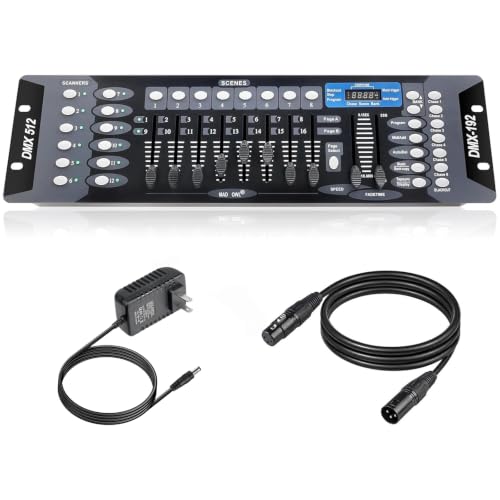
- Controls up to 12 fixtures
- Stores scenes and six chases
- Includes 6.6-foot DMX cable
Best For: Small stage, club, and DJ lighting setups
Expanded Fixture Control

- Controls up to 24 fixtures
- Includes MIDI and music mode
- Stores 30 banks and six chases
Best For: Multi-fixture DJ, club, and stage systems
Professional 384-Channel Workflow

- Controls up to 12 fixtures
- Supports up to 32 channels per fixture
- Stores 240 scenes and six chases
Best For: Stage and event rigs using higher-channel fixtures
Creative Control
384-Channel DMX512 Stage Lighting Controller

- 384 channels for detailed fixture control
- 30 banks of eight programmable scenes
- Compact console with LED gooseneck light
Best For: Programmable wired stage lighting setups
Wireless Command
Rockville ROCKFORCE W4 DMX Controller
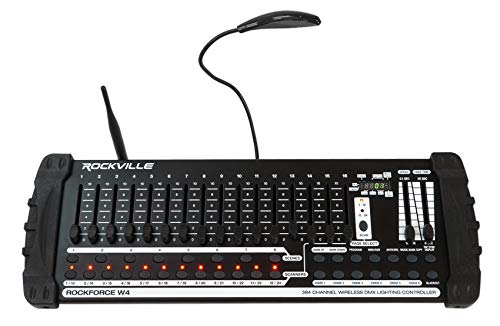
- Built-in 2.4GHz wireless DMX transmitter
- 384 channels with banks, chases, and scenes
- MIDI, music, and manual control modes
Best For: Mobile and professional wireless event setups
Easy Show Control
CO-Z 192 DMX Stage Light Controller

- 192 channels control up to 12 fixtures
- Supports up to 240 programmable scenes
- Organized controls with voice operation
Best For: Amateur users and smaller lighting rigs
Best for DJ-Integrated Shows

- Two DMX universes with input, output, and Thru options
- Direct Engine DJ compatibility for computer-free performances
- Tactile controls for effects, intensity, and lighting parameters
Best For: DJs creating synchronized SoundSwitch lighting performances
Best Budget Manual Console
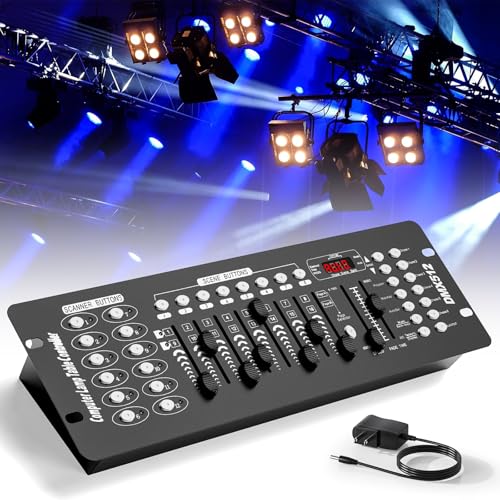
- 192 channels across 12 devices
- Programmable scenarios, chases, and up to 240 scenes
- Beginner-friendly layout with eight manual sliders
Best For: Small events and first-time DMX operators
Best Wireless Flexibility

- 384 channels with support for up to 12 intelligent lights
- 2.4G wireless and 3-pin XLR wired modes
- Sound, MIDI, automatic, and manual control options
Best For: Indoor stages and events needing flexible wireless or wired control
Versatile 192-Channel Control – Compact DMX Board
For shoppers comparing DMX controllers for stage lighting, this 192-channel board offers practical control for smaller stage, club, and DJ setups. It can manage up to 12 fixtures with 16 channels or fewer and includes a 6.6-foot DMX cable.
Best For: DJs, small performance venues, and users who need programmable scenes and chases in a rack-mount console.
Pros:
- Controls up to 12 lighting fixtures with 16 channels or fewer.
- Stores 23 banks of 8 programmable scenes and supports six chases.
- Faders and buttons support quick programming and real-time adjustments.
- Includes a 6.6-foot DMX cable.
Cons:
- Its 192-channel capacity is less than some larger controllers.
- Designed for fixtures with 16 channels or fewer.
The WK-192 is a straightforward choice when you want hands-on programming without moving to a larger console. Its metal, rack-mount construction and included cable make it a practical starting point for conventional DMX setups.
Expanded Fixture Control – Rockville ROCKFORCE 384
This Rockville console is a strong option among DMX controllers for stage lighting when you need more channel capacity and flexible triggering. It controls up to 24 intelligent lights with 16 channels each, while MIDI and music modes add alternative ways to run a show.
Best For: DJs, clubs, and stage operators managing multiple intelligent fixtures with programmable scenes, chases, MIDI, or sound-triggered control.
Pros:
- Provides 384 channels for up to 24 fixtures with 16 channels each.
- Stores 30 banks of 8 scenes and six programmable chases.
- Offers MIDI control, a built-in microphone, and music mode.
- Includes a metal housing, LED display, and gooseneck lamp.
Cons:
- Its feature set may be more than needed for a basic lighting rig.
- The controller is heavier than some compact alternatives at 5.3 pounds.
With its larger fixture count, manual override, reversible channels, and power-failure memory, the ROCKFORCE 384 is suited to more involved lighting systems. The universal 110–240V power supply also supports use across different venues.
Beginner-Friendly Programming – MINGJIE DMX512 Console
The MINGJIE DMX512 console combines 192-channel control with an organized interface, making it a practical pick among DMX controllers for stage lighting. It supports up to 12 intelligent fixtures, 240 scenes, six chases, and sound-activated operation.
Best For: Mobile DJs, event users, and beginners who want manual programming plus automatic sound-activated lighting modes.
Pros:
- Controls up to 12 fixtures through 192 DMX channels.
- Stores 240 scenes across 30 banks and supports six chases.
- Clearly separates fixture selection, faders, scene controls, and timing functions.
- Includes a 4-foot 3-pin DMX cable and supports 100–240V input.
Cons:
- Has fewer channels than 384-channel alternatives.
- The included DMX cable is shorter than the cable supplied with some competitors.
Its alloy chassis, accessible layout, and combination of automatic and programmable modes make this console approachable without giving up core show-control features. It is especially useful for users moving from simple plug-and-play lighting to stored scenes and chases.
Professional 384-Channel Workflow – CHAUVET DJ Obey 70
The CHAUVET DJ Obey 70 is a capable choice for shoppers evaluating DMX controllers for stage lighting, with 384 channels and support for up to 12 intelligent lights. It also provides extensive scene storage and programmable fade and speed settings for repeatable shows.
Best For: Stage, DJ, and event operators who need up to 32 channels per fixture and detailed scene, chase, fade, and speed programming.
Pros:
- Provides 384 DMX channels of control.
- Supports up to 12 intelligent lights with as many as 32 channels each.
- Stores 30 banks of 8 scenes, for up to 240 scenes.
- Offers six chases with fade and speed settings for each step.
Cons:
- It is heavier than several compact 192-channel consoles at 6.9 pounds.
- The supplied notes do not list an included DMX cable.
The Obey 70 stands out when fixture profiles require more than 16 channels and you want structured programming for recurring performances. Its rack-mount design and broad scene capacity suit a dedicated lighting-control position.
Creative Control – 384-Channel DMX512 Stage Lighting Controller
For users comparing DMX controllers for stage lighting, this 384-channel console offers a compact wired setup with programmable scenes and fixture control. It supports 30 banks of eight scenes and up to 24 fixtures, giving you room to build repeatable lighting looks for shows, clubs, or live events.
Best For: Programmable stage setups that need extensive channel capacity without a large console.
Pros:
- 384 DMX channels support detailed fixture control.
- Provides 30 banks with eight programmable scenes each.
- Compact, lightweight design includes protective gel handles.
- LED gooseneck light helps with console operation.
Cons:
- Does not list wireless DMX or MIDI functionality.
- Its many channels and scene options may require a learning period.
This is a practical choice when scene programming and channel capacity matter more than wireless operation. The 384-channel layout gives creative users substantial control in a relatively compact format.
Wireless Command – Rockville ROCKFORCE W4 DMX Controller
The Rockville ROCKFORCE W4 stands out among DMX controllers for stage lighting by combining 384-channel control with built-in 2.4GHz wireless transmission. It can manage up to 24 intelligent lights, organize scenes into banks and chases, and add MIDI, music-synced, or manual control for flexible event operation.
Best For: Mobile DJs and professional event setups that need wireless control, MIDI, and multiple operating modes.
Pros:
- Built-in 2.4GHz transmitter supports up to seven light groups and 25 receivers.
- Offers 30 banks, six chases, and up to 240 scenes.
- Includes MIDI, music-synced effects, and manual override.
- Rugged 4U rack-mountable design includes 16 sliders and wired DMX in/out.
Cons:
- Wireless compatibility is specifically listed for Rockville, Chauvet, and American DJ lights.
- Its broader feature set may be more than needed for simple lighting rigs.
Choose this model if wireless flexibility is central to your setup. The combination of wireless transmission, wired connections, MIDI, and scene automation makes it one of the more versatile options in this group.
Easy Show Control – CO-Z 192 DMX Stage Light Controller
For buyers seeking approachable DMX controllers for stage lighting, the CO-Z 192 offers a simpler 192-channel layout for controlling up to 12 intelligent lights with up to 16 channels each. Its organized control sections, voice control, and support for up to 240 scenes suit DJs, gatherings, churches, and smaller performance spaces.
Best For: Amateur users and smaller lighting rigs that prioritize straightforward controls and scene switching.
Pros:
- Controls up to 12 fixtures with 192 total channels.
- Supports up to 240 scenes for varied show programming.
- Dedicated sections organize fixture, scene, channel, timing, and function controls.
- Voice control enables hands-free scene changes.
Cons:
- Has fewer channels and fixtures than the 384-channel alternatives.
- Voice control may not suit environments where hands-on programming is preferred.
This controller is a sensible entry point for users who want scene-based control without the larger capacity of a professional 384-channel board. Its compact 3.9-pound design and clearly divided controls make it convenient for smaller shows and events.
Best for DJ-Integrated Shows – SoundSwitch Control One
For DJs who want software-driven control, the SoundSwitch Control One is one of the more specialized dmx controllers for stage lighting. It provides hands-on control for SoundSwitch, supports two DMX universes, and connects directly with compatible Engine DJ hardware for computer-free performances.
Best For: DJs and performers building synchronized lighting shows around SoundSwitch, Engine DJ, compatible AlphaTheta setups, or live audio sources.
Pros:
- Provides 1:1 tactile control for SoundSwitch software with two DMX universe inputs and outputs.
- Works directly with Denon DJ and Numark hardware running Engine DJ OS.
- Includes a touch strip, smooth encoders, and customizable RGB performance pads.
- Supports live audio BPM detection and control of color, brightness, strobe, moving heads, and gobos.
Cons:
- Its feature set is closely tied to SoundSwitch and compatible DJ ecosystems.
- PRO DJ LINK Bridge use requires a laptop running SoundSwitch.
The Control One is a strong choice when lighting is part of a DJ performance workflow rather than a standalone manual console. Its dedicated controls and broad effect access make it particularly useful for on-the-fly show adjustments.
Best Budget Manual Console – 192-Channel DMX Controller
This compact console offers a straightforward entry point for operators comparing dmx controllers for stage lighting. With 192 channels, manual sliders, programmable scenes, and support for common 3-pin stage fixtures, it is designed for small events and beginner-friendly operation.
Best For: Small parties, concerts, festivals, and beginners who need manual control of compatible 3-pin DMX fixtures.
Pros:
- Controls up to 12 devices with 16 channels each, for 192 total channels.
- Stores programmable scenarios and chases, with capacity for up to 240 scenes.
- Eight sliders provide direct manual channel control.
- Includes a 3-pin cable and supports fixtures such as moving heads, fog machines, PAR lights, and wall washers.
Cons:
- The 192-channel layout is less expansive than higher-channel consoles.
- Its manual control format may be less convenient for computer-based or advanced software workflows.
- The supplied notes list both 360-day repair coverage and a 90-day manufacturer warranty, so coverage should be verified before purchase.
This controller emphasizes accessible hands-on programming over advanced integration. It makes sense for smaller rigs where physical sliders, basic scene storage, and simple 3-pin connectivity are the main priorities.
Best Wireless Flexibility – 384-Channel DMX Controller
For setups that need both wireless convenience and conventional cabling, this 384-channel unit is a flexible option among dmx controllers for stage lighting. It combines 2.4G wireless transmission with 3-pin XLR control, while adding sound activation, MIDI support, and programmable scene storage.
Best For: Weddings, bars, discos, live houses, churches, banquet halls, and indoor stages that need wireless or wired fixture control.
Pros:
- Offers 384 DMX512 channels and supports up to 12 intelligent lights.
- Provides both 2.4G wireless and traditional 3-pin XLR wired operation.
- Supports sound-activated, automatic, manual, and MIDI control modes.
- Stores 30 banks and 240 preset static scenes with scene copy, insert, and delete functions.
Cons:
- Wireless operation may require compatible wireless fixtures or receiving equipment.
- The controller requires a 9V battery according to the supplied specifications.
- Its focus on indoor applications may limit suitability for outdoor deployments.
This is the most versatile option of the three for installations where cable runs are inconvenient. Its higher channel count and multiple control modes also give operators room to build more customized shows as their lighting system grows.
How We Picked the Best Dmx Controllers for Stage Lighting
We evaluated these Dmx Controllers for Stage Lighting by focusing on the features that affect real-world setup and operation: channel capacity, fixture support, scene and bank programming, control layout, wired and wireless connectivity, MIDI compatibility, sound activation, and suitability for different venue sizes. We also considered whether each controller is better suited to manual live control, preprogrammed shows, DJ use, or computer-assisted lighting workflows.
Before buying, confirm the fixture count and channel requirements in your rig. A controller advertised with 192 or 384 channels may support fewer fixtures than expected if each light uses many DMX channels.
Quick Comparison
| Controller Type | Best For | Key Advantage |
|---|---|---|
| 192-channel console | Small rigs and beginners | Simple, affordable programming |
| 384-channel console | Larger fixture setups | More banks, scenes, and fixture capacity |
| Wireless DMX model | Clean event and stage setups | Less cabling between controller and fixtures |
| MIDI-enabled controller | DJs and hybrid performers | Integration with MIDI hardware or software |
| Software-focused controller | Computer-based production | Advanced visual programming and automation |
Key Buying Factors for Dmx Controllers for Stage Lighting
Channel Count and Fixture Compatibility
Choose enough channels for your current fixtures plus reasonable expansion. Check each light’s DMX mode, because a moving head or pixel fixture can consume substantially more channels than a basic LED par.
Programming and Live Operation
Look for clearly labeled faders, fixture buttons, scene storage, chases, banks, and blackout controls. Manual consoles can be quick to operate once programmed, while software-based systems may offer more complex effects but require a computer and additional setup.
Connectivity
Wired DMX remains dependable and is usually the simplest choice for permanent installations. Wireless or dual-mode units can speed up event setup, but verify transmitter and receiver compatibility, range, interference handling, and whether wireless adapters are included.
MIDI, Sound Activation, and Expansion
MIDI support is useful when lighting cues need to follow a keyboard, DJ controller, sequencer, or other performance hardware. Sound-activated modes can help with casual parties, but programmed scenes generally provide more consistent results for concerts and productions.
Who Should Buy Which Dmx Controllers for Stage Lighting?
Choose a 192-Channel Controller If:
You have a small DJ setup, a few LED fixtures, or are learning DMX programming. These models are typically easier to understand and adequate for basic scenes, fades, and chases.
Choose a 384-Channel or Wireless Controller If:
Your rig includes multiple fixture types, you expect to expand, or you regularly work at changing venues. Extra capacity and wireless operation can reduce limitations during setup and performance.
Choose MIDI or Software Integration If:
Your show already relies on a computer, MIDI controller, DAW, or automated performance system. These options are best for synchronized lighting cues and more elaborate productions, provided you are comfortable configuring software and backups.