Choosing among DMX controllers is easier when you match the console to your fixture count, programming style, and venue. The right controller can simplify scenes, chases, dimming, and live transitions without forcing you to pay for features you will not use.
This roundup compares 10 options ranging from compact 12-channel dimmers to 384-channel consoles, app-based systems, and wireless-capable controllers.
Best 10 Dmx Controllers Picks for 2026
Best Standalone Pick

- Standalone DMX control
- 37 backlit buttons and four encoders
- Supports up to four universes
Best For: Hands-on control of larger lighting setups
Best for DJ Integration

- 1:1 SoundSwitch control
- Two DMX universes
- Dual USB and tactile controls
Best For: DJs syncing lighting with compatible software and hardware
Best App-Based Option

- 256-channel tablet control
- Over 15,000 fixtures supported
- 50 presets and 21 automatic effects
Best For: Quick, tablet-based control of mobile lighting systems
Best Overall Control

- 384 channels control up to 24 fixtures
- Stores 240 scenes and six chases
- MIDI, music mode, and metal housing
Best For: DJs, clubs, and stage operators needing extensive fixture control
Best for Programmable Shows

- Offers 384 DMX512 channels
- Stores 30 banks of eight scenes
- Compact body with handles and gooseneck light
Best For: Stage and event setups focused on scene programming
Best Beginner-Friendly Option

- Controls up to 12 fixtures
- Stores up to 240 scenes
- Includes voice control and organized controls
Best For: Amateur users and smaller event lighting setups
Compact 12-Channel Control

- Controls up to 12 DMX512 channels
- Portable aluminum housing with smooth faders
- Standard 3-pin XLR DMX output
Best For: Small stages and DMX fixtures with 12 channels or fewer
Wireless 384-Channel Flexibility

- 384 channels support up to 12 intelligent lights
- 2.4G wireless and wired 3-pin XLR modes
- Stores 30 banks and 240 static scenes
Best For: DJs, events, bars, and indoor stage lighting
Programmable 192-Channel Control
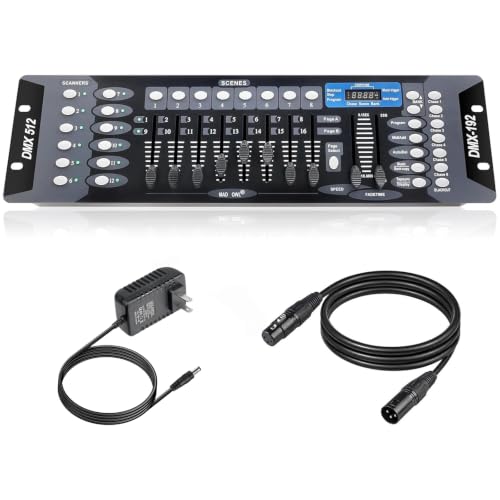
- Controls up to 12 fixtures with 16 channels or fewer
- Stores programmable scenes and six chases
- Includes a 6.6-foot DMX cable
Best For: Stages, clubs, and venues using programmable lighting scenes
Best Standalone Pick – ADJ WMX1 Mk2
The ADJ WMX1 Mk2 is a strong choice for buyers who want hands-on control from a standalone DMX controller. Its 37 backlit buttons, four rotary encoders, and support for up to four universes suit more involved lighting setups.
Best For: DJs, venues, and lighting operators who prefer dedicated hardware controls and multi-universe capability.
Pros:
- Standalone operation with 37 backlit silicone buttons
- Four rotary encoders for hands-on adjustments
- Supports up to four universes and has four output sockets
Cons:
- May offer more capacity than simple, small lighting rigs require
- Dedicated hardware can be less convenient than app-based control for some users
With its substantial control surface and four-universe support, the WMX1 Mk2 is geared toward users who want a dedicated, scalable DMX control setup rather than a basic compact interface.
Best Traditional Console – MINGJIE 192-Channel DMX512 Controller
The MINGJIE DMX512 Controller provides a traditional console layout for managing up to 192 channels and 12 intelligent fixtures. It combines manual faders with sound activation, scene storage, and chase programming for flexible event control.
Best For: Mobile DJs, clubs, parties, and small stage productions needing a conventional DMX512 console.
Pros:
- Controls 192 channels and up to 12 intelligent fixtures
- Stores 240 scenes in 30 banks and supports six chases
- Includes a 3-pin DMX cable and accepts 100–240V input
- Rugged alloy chassis is designed for heat dissipation
Cons:
- Traditional console operation may require more setup than an app-based system
- Its 192-channel capacity may be excessive for very small rigs
This is a practical option for buyers who want physical faders, dedicated scene controls, and sound-activated operation in a familiar console format.
Best for DJ Integration – SoundSwitch Control One
The SoundSwitch Control One is designed for software-centered DMX controllers, offering tactile control over SoundSwitch lighting shows. Its dual USB ports, two DMX universes, touch strip, encoders, and RGB pads make it suited to live DJ performance.
Best For: DJs using SoundSwitch, Engine DJ devices, or compatible AlphaTheta setups to synchronize lighting with music.
Pros:
- Provides 1:1 control for SoundSwitch software
- Two DMX universes with inputs, outputs, and a thru option
- Dual USB ports support seamless DJ transitions
- Touch strip, encoders, and RGB pads enable responsive performance control
Cons:
- Its full feature set depends on compatible software or DJ hardware
- Some AlphaTheta configurations require a laptop running SoundSwitch
Control One is most compelling when your lighting workflow already centers on SoundSwitch or compatible DJ equipment. It adds physical performance controls without replacing the software-based system.
Best App-Based Option – ADJ MyDMX Go
The ADJ MyDMX Go is a compact app-based DMX controller for iPad or Android tablets. It offers 256-channel control, wireless operation over Wi-Fi, a fixture library of more than 15,000 entries, and automatic effects without requiring traditional programming.
Best For: Users who want quick tablet-based control for compatible fixtures, mobile setups, and straightforward lighting displays.
Pros:
- 256-channel control through an iPad or Android tablet
- Supports Wi-Fi and USB connections
- Offers more than 15,000 fixtures in its library
- Includes 50 user presets and 21 automatic effects
Cons:
- Requires a compatible iPad or Android tablet for app control
- Tablet-based operation may not suit users who prefer physical faders
- Supports up to two lighting universes rather than four
MyDMX Go favors accessibility and fast setup over traditional console programming. It is a convenient choice for operators who want broad fixture compatibility and effect control from a tablet.
Best Overall Control – Rockville ROCKFORCE 384
The Rockville ROCKFORCE 384 is one of the more capable DMX controllers for DJs, clubs, and stage setups that need control over multiple fixtures. Its 384 channels, programmable scenes and chases, MIDI support, and music-triggered mode provide plenty of flexibility for building repeatable light shows.
Best For: DJs, clubs, and stage operators controlling up to 24 intelligent lights with detailed scene and chase programming.
Pros:
- Controls up to 24 fixtures with 16 channels each.
- Stores 240 scenes across 30 banks and six programmable chases.
- Includes MIDI control, a built-in microphone, power-failure memory, and reversible DMX channels.
- Durable metal housing and an included LED gooseneck lamp support use in dark environments.
Cons:
- The large number of controls may take time for beginners to learn.
- Its 5.3-pound metal construction is less lightweight than a basic controller.
Choose this model if you want broad fixture capacity and advanced programming in a conventional hardware console. The 16 sliders, MIDI features, and music mode make it especially useful for live performance environments.
Best for Programmable Shows – 384CH DMX512 Stage Console
This 384-channel console is a practical choice among DMX controllers for users who want to edit and save lighting sequences for bar, club, live, or stage shows. It supports 30 banks of eight programmable scenes, giving operators a structured way to build and recall lighting looks.
Best For: Small-to-medium stage and event setups that need 384-channel control and organized scene programming.
Pros:
- Provides 384 DMX512 channels for detailed lighting control.
- Supports 30 banks with eight programmable scenes each.
- 110–240V power compatibility suits a range of electrical environments.
- Compact design includes side handles and an LED gooseneck light.
Cons:
- The notes do not specify MIDI, music-mode, or chase functionality.
- Its scene-focused layout may be more involved than a simple manual controller.
This console makes sense when scene creation and recall are the priority. Its channel count matches the Rockville-style 384-channel format, while the compact body and gooseneck light help with portable show operation.
Best Beginner-Friendly Option – CO-Z 192 DMX Controller
The CO-Z 192 is a more compact option for buyers comparing DMX controllers for smaller lighting systems. It controls up to 12 intelligent lights with up to 16 channels each and combines scene storage, voice control, and a clearly divided control layout for more approachable operation.
Best For: Amateur users, DJs, weddings, churches, family gatherings, and small venues running up to 12 fixtures.
Pros:
- Controls up to 12 intelligent lights with up to 16 channels each.
- Supports up to 240 scenes for building more complex shows.
- Voice control can switch between lighting scenes.
- Dedicated sections for fixture selection, scenes, channels, pages, timing, and functions simplify navigation.
Cons:
- Its 192-channel capacity is lower than the two 384-channel consoles.
- The plastic construction may feel less rugged than a metal-bodied controller.
- It is designed for up to 12 fixtures rather than larger lighting rigs.
The CO-Z is a sensible fit when ease of use and a smaller footprint matter more than maximum channel capacity. Its voice control and organized seven-section layout can help newer operators manage common event lighting tasks.
Compact 12-Channel Control – MAD OWL Mini DMX Dimmer
For small setups, this compact 12-channel unit is one of the more straightforward DMX controllers to consider. It uses the DMX512 protocol, with six sub-control faders, a master fader, and a one-key blackout function for quick lighting adjustments.
Best For: Small stages and users controlling DMX fixtures with 12 channels or fewer.
Pros:
- Controls up to 12 DMX512 channels.
- Compact, lightweight aluminum design suited to travel.
- Standard 3-pin XLR DMX output supports simple connections.
- Faders are designed for smooth operation.
Cons:
- Not suitable for lighting equipment requiring more than 12 channels.
- Provides basic dimming control rather than advanced scene programming.
This is a practical choice when portability and simple manual control matter more than extensive programming features. Pair it with a compatible DMX512 dimming power supply for a permanent lighting control setup.
Wireless 384-Channel Flexibility – DMX512 Stage Controller
This 384-channel console is among the more versatile DMX controllers for DJs, event operators, and indoor stage setups. It combines wired 3-pin XLR and 2.4G wireless operation with sound-activated, automatic, manual, and MIDI control modes.
Best For: Weddings, bars, discos, live stages, and users who want programmable wireless or wired control.
Pros:
- Offers 384 DMX512 channels for up to 12 intelligent lights.
- Supports both 2.4G wireless and traditional wired operation.
- Includes sound-activated, auto, manual, and MIDI control modes.
- Stores 30 banks and 240 preset static scenes.
Cons:
- The feature set may be more than needed for very simple lighting rigs.
- Requires a 9V battery according to the supplied specifications.
Choose this console if you need room to build and recall custom light shows across different venues. Its dual-mode connectivity and scene storage make it a strong fit for event-oriented setups.
Programmable 192-Channel Control – DMX Lighting Console
This 192-channel board is a practical middle ground among DMX controllers, offering hands-on faders and buttons for stage and DJ lighting. It can control up to 12 fixtures with 16 channels or fewer and includes scene, chase, and programming functions.
Best For: Stages, clubs, and performance venues needing programmable control for multiple fixtures.
Pros:
- Provides 192 channels across up to 12 lighting fixtures.
- Supports 23 banks of eight programmable scenes.
- Allows 240-step scenes and six programmable chases.
- Includes a 6.6-foot DMX cable.
Cons:
- Fixtures must use 16 channels or fewer.
- The console has a relatively large footprint at 22.44 inches long.
Its combination of physical controls and programmable scenes makes it suitable for operators who want repeatable lighting sequences without moving to a more complex system. The included cable also helps simplify initial setup with compatible equipment.
How We Picked These Dmx Controllers
We focused on practical differences that affect real-world lighting control: channel capacity, fixture support, scene and chase programming, wireless or wired operation, MIDI compatibility, portability, and suitability for DJs, small stages, clubs, and mobile events. We also considered whether each controller is best suited to simple dimming, conventional fixture control, or more flexible show programming.
Because product specifications and included accessories can vary, confirm the current listing for channel layouts, cable requirements, software compatibility, and wireless range before purchasing.
Quick Comparison
| Best For | Look For | Most Suitable Type |
|---|---|---|
| Small lighting setups | Simple controls and low channel counts | Compact 12- or 192-channel console |
| DJs and mobile performers | Scenes, chases, MIDI, and portability | 192- or 384-channel controller |
| Clubs and live events | More fixture capacity and programming depth | 384-channel console or app-based system |
| Flexible installation | Wireless DMX and wired backup | Dual-mode wireless/wired controller |
| Tablet-based operation | App control and streamlined programming | Software or app-driven controller |
Key Buying Factors for Dmx Controllers
Channel Capacity
Channel count determines how many DMX parameters you can control, not simply how many fixtures you can connect. A basic light may use only a few channels, while moving heads, LED bars, and effects can require many more. Leave room for expansion instead of choosing a controller that is already near its limit.
Programming and Playback
Scenes store lighting states, while chases sequence those scenes for automated movement or effects. Look for enough banks, scenes, fixtures, and playback controls for your show format. Dedicated faders are useful for hands-on operation, while app-based systems may offer a cleaner interface and easier updates.
Connectivity
Standard wired DMX remains dependable and is often the best choice for permanent or complex setups. Wireless DMX can reduce cable runs and speed up setup, but check compatibility, range, interference risks, and whether the controller supports wired operation as a backup.
MIDI, Sound Activation, and Software
MIDI support can connect lighting cues to a keyboard, DJ system, or performance controller. Sound-activated modes are convenient for casual events but provide less precise control than manually programmed scenes. App and computer-based systems can be powerful, though they may require a compatible device and a more involved setup.
Who Should Buy Which Dmx Controllers?
Choose a compact controller if you operate a small stage, basic wash lights, or a few dimmable fixtures and want straightforward manual control.
Choose a 192-channel model for entry-level DJ work, small venues, and mobile performers who need scenes and chases without a complex programming workflow.
Choose a 384-channel controller if you run multiple fixtures, fog or effect equipment, or larger live shows and want more room for expansion.
Choose a wireless or app-based system when fast setup, reduced cabling, and remote operation matter more than traditional fader-based control. For professional events, prioritize dependable connectivity, backup options, and a controller you can operate confidently in low-light conditions.