The right preamp can make a quiet dynamic or ribbon microphone far easier to record, while giving condenser microphones a cleaner, more controlled signal path. For home studios, the best choice depends on more than maximum gain: noise performance, phantom-power behavior, impedance, controls, and workflow all matter.
We’ve gathered 10 microphone preamps for home studios, including inline boosters, tube-style units, channel strips, and rack-ready options. Use the guide below to narrow the list by microphone type, recording goals, and available equipment.
Best 10 Microphone Preamps for Home Studios Picks for 2026
Versatile Channel Strip

- Compression, de-essing, enhancement, and gating
- XLR and 1/4-inch inputs with loop-out
- Rack-mountable single-channel design
Best For: Vocal recording and integrated home-studio processing
Clean Gain Booster
Cloudlifter CL-1 Mic Activator

- Adds up to +25 dB of gain
- Uses phantom power without passing it to passive mics
- Compact XLR inline design
Best For: Quiet passive microphones, podcasts, and voiceover
Inline Class-A Gain
- Low-noise Class-A JFET amplifier
- Double single-ended topology
- Shielded compact enclosure
Best For: Simple inline gain for home-studio microphones
Variable Tube Voicing
- Single-channel tube preamplifier
- Variable valve voicing
- Supports microphones and multiple instruments
Best For: Tube-flavored vocal and instrument recording
Best Inline Gain Booster

- Adds up to 28 dB of transparent gain
- Ultra-slim metal XLR design
- Suited to dynamic and passive ribbon mics
Best For: Low-output dynamic and passive ribbon microphones
Best Rack-Mount Control Hub
- Three-band EQ and crossover functions
- Multiple inputs plus XLR master outputs
- 1U rack-mount design with ground lift
Best For: Rack-based home audio and recording setups
Best Compact Tube-Style Option

- Professional-quality hybrid design
- Compact, reliable aluminum chassis
- Single-channel XLR microphone preamp
Best For: Affordable, space-conscious home recording setups
Best Dynamic-Mic Signal Booster

- Adds up to 29 dB of gain
- Metal XLR plug-in design
- Requires 48V phantom power
Best For: Dynamic and ribbon microphones in home studios
Best Simple Tube Option

- Single-channel tube preamplifier
- Supports microphones and instruments
- Straightforward home-studio format
Best For: Basic one-source recording setups
Best Versatile Low-Noise Preamp

- 19–66 dB gain with -120 dBV EIN
- Works with microphones and instruments
- XLR, TRS, TS, and Type-C connectivity
Best For: Flexible home-studio vocal and instrument recording
Versatile Channel Strip – dbx 286s Microphone Preamp
The dbx 286s is a strong choice for home studios that need more than basic microphone gain. This single-channel microphone preamp for home studios combines compression, de-essing, enhancement, and expander/gate processing in a rack-mountable 1U unit.
Best For: Vocal recording, spoken-word production, and home setups that want integrated signal processing.
Pros:
- Includes compression, de-esser, enhancer, and expander/gate sections.
- Accepts XLR microphone input plus 1/4-inch line-level sources.
- Loop-out and insert connections support additional processing.
- Status LEDs provide at-a-glance level and processor monitoring.
Cons:
- Its 1U rack format may be more equipment than a minimalist setup needs.
- It is a single-channel unit.
The dbx 286s is especially practical when you want a vocal-ready signal chain in one box rather than separate processors. Its broad feature set makes it a flexible centerpiece for a compact home studio.
Clean Gain Booster – Cloudlifter CL-1 Mic Activator
The Cloudlifter CL-1 is a compact microphone gain booster for home studios using quiet passive microphones. It uses +48V phantom power to provide up to 25 dB of gain while keeping phantom power from passing to the microphone itself.
Best For: Passive ribbon microphones, quiet vocals, podcasts, streaming, and voiceover setups that need extra clean signal strength.
Pros:
- Provides up to +25 dB of microphone gain.
- Designed to preserve a microphone’s natural sound.
- Compatible with tube, battery-powered, and power-supply-driven microphones.
- Compact stainless-steel enclosure and straightforward XLR connectivity.
Cons:
- Requires standard +48V phantom power from the connected preamp or interface.
- It is a gain activator rather than a full channel strip with tone-shaping controls.
The CL-1 makes sense when your existing interface or preamp does not provide enough clean gain for a passive microphone. It adds focused signal boost without adding a larger processor section to the setup.
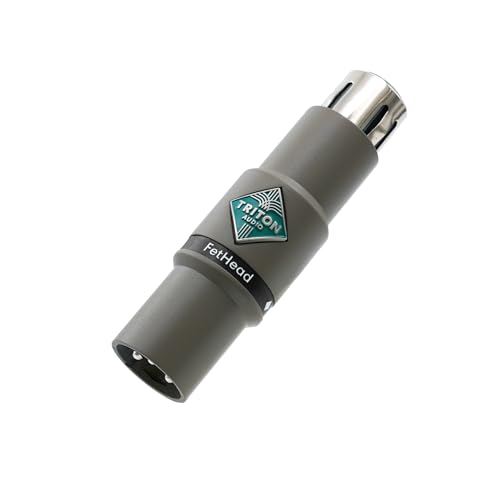
Inline Class-A Gain – Triton Audio FetHead
The Triton Audio FetHead is an inline microphone preamp for home studios that need a low-noise gain stage between a microphone and the main preamp. Its Class-A JFET amplifier and shielded enclosure are aimed at adding gain while keeping the signal path compact.
Best For: Home-studio users who want a small inline preamp with a Class-A JFET design.
Pros:
- Uses a low-noise Class-A JFET amplifier.
- Features a double single-ended amplifier topology.
- Shielded enclosure helps keep the inline unit compact and protected.
Cons:
- Provides inline gain rather than multiple channel-strip effects.
- The supplied notes do not specify a gain figure or connector configuration.
The FetHead is best considered a focused gain solution rather than an all-in-one processor. Its small form factor and stated low-noise Class-A design suit users building a simple microphone chain.
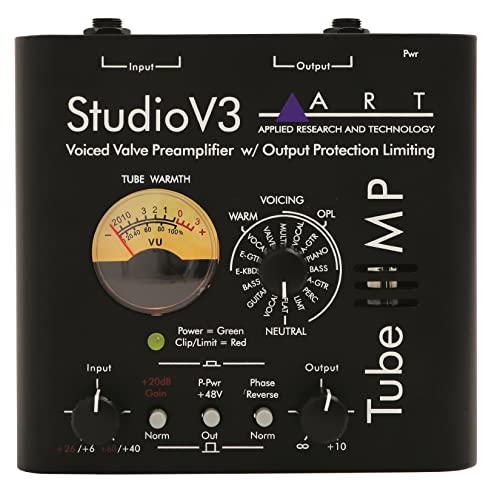
Variable Tube Voicing – ART Tube MP Studio V3
The ART Tube MP Studio V3 gives home-studio users a single-channel tube microphone and instrument preamp with variable valve voicing. It supports microphones, guitars, keyboards, bass, drums, and vocals in a metal enclosure.
Best For: Home recording setups that want tube-based preamplification for vocals and instruments.
Pros:
- Single-channel tube microphone and instrument preamplifier.
- Includes variable valve voicing.
- Works with vocals, guitars, keyboards, bass, and drums.
- Metal enclosure and a two-year warranty are specified.
Cons:
- It provides one output channel.
- The supplied notes do not detail the available controls or exact tube voicing range.
The Tube MP Studio V3 is a suitable option for recording engineers who want tube amplification in a straightforward standalone unit. Its broad instrument compatibility makes it useful beyond vocal tracking.
Best Inline Gain Booster – sE Electronics DM1 Dynamite
For home studios using low-output dynamic or passive ribbon microphones, the sE Electronics DM1 Dynamite adds up to 28 dB of clean, transparent gain inline. Its compact XLR format is useful when your interface or mixer needs extra microphone level without adding a full rack unit.
Best For: Dynamic and passive ribbon microphones used for podcasting, recording, or live sound.
Pros:
- Provides +28 dB of clean, transparent gain.
- Compact, ultra-slim inline design adds minimal bulk.
- Metal housing and gold-plated XLR connectors support dependable use.
- Designed to reduce unwanted buzz, hum, and RF interference.
Cons:
- Designed for dynamic and passive ribbon microphones, not described as a standalone multi-input preamp.
- Requires a corded-electric power source.
The DM1 is a focused solution rather than a feature-heavy studio preamp. Choose it when your existing XLR setup works well but needs more clean gain for a quieter microphone.
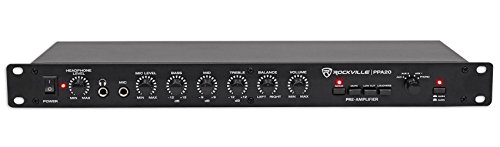
Best Rack-Mount Control Hub – Rockville PPA20 Preamp
The Rockville PPA20 takes a broader approach to microphone preamps for home studios, combining a 1U rack-mount preamp with source selection, three-band EQ, crossover functions, and multiple inputs and outputs. It suits setups that need flexible routing and basic sound shaping in one chassis.
Best For: Home audio, studio recording, and live setups requiring multiple connections and hands-on tone control.
Pros:
- Offers bass, midrange, and treble controls for sound shaping.
- Includes a 1/4-inch microphone input, RCA phono, five AUX inputs, XLR master outputs, and headphone output.
- Provides low-cut filtering, ground lift, mute/pad, balance, and loudness compensation.
- Fits a compact 1U rack-mount format.
Cons:
- Its feature set is broader than a simple dedicated microphone preamp.
- The supplied specifications list a 1/4-inch microphone input rather than an XLR microphone input.
- At about 5 pounds, it is less portable than compact desktop or inline units.
The PPA20 is a practical choice when connectivity and control matter as much as microphone gain. It is especially appropriate for a rack-based system where EQ, source switching, and hum-reduction tools are useful.
Best Compact Tube-Style Option – ART Tube MP Project Series
The ART Tube MP Project Series is a compact, cost-effective microphone preamp for home studios that want a straightforward single-channel unit. Its hybrid design and all-aluminum stackable chassis make it a practical fit for basic microphone and computer recording setups.
Best For: Home-recording users seeking an affordable, compact single-channel microphone preamp.
Pros:
- Uses a professional-quality hybrid design.
- Compact and reliable for space-conscious setups.
- All-aluminum chassis is stackable.
- Provides XLR connectivity and one channel.
Cons:
- The supplied notes do not specify onboard EQ, multiple inputs, or advanced routing features.
- It is a single-channel unit.
- Its listed 20 kHz maximum sample rate may limit high-resolution digital workflows.
The Tube MP Project Series keeps the feature set focused and the footprint small. It makes sense for a simple microphone chain where affordability, portability, and one-channel operation are more important than extensive controls.
Best Dynamic-Mic Signal Booster – StudioMan DPM1 XLR Preamp
For home studios using a low-output dynamic or ribbon microphone, the StudioMan DPM1 adds up to 29 dB of gain before the signal reaches your interface. Its compact XLR design is intended to improve recording levels without requiring a larger interface upgrade.
Best For: Home-studio users with dynamic or ribbon microphones, including setups built around microphones such as the SM7B or SM58.
Pros:
- Provides up to 29 dB of stated gain for quieter microphones.
- Compact metal housing is designed to help shield against interference and hum.
- Plug-and-play XLR connection works with compatible interfaces and mixers.
- Includes a one-year manufacturer warranty and technical support.
Cons:
- Not suitable for condenser microphones.
- Requires 48V phantom power, which is not included.
- Its compatibility depends on an interface or mixer that supplies phantom power.
The DPM1 is a focused solution rather than a complete microphone preamp: it makes the most sense when your existing interface needs extra clean gain for a dynamic or ribbon mic. Confirm phantom-power availability and microphone type before buying.
Best Simple Tube Option – ART Tube MP
The ART Tube MP is a single-channel tube microphone and instrument preamplifier for home-studio users who want a dedicated gain stage for one source. Its straightforward design makes it a practical option for basic vocal or instrument recording chains.
Best For: Home studios needing a single-channel tube microphone or instrument preamplifier.
Pros:
- Designed for both microphone and instrument preamplification.
- Single-channel format is simple for focused recording setups.
- Provides a dedicated preamp stage for a home-studio signal chain.
Cons:
- The supplied notes do not specify gain range, connectivity, noise performance, or included accessories.
- One channel may be limiting for multi-microphone recording.
The ART Tube MP is worth considering when a basic, single-channel tube preamplifier fits your workflow. Because the supplied specifications are limited, verify the detailed input, output, power, and gain information before purchase.
Best Versatile Low-Noise Preamp – RO03 66 dB Mic Preamp
The RO03 is a flexible choice among microphone preamps for home studios, offering selectable XLR, TRS, and TS connectivity, 19–66 dB of stated gain, and a -120 dBV EIN specification. It supports dynamic, condenser, and ribbon microphones as well as instruments, with Type-C power for more portable setups.
Best For: Home-studio users recording different microphone types and instruments who want broad gain and connection options.
Pros:
- Supports dynamic, condenser, and ribbon microphones plus instruments.
- Offers a 19–66 dB gain range and a stated -120 dBV EIN.
- Includes XLR, TRS, and TS connectivity with simultaneous usable outputs.
- 1MΩ instrument input impedance is designed to reduce impedance-related signal loss.
Cons:
- The two input ports cannot be used simultaneously.
- The supplied guidance recommends connecting to an interface’s TRS line input for the lowest noise.
- Requires suitable cables and a Type-C power source or included power accessories.
The RO03 stands out for versatility, especially if your home studio alternates between vocals, microphones, and instruments. For the cleanest stated performance, follow the recommended TRS line-input connection rather than routing it into an interface’s XLR input.
How We Picked These Microphone Preamps for Home Studios
We selected products across the main preamp categories used in home recording: inline gain boosters for low-output microphones, standalone tube and solid-state preamps, channel strips with dynamics processing, and rack-style units with additional routing or tone controls. We considered gain range, noise claims, phantom-power requirements, control layout, microphone compatibility, construction, and how easily each unit fits into a typical audio-interface setup.
Specifications should be checked against your exact microphone and interface. In particular, advertised gain does not always indicate how quietly a preamp operates at its highest setting.
Quick Comparison
| Type | Best For | What to Watch |
|---|---|---|
| Inline activator | Low-output dynamic and ribbon microphones | Usually needs phantom power and a second preamp |
| Tube preamp | Adding color or gentle saturation | Tube character is not always the cleanest option |
| Channel strip | Tracking vocals or instruments with processing | More controls require a longer setup process |
| Rack preamp | Permanent studio installations | Needs rack space and may offer more features than necessary |
Key Buying Factors for Microphone Preamps for Home Studios
Gain and Noise
Dynamic and ribbon microphones often need substantially more clean gain than condensers. Choose enough headroom that normal performances do not force the gain control to its limit. A low equivalent input noise rating, when measured under comparable conditions, is especially valuable for quiet sources and high-gain recording.
Phantom Power and Compatibility
Condenser microphones generally require 48V phantom power. Inline boosters also commonly rely on phantom power, even though they do not pass it to the microphone in the same way. Confirm the signal path before use, and exercise extra caution with passive ribbon microphones: follow the microphone manufacturer’s guidance before enabling phantom power.
Clean or Colored Sound
Solid-state designs are often preferred when you want transparent gain, while tube circuits and channel strips can add saturation, compression, de-essing, or equalization. Extra processing can be useful during tracking, but a clean preamp gives you more flexibility for mixing later.
Connections and Workflow
Check whether the unit uses XLR or TRS outputs, whether it connects directly to your interface, and whether its output level matches your interface’s line input. Front-panel metering, a high-pass filter, pad, phase switch, and insert or loop connections can be more useful in daily work than headline gain figures.
Who Should Buy Which Microphone Preamps for Home Studios?
Choose an inline activator if your dynamic or ribbon microphone sounds too quiet but your interface preamp is otherwise clean. Choose a tube model if you want a warmer, more characterful tracking sound. A channel strip is the better fit for vocalists who want compression, de-essing, gating, or enhancement before the signal reaches the interface. For a permanent multi-device setup, a rack-mount preamp can provide convenient access and additional routing or EQ. If you record varied sources and want maximum flexibility, prioritize clean gain, low noise, phantom-power control, and enough headroom over decorative features.