The best multitrack recorder can turn a rehearsal, live performance, or songwriting idea into a finished production without requiring a computer. The right choice depends on how many inputs you need, where you record, and how much hands-on control you want.
We’ve selected 10 multitrack recorders for musicians, covering compact battery-powered units, touchscreen workstations, and mixer-based systems for larger ensembles. Use the guide below to narrow the field by workflow, features, and budget.
Best 10 Multitrack Recorders for Musicians Picks for 2026
Best Flexible 4-Track Pick

- Four-track recording with bounce and undo
- 32-bit float capture helps prevent clipping
- Battery or USB-C operation with built-in rhythms
Best For: Mobile songwriting, demos, and quick overdubs
Best Pocket Practice Recorder
- Three modes cover multitrack, practice, and live recording
- 64 V-Tracks with eight-track simultaneous playback
- Built-in microphone, rhythms, amps, and effects
Best For: Practice, play-along sessions, and live ideas
Best Computer-Free Production Choice
- 16-track recorder with eight-track simultaneous recording
- Six XLR inputs and touchscreen editing
- Built-in effects, rhythms, and synth sounds
Best For: Band demos and standalone multitrack production
Best Simple Songwriting Pocketstudio

- Six-track recording with two-track simultaneous input
- Built-in omnidirectional condenser microphones
- Battery operated with CD-quality WAV recording
Best For: Portable songwriting demos and layered ideas
Best for Full-Band Monitoring

- 14-track simultaneous recording at 24-bit/96kHz
- Five personalized monitor mixes
- Battery power and USB connectivity
Best For: Bands, rehearsals, live performances, and podcasts
Best for Portable Songwriting
BOSS BR-600 Digital Multitrack Recorder

- Eight simultaneous playback tracks
- Built-in stereo microphone and drum machine
- Guitar, vocal, and pitch-correction effects
Best For: Portable songwriting and guitar-based recording
Best Compact Battery-Powered Mixer

- 12-track recording at 24-bit/96kHz
- Four headphone outputs with three monitor mixes
- Simultaneous SD-card and computer recording
Best For: Small bands, mobile sessions, and podcasts
Best Layering Recorder
- 32-bit float recording
- Four-track recording with bounce track
- Includes 128GB card and accessories
Best For: Layered demos and portable song sketches
Best for Live Multitrack Sessions

- 22-track simultaneous recording
- Six customizable monitor outputs
- Wireless iPad mixing control
Best For: Bands and larger live recording setups
Best Portable Practice Studio

- Eight-track touchscreen recording
- Built-in drum loops and FM synths
- Battery powered with USB-C interface
Best For: Mobile songwriters and solo musicians
Best Flexible 4-Track Pick – Zoom R4
The Zoom R4 is a practical choice among multitrack recorders for musicians who want a compact, battery-powered setup for capturing ideas, layering parts, and bouncing tracks without adjusting gain. Its two XLR/TRS combo inputs accommodate microphones, instruments, and keyboards.
Best For: Mobile songwriting, demos, overdubbing, and musicians who want clip-free recording with built-in rhythms.
Pros:
- Records, layers, and bounces up to four tracks with undo support.
- 32-bit float recording helps prevent clipping without manual gain adjustments.
- Includes more than 80 rhythm patterns, built-in effects, and stereo microphones.
- Works as a USB audio interface and runs on AA batteries or USB-C.
Cons:
- Provides only two XLR/TRS combo inputs.
- Its four-track limit may be restrictive for larger arrangements.
The R4 stands out for portable, low-fuss recording. It is especially appealing when quick setup, flexible power, and dependable capture matter more than extensive track counts.
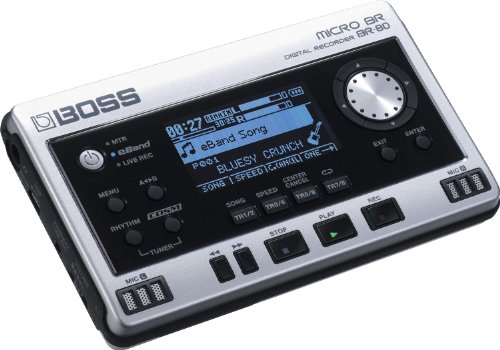
Best Pocket Practice Recorder – BOSS BR-80
The BOSS BR-80 combines a multitrack recorder, practice tool, and live recorder in a compact design. For musicians comparing multitrack recorders for musicians, its built-in stereo microphone, backing patterns, and eBand play-along features make it useful beyond basic tracking.
Best For: Practice, songwriting sketches, live capture, and musicians who want built-in effects and play-along functions.
Pros:
- Offers MTR, eBand, and Live Recorder modes.
- Provides 64 V-Tracks and eight simultaneous playback tracks.
- Includes a stereo condenser microphone, backing patterns, COSM amps, and effects.
- Can function as a USB audio interface with built-in effects.
Cons:
- Records to SD/SDHC cards up to 32 GB, rather than offering larger stated storage.
- Uses a single AAA battery according to the supplied specifications.
- The included warranty is listed as 90 days.
The BR-80 is a versatile pocket recorder for musicians who value practice and inspiration as much as multitrack recording. Its three operating modes broaden its usefulness for everyday musical work.
Best Computer-Free Production Choice – Zoom R20
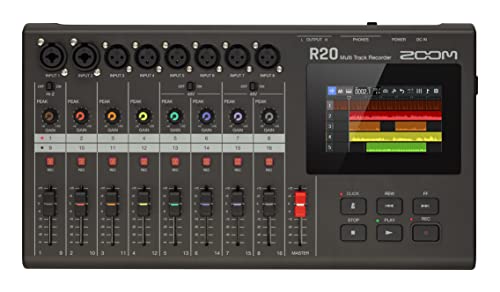
The Zoom R20 is designed for musicians who want a hands-on alternative to computer-based production. Its touchscreen workflow supports recording, editing, and mixing directly on the unit, while six XLR inputs and 16-track capability accommodate fuller arrangements.
Best For: Multitrack demos, band projects, and creators who want touchscreen editing without relying on a computer.
Pros:
- Records up to 16 tracks, with up to eight tracks simultaneously.
- Offers six XLR inputs, including two XLR/TRS combo inputs.
- Touch controls support drag, drop, swipe, and pinch editing.
- Includes effects, 150 rhythm patterns, and an 18-sound onboard synth.
Cons:
- Its maximum sample rate is listed as 44.1 kHz.
- At 4.3 pounds, it is less pocket-friendly than smaller portable recorders.
- The touchscreen workflow may be more equipment than a simple idea recorder requires.
With its higher track count, multiple inputs, and onboard editing, the R20 is the strongest fit here for complete projects. It offers a focused standalone workflow while retaining USB connectivity for Windows and macOS systems.
Best Simple Songwriting Pocketstudio – Tascam DP-006
The Tascam DP-006 is a straightforward battery-operated pocketstudio for musicians who want dedicated recording controls and built-in microphones. Among multitrack recorders for musicians, it offers up to six tracks, two-track simultaneous recording, and a dedicated stereo master track for compact songwriting sessions.
Best For: Songwriters making portable demos with built-in microphones and simple track layering.
Pros:
- Supports up to six tracks and six-track simultaneous playback.
- Includes two built-in omnidirectional condenser microphones.
- Records at CD-quality 16-bit/44.1 kHz resolution.
- Runs on four included AA batteries.
Cons:
- Allows only two tracks to be recorded simultaneously.
- Its 4 GB memory capacity and 9-hour stated recording time are modest.
- It lacks the higher-resolution 32-bit float recording found on the Zoom R4.
The DP-006 favors simplicity and portability over advanced editing features. It is a sensible option for capturing song ideas and layering parts when a dedicated, battery-powered recorder is preferred.
Best for Full-Band Monitoring – Zoom LiveTrak L-12
For musicians comparing multitrack recorders for musicians, the Zoom LiveTrak L-12 stands out as a mixer/recorder built for larger rehearsals, live performances, and podcast setups. It records up to 14 tracks simultaneously at 24-bit/96kHz to an SD card and includes extensive monitoring and USB connectivity.
Best For: Full bands, live recording, rehearsals, and musicians who need multiple personalized headphone mixes.
Pros:
- Records up to 14 tracks simultaneously at 24-bit/96kHz.
- Five separate monitor mixes with dedicated headphone outputs.
- Includes 12 inputs, 16 onboard effects, and USB audio interface functionality.
- Battery power supports mobile recording sessions.
Cons:
- Larger and heavier than the compact L-8, at 17.5 inches wide and 5.7 pounds.
- Its 12-channel mixer layout may be more than a solo musician needs.
The L-12 is a strong choice when monitoring flexibility and track count matter most. Its combination of mixer controls, onboard effects, SD recording, and computer connectivity makes it especially practical for ensemble work.
Best for Portable Songwriting – BOSS BR-600 Digital Multitrack Recorder
The BOSS BR-600 is a compact option for musicians seeking multitrack recorders for musicians with built-in creative tools. It provides eight simultaneous playback tracks, 64 V-Tracks, a built-in stereo microphone, effects processing, and battery-powered operation.
Best For: Portable songwriting, guitar-based recording, and musicians who want built-in drums and effects.
Pros:
- Offers eight simultaneous playback tracks and 64 V-Tracks.
- Includes a built-in stereo microphone for recording without an external mic.
- Built-in drum machine features velocity-sensitive pads.
- Provides guitar and vocal effects, including a pitch corrector.
Cons:
- Included storage is limited to a 128MB CompactFlash card.
- Recording time with the listed storage is 2 hours and 16 minutes.
- Requires four 9V batteries for battery operation.
The BR-600 favors self-contained portability over high channel counts. Its microphone, drum machine, effects, and battery support make it useful for capturing ideas and building songs away from a studio.
Best Compact Battery-Powered Mixer – Zoom LiveTrak L-8
Musicians looking at multitrack recorders for musicians who also need a portable mixer may find the Zoom LiveTrak L-8 a practical fit. It records up to 12 tracks at 24-bit/96kHz, supports simultaneous SD-card and computer recording, and offers four headphone outputs in a compact battery-powered design.
Best For: Small bands, mobile sessions, podcasts, and performers who need flexible headphone monitoring.
Pros:
- Captures up to 12 tracks simultaneously at 24-bit/96kHz.
- Provides four headphone outputs and three independent monitor mixes.
- Can record to an SD card and computer at the same time via USB.
- Compact, lightweight design supports gigs and mobile sessions.
Cons:
- Its eight-channel configuration is less expansive than the L-12.
- Offers three monitor mixes, fewer than the L-12’s five.
The L-8 balances recording capability and portability well. It is especially useful for smaller setups that need onboard effects, multiple headphone feeds, and the option to create an SD-card backup while recording to a computer.
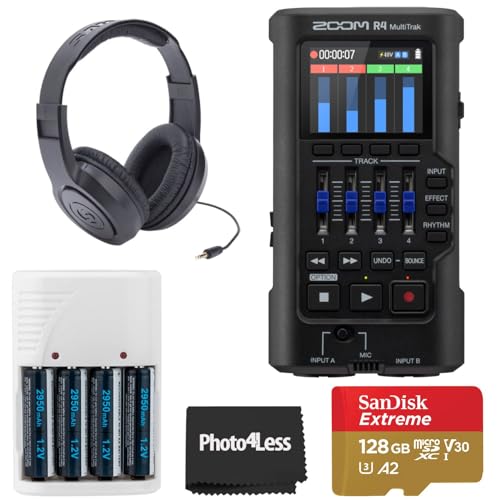
Best Layering Recorder – Zoom R4 MultiTrak
The Zoom R4 is a practical choice among multitrack recorders for musicians who want to build songs in layers without managing complicated gain settings. It records up to four tracks, then lets you mix and bounce them to a dedicated bounce track to make room for additional parts.
Best For: Musicians creating layered demos, acoustic recordings, and portable song sketches.
Pros:
- 32-bit float recording reduces the need to set input gain.
- Two XLR/TS combo inputs accommodate microphones, instruments, and keyboards.
- Built-in stereo microphone is useful for acoustic guitar, vocals, or quick reference takes.
- Bundle includes a 128GB microSDXC card, headphones, batteries, and charger.
Cons:
- Four-track recording requires bouncing to continue adding layers.
- Its 2-inch screen may feel limited for detailed editing.
The R4 suits creators who value straightforward layering and a generous included-accessory bundle. Its bounce workflow is especially useful for compact arrangements, though musicians planning larger simultaneous sessions may want a higher-channel recorder.
Best for Live Multitrack Sessions – Zoom LiveTrak L-20R
The Zoom LiveTrak L-20R is built for musicians who need substantial input capacity and hands-on session control. With 20 inputs, 22-track simultaneous recording, wireless iOS control, and multiple monitor outputs, it is suited to recording rehearsals, performances, and larger ensembles.
Best For: Bands, live recording setups, and musicians who need extensive routing and monitor-output options.
Pros:
- Records 22 tracks simultaneously and supports 20-track playback.
- Provides six customizable monitor outputs plus a dedicated FOH output.
- Wireless iPad control supports mixing, monitoring, and recording.
- Includes 20 built-in chorus, delay, and reverb effects with adjustable parameters.
Cons:
- Its 20-channel design is less portable than compact recorder options.
- Requires corded electric power.
- Wireless iOS control may not suit musicians without an iPad.
The L-20R is the strongest fit here for complex live or ensemble workflows. Its routing and recording capacity offer room to grow, but the larger feature set and corded design make it better for an established setup than casual mobile capture.
Best Portable Practice Studio – Zoom R12 Portable Recorder
The Zoom R12 combines portable multitrack recording with touchscreen editing and built-in songwriting tools. It records up to eight tracks, includes drum loops and FM synths, and works as a USB-C audio interface and DAW control surface for musicians who want to develop ideas with or without a computer.
Best For: Mobile songwriters, solo musicians, and producers who want built-in rhythms and computer-free editing.
Pros:
- Eight-track recording with DAW-style touchscreen editing.
- Includes 150 drum loops and 18 FM synth instruments.
- Both inputs provide 48V phantom power; input 1 also includes Hi-Z for guitar and bass.
- Runs for up to five hours on four AA batteries.
Cons:
- Only two XLR/TRS combo inputs are provided for recording sources.
- Battery operation is rated for up to five hours, which may limit longer sessions.
The R12 is a flexible middle ground for musicians who want more tracks than a basic portable recorder and more creative tools than a simple capture device. Its touchscreen, loops, synths, and USB-C connectivity make it particularly useful for building complete ideas on the move.
How We Picked These Multitrack Recorders for Musicians
We focused on the features that most affect real-world recording: simultaneous inputs, track capacity, portability, monitoring, onboard microphones, effects, editing controls, storage, and power options. The selection includes dedicated pocket recorders, tabletop workstations, and mixer-recorders so solo artists, bands, podcasters, and live engineers can compare suitable formats.
We also considered workflow. Some musicians want immediate recording with physical controls, while others benefit from touchscreen editing, drum patterns, wireless control, or USB connectivity for computer-based production.
Quick Comparison
- Best for portable ideas: Zoom R4, Tascam DP-006, or Roland BR-80.
- Best for touchscreen production: Zoom R12 or Zoom R20.
- Best for live bands: Zoom LiveTrak L-12 or L-20R.
- Best for compact podcast and music setups: Zoom LiveTrak L-8.
- Best for traditional standalone recording: Boss BR-600.
Key Buying Factors
Inputs and Simultaneous Recording
Count the microphones, instruments, and line-level sources you plan to record at once. Two combo inputs suit solo performers, while six or more inputs are more practical for drum kits, full bands, and ensemble sessions. Also check whether all inputs can record simultaneously rather than simply feeding a mix.
Track Count and Workflow
More tracks provide flexibility for overdubs, but track capacity is only useful if the recorder is easy to operate. Physical faders favor live mixing, while touchscreens and dedicated editing controls can speed up arrangement and song development.
Portability and Power
Battery operation and built-in microphones are valuable for rehearsals, travel, and spontaneous songwriting. Larger mixer-recorders generally offer more inputs and routing options but need more space and may be better suited to studios, stages, or fixed setups.
Effects, Loops, and Connectivity
Built-in effects can reduce the need for external equipment, while drum loops help solo musicians develop arrangements. USB audio, SD or microSD storage, wireless control, and headphone outputs should match how you transfer, monitor, and finish recordings.
Who Should Buy Which Multitrack Recorders for Musicians?
Solo songwriters and mobile musicians should prioritize a compact recorder with built-in microphones, battery power, and quick overdubbing. Producers who want more arrangement control should look for touchscreen operation, higher track counts, effects, and drum patterns. Bands and live performers will usually benefit from mixer-recorders with multiple simultaneous inputs, independent monitoring, and physical channel controls. Podcasters and small production teams should consider models with flexible routing, USB connectivity, and easy headphone monitoring.
Before buying, decide whether you need a standalone recorder or a mixer that also records. Choosing the simplest system that supports your input count and recording style will make it easier to capture ideas consistently and finish more music.