A well-chosen patch bay can make a home studio easier to reconfigure, troubleshoot, and expand. Instead of reaching behind racks or constantly swapping cables, you can keep essential connections accessible at the front of your setup.
This roundup includes balanced patch bays, TRS and TS patch cables, and XLR options for different signal paths and budgets. Use the buying guide below to match the right format, wiring style, and cable type to your equipment.
Best 10 Patch Bays for Home Studios Picks for 2026
Flexible Rack Routing

- 48 balanced 1/4-inch connections
- Normal, half-normal, and thru modes
- 1U rack-mountable metal design
Best For: Home studios needing flexible balanced routing
Heavy-Duty TRS Connectivity

- 48-point patch bay
- 96 gold-plated TRS connectors
- Stainless-steel construction
Best For: TRS-centered studio racks needing many connections
Compact XLR Patch Runs
2-Pack Balanced XLR Patch Cables

- Two 1-foot female-to-female XLR cables
- Triple-layer EMI/RFI shielding
- Locking connectors with strain relief
Best For: Short XLR connections in compact studio racks
Extended TRS Cable Set

- Six 6-foot TRS-to-TRS cables
- Flexible heavy-duty rubber jackets
- Designed for balanced audio connections
Best For: Longer 1/4-inch TRS runs across studio equipment
Rackmount Organization

- 48-point balanced patch-bay format
- Rackmount, steel, and fully shielded design
- Suitable for recording, PA, AV, and live sound
Best For: Rack-mounted studios needing organized XLR connections
Flexible TS Routing
AxcessAbles 1/4-Inch TS Patch Cables

- Six 3-foot unbalanced TS cables
- Multi-color jackets simplify identification
- OFC conductors and spiral shielding
Best For: Unbalanced mono effects and outboard gear
Balanced Studio Connections
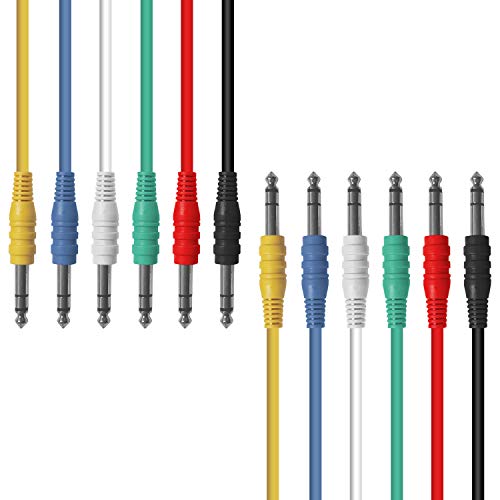
- Six 3-foot 1/4-inch TRS cables
- Designed for balanced studio connections
- Multi-color, flexible, and shielded
Best For: Balanced 1/4-inch patch-bay and outboard routing
Best Color-Coded TS Cable Pack
5-Foot Unbalanced Patch Cables

- Six 1/4-inch TS cables for mono routing
- Multicolor jackets simplify cable identification
- OFC conductors and spiral shields
Best For: Home studios using unbalanced mono patch connections
Best Compact Balanced Cable Pack
- Six balanced 1/4-inch TRS cables
- Compact length helps minimize rack clutter
- Multicolor construction aids cable tracing
Best For: Short balanced connections in organized studio racks
Best Long Balanced Cable Pack

- Six 5-foot balanced TRS cables
- Extra reach for larger studio layouts
- Multicolor jackets support cable organization
Best For: Longer balanced runs between patch bays and outboard gear
Flexible Rack Routing – Samson S-Patch Plus
Samson S-Patch Plus Balanced 48-Point 1/4" Patch Bay | 1/4 Inch Phone Connections
Check Price On AmazonThe Samson S-Patch Plus is a strong choice for patch bays for home studios that need centralized, flexible routing. Its 48 balanced 1/4-inch connections, rack-ready 1U design, and front-panel mode switches make it easier to connect studio equipment without reaching behind the rack.
Best For: Home studios that need normalled, half-normalled, and thru routing in one balanced patch bay.
Pros:
- Provides 48 front and 48 rear 1/4-inch connections.
- Supports normal, half-normal, and thru operation through front-panel switches.
- Rack-mountable 1U metal construction helps organize equipment connections.
- Fully balanced design supports a clean signal path.
Cons:
- Requires a 19-inch rack or suitable rack space.
- Its 1/4-inch TRS connections may not suit setups built around XLR patching.
With its broad routing options and compact rack format, the S-Patch Plus is a versatile central connection point for a growing home recording setup.
Heavy-Duty TRS Connectivity – Black Lion Audio PBR
The Black Lion Audio PBR is a straightforward option among patch bays for home studios, offering 48 points through 96 gold-plated TRS connectors. Its stainless-steel construction and black-anodized finish suit permanent studio installations where plentiful TRS access is the priority.
Best For: Studios that want a high-connection-count TRS patch bay for broadly compatible audio equipment.
Pros:
- Offers 48 patch points with 96 gold-plated TRS connectors.
- TRS connectivity works with a wide range of compatible audio equipment.
- Stainless-steel construction provides a substantial build.
Cons:
- The supplied notes do not specify selectable routing modes.
- Its listed dimensions and 4.31-pound weight may require careful rack planning.
The PBR focuses on dense TRS connectivity and durable construction, making it a practical fit when your studio workflow centers on accessible balanced patch points.
Compact XLR Patch Runs – 2-Pack Balanced XLR Patch Cables
These 1-foot female-to-female XLR cables are a useful accessory for patch bays for home studios, especially when short, balanced connections are needed between rack equipment. The two-pack combines oxygen-free copper conductors, triple-layer shielding, locking connectors, and reinforced strain relief.
Best For: Home studios, podcast booths, and rack setups using standard 3-pin XLR connections in tight spaces.
Pros:
- Short 1-foot length helps reduce cable clutter in racks and around patch bays.
- Balanced OFC conductors and triple-layer shielding are designed to limit interference.
- Locking zinc-alloy XLR connectors help prevent accidental disconnection.
- Two matching cables support simultaneous connections.
Cons:
- Female-to-female XLR connectors are not a substitute for 1/4-inch TRS patch cables.
- The fixed 1-foot length may be too short for equipment positioned farther apart.
For XLR-based signal paths, this compact pair can keep short rack connections tidy while preserving balanced connectivity and secure cable retention.
Extended TRS Cable Set – Seismic Audio SATRX-6 6-Pack
Seismic Audio SATRX-6Black6 6 Pack of Black 6' 1/4"TRS to 1/4" TRS Patch Cables
Check Price On AmazonThe Seismic Audio SATRX-6 six-pack is a practical cable complement for patch bays for home studios that use 1/4-inch TRS connections. Each 6-foot cable has metal TRS plugs, a flexible heavy-duty rubber jacket, and conductors intended for balanced audio equipment.
Best For: Home studios needing multiple longer TRS runs between mixers, processors, amplifiers, and other balanced gear.
Pros:
- Includes six 6-foot male-to-male 1/4-inch TRS cables.
- Heavy-duty flexible rubber jackets support regular studio use.
- Suitable for connecting balanced mixers, equalizers, compressors, effects units, and amplifiers.
- Includes a one-year manufacturer defect and labor warranty.
Cons:
- Six-foot cables can add slack in compact racks.
- They use 1/4-inch TRS connectors rather than XLR.
This set is a useful choice when your patch-bay wiring needs reach and quantity, particularly for connecting equipment spread across a rack or studio workspace.
Rackmount Organization – Art Pro Audio P48 Patch Bay
The Art Pro Audio P48 is a 48-point balanced patch bay for home studios that need a neater, more accessible way to organize connections. Its rackmount design, steel construction, and fully shielded build suit recording, PA, AV, home theater, and live-sound setups.
Best For: Home or professional studios that need rack-mounted cable organization and easier equipment routing.
Pros:
- 48-point balanced patch-bay format for extensive connections.
- Rackmount design fits a standard 19-inch setup.
- Fully shielded construction helps organize cables and reduce connector wear.
- Broadly suited to recording, PA, AV, home theater, and live sound.
Cons:
- Its XLR connector format may not suit studios built primarily around 1/4-inch connections.
- Designed for indoor installations.
The P48 is a practical choice when tidy rack integration and connector protection matter more than a compact desktop format. Confirm that its XLR connections match the rest of your signal chain before buying.
Flexible TS Routing – AxcessAbles 1/4-Inch TS Patch Cables
These six 3-foot unbalanced TS cables are useful accessories for patch bays for home studios, especially when routing outboard effects and other mono gear. Multi-color jackets make connections easier to identify, while flexible construction supports frequent repositioning.
Best For: Home or professional studios connecting unbalanced mono outboard gear, effects, and patch bays.
Pros:
- Six 3-foot 1/4-inch TS cables provide several short routing options.
- Multi-color design helps with quick visual cable identification.
- Nickel-plated plugs support durability and signal transfer.
- OFC conductors and spiral shields are designed for clarity and interference rejection.
Cons:
- Unbalanced TS wiring is not the right choice for balanced connections.
- Three-foot length may be limiting for equipment spaced farther apart.
- The set is intended for indoor and studio-style use rather than a dedicated rack unit.
Choose this pack when your setup uses unbalanced mono connections and you want color-coded cables for effects and outboard routing. For balanced equipment, use the TRS alternative instead.
Balanced Studio Connections – AxcessAbles TRS Patch Cables
This six-pack of 3-foot 1/4-inch TRS cables is a practical match for patch bays for home studios using balanced stereo or balanced equipment connections. The multi-color cables are flexible for repeated routing, with nickel-plated plugs, OFC conductors, and spiral shielding.
Best For: Home or professional studios patching balanced outboard gear, mixers, amplifiers, and effects.
Pros:
- Six 3-foot male-to-male TRS cables support balanced connections.
- Multi-color construction makes signal paths easier to track.
- OFC conductors and spiral shields are designed for clarity and interference rejection.
- Flexible cables are suitable for repeated studio routing.
Cons:
- Three-foot length may not reach widely separated equipment.
- TRS cables may be unsuitable for unbalanced TS-only connections.
- Designed around 1/4-inch connections, so other connector formats require adapters or different cables.
This pack is the better fit of the two AxcessAbles options when your patching system relies on balanced 1/4-inch connections. Verify that your equipment supports TRS before selecting it.
Best Color-Coded TS Cable Pack – 5-Foot Unbalanced Patch Cables
For patch bays for home studios, this six-pack of 5-foot 1/4-inch TS cables is a practical choice for routing unbalanced mono signals between outboard gear and effects. The multicolor design can make connections easier to trace, while the flexible construction suits general studio use.
Best For: Home studios using unbalanced mono connections with outboard processors, effects, or patch bays.
Pros:
- Includes six 5-foot, male-to-male 1/4-inch TS cables.
- Multicolor jackets help identify signal paths quickly.
- OFC conductors and spiral shields support signal clarity and interference rejection.
- Nickel-plated plugs are designed for durability and efficient signal transfer.
Cons:
- These are unbalanced TS cables, so they are not the right choice for balanced TRS connections.
- Five-foot lengths may be more cable than needed for compact patch-bay layouts.
This pack makes the most sense when your setup specifically calls for unbalanced TS patching and you want longer, color-coded leads. Confirm your equipment’s connector and signal requirements before buying.
Best Compact Balanced Cable Pack – 1.5-Foot TRS Patch Cables
For patch bays for home studios, these 1.5-foot 1/4-inch TRS cables offer a tidy way to connect balanced stereo-capable equipment without leaving excessive slack. The six multicolor cables are suited to short runs between patch bays, mixers, and outboard effects.
Best For: Home or professional studios that need short, balanced TRS connections for organized equipment racks.
Pros:
- Six male-to-male 1/4-inch TRS cables provide balanced patching.
- The 1.5-foot length helps reduce clutter in compact setups.
- Multicolor cables make individual connections easier to follow.
- OFC conductors, spiral shields, and nickel-plated plugs support reliable studio use.
Cons:
- The short length may not reach widely spaced equipment.
- TRS cables may be unsuitable for equipment requiring unbalanced TS connections.
This is the most convenient option of the three when your patch bay and nearby equipment use balanced TRS connections. Its compact length favors clean, close-together layouts rather than long routing runs.
Best Long Balanced Cable Pack – 5-Foot TRS Patch Cables
For patch bays for home studios, this six-pack of 5-foot 1/4-inch TRS cables provides extra reach for connecting equipment across a larger workstation or rack. The balanced design and multicolor jackets support flexible routing and easier connection management.
Best For: Home studios needing longer balanced TRS runs between patch bays, mixers, and outboard equipment.
Pros:
- Includes six 5-foot male-to-male 1/4-inch TRS cables.
- Balanced construction is suitable for compatible stereo or balanced connections.
- Multicolor cables help distinguish multiple signal paths.
- OFC conductors, spiral shielding, and nickel-plated plugs are built for studio routing.
Cons:
- Five-foot leads can create extra slack in a compact patch-bay setup.
- These TRS cables are not intended as a substitute for unbalanced TS cables where TS wiring is required.
Choose this pack when reach matters more than minimizing cable length. It is a practical fit for larger home-studio layouts, provided your connected equipment supports 1/4-inch TRS connections.
How We Picked the Best Patch Bays for Home Studios
We focused on products that solve common studio-routing problems: organizing rack gear, simplifying access to inputs and outputs, and reducing the need to repeatedly connect equipment at the rear of a rack. The selection includes dedicated 48-point patch bays as well as the balanced, unbalanced, and XLR cables needed to build a usable patching system.
We also considered connection type, channel count, cable length, color coding, shielding, and likely compatibility with interfaces, mixers, compressors, preamps, effects processors, and other line-level equipment. Because a patch bay is only as useful as the cables connected to it, the roundup includes several cable configurations rather than patch-bay hardware alone.
Quick Comparison
- For a full rack-routing hub: Choose a 48-point balanced patch bay such as the Samson, Black Lion Audio, or ART option.
- For balanced line-level connections: Use TRS-to-TRS cables and a balanced patch bay to help preserve noise rejection.
- For instrument or other unbalanced paths: Choose TS-to-TS cables and avoid mixing balanced and unbalanced wiring without checking the equipment requirements.
- For XLR-only connections: Use the XLR female-to-female cable option where connector gender and signal type match your gear.
- For an organized setup: Multi-color cable packs make it easier to identify sends, returns, instruments, and monitor paths.
Key Buying Factors for Patch Bays for Home Studios
Connection Type and Signal Balance
Start by identifying whether your equipment uses 1/4-inch TRS, 1/4-inch TS, or XLR connections. TRS is commonly used for balanced line-level audio, while TS is typically used for unbalanced instrument connections. A patch bay does not automatically convert an unbalanced signal into a balanced one, so the cable and equipment must support the wiring you need.
Normalled, Half-Normalled, and Through Routing
Check how the bay is wired internally. Normalled or half-normalled connections can pass a default signal until a patch cable changes the route, which is useful for keeping common mixer-to-interface or insert paths connected. Through-style routing is more straightforward when you want every connection to be explicitly patched. Confirm the rear-panel layout before installation.
Channel Count and Rack Space
A 48-point bay provides substantial flexibility, but it may be more than a small setup needs. Count the outputs, inputs, inserts, and effects connections you expect to use, then leave room for expansion. Also verify rack width, mounting hardware, and access to rear connections.
Cable Length, Shielding, and Identification
Use short cables at the front of a rack to reduce clutter, while longer cables may be appropriate for equipment spaced farther apart. Shielding and construction matter in busy rooms with power supplies and multiple digital devices. Color-coded cables can speed up troubleshooting and make complex routing easier to understand.
Who Should Buy Which Patch Bays for Home Studios?
Choose a dedicated balanced patch bay if you regularly connect several pieces of rack gear and want a permanent, expandable routing center. Choose TRS cable packs for balanced mixer, interface, and outboard connections. Choose TS cables for compatible guitars, pedals, and unbalanced equipment. Choose XLR cables when your setup uses XLR patching and you have confirmed the required connector genders.
For most growing home studios, the best approach is to match a balanced patch bay with clearly labeled TRS cables, then add TS or XLR cables only for equipment that specifically requires them. Label both ends of every connection and document the rear-panel routing before changing the setup.