Great interview audio starts with the right recorder: one that’s easy to carry, simple to operate, and resilient enough to capture clean dialogue in real-world conditions.
This roundup of portable field recorders for interviews focuses on models that balance sound quality, input options, battery life, and portability for field reporting, podcasting, and on-the-go content creation.
Best 10 Portable Field Recorders for Interviews Picks for 2026
Clip-Free 4-Track Interview Recorder
Zoom H4 Essential Handheld Recorder

- 32-bit float recording helps reduce clipped takes.
- Built-in stereo mics plus two XLR/TRS inputs.
- USB-C recording plus SD card backup.
Best For: Interviewers and filmmakers needing a versatile handheld recorder.
Ready-to-Go Lavalier Interview Bundle

- Bundle includes recorder, lavalier mic, card, batteries, and windscreen.
- 32-bit float recording means no level adjustments.
- Mono mode supports on-the-go interviews.
Best For: Creators who want an easy bundled recorder for interviews.
Flexible 4-Channel Field Recorder
TASCAM DR-40XP Portable Handheld Recorder
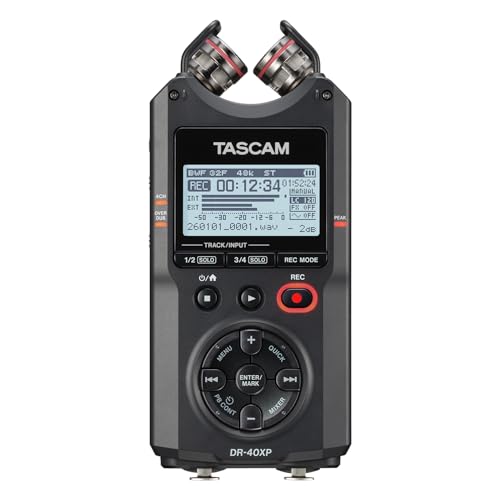
- 4-channel recording captures built-in and external inputs together.
- Adjustable A-B or X-Y mics for flexible stereo capture.
- USB-C audio interface supports computer or mobile workflows.
Best For: Interview and video creators needing flexible input options.
Wearable 32-Bit Float Interview Recorder

- 32-bit float recording avoids gain adjustments.
- Includes lavalier mic, windscreen, and clip.
- Up to 15 hours on two AAA batteries.
Best For: Journalists and creators needing a discreet wearable interview recorder.
Compact Secure Voice Recorder
192GB Voice Recorder for Meetings & Interviews

- WAV recording for clear interview audio
- Compact body with long battery life
- Password protection and built-in speaker
Best For: interviews, meetings, and lecture capture on the go
Clip-Free Interview Recorder

- 32-bit float recording helps prevent clipping
- X/Y stereo mics capture natural voice sound
- USB-C mic mode for calls and streaming
Best For: creators and interviewers needing cleaner audio with USB flexibility
Budget Voice Capture Recorder
8GB Interview Recorder with Playback

- Voice activation helps save space on long sessions
- Noise reduction and sensitive mic for spoken audio
- Simple controls with A-B repeat and password protection
Best For: budget interview, lecture, and meeting recording
Compact XLR Starter Recorder
Zoom H1 XLR for interviews and handheld use

- 32-bit/96kHz recording for clip-free audio
- Two locking XLR/TRS inputs for flexible setups
- OLED waveform display for easy level checking
Best For: Solo interviewers and creators needing a compact XLR recorder
Multi-Guest Interview Hub
Zoom PodTrak P4 for remote and panel sessions

- Four XLR inputs with phantom power
- Four headphone outs with individual control
- Mix-minus and USB support for remote interviews
Best For: Panels, podcasts, and remote interview setups
Built-In Mic Travel Recorder
Zoom H2 Essential for quick interview capture

- Three built-in mics with nine recording patterns
- 32-bit float recording helps prevent clipping
- 20-hour battery life supports long field days
Best For: Journalists and interviewers wanting a self-contained handheld recorder
Clip-Free 4-Track Interview Recorder – Zoom H4 Essential Handheld Recorder
If you want a practical choice among portable field recorders for interviews, the Zoom H4 Essential is built to handle spoken word, video audio, and other live recordings with less worry about distortion. Its 32-bit float recording and four-track design make it a flexible grab-and-go option when you need built-in mics, external inputs, and USB-C recording in one unit.
Best For: Interviewers, podcasters, and filmmakers who want a versatile handheld recorder with built-in mics and external input options.
Pros:
- 32-bit float recording helps avoid clipped or distorted takes.
- Built-in stereo mics plus two XLR/TRS inputs support multiple recording setups.
- Records to a phone, tablet, or computer over USB-C while also backing up to SD card.
- Spoken menu guidance can make navigation easier for guided use.
Cons:
- Best suited to users who want a fuller handheld recorder rather than the smallest possible body-pack.
- Microphone and input flexibility may be more than needed for very simple one-mic interviews.
The H4 Essential is a strong all-around field recorder when interview work may also turn into video, podcast, or location audio work. If you want one device that can adapt to different capture needs, this one is easy to justify.
Ready-to-Go Lavalier Interview Bundle – Zoom H1essential Bundle
For portable field recorders for interviews, the Zoom H1essential bundle is a straightforward starter kit with the recorder, lavalier mic, storage, windscreen, batteries, and extras included. Its 32-bit float recording means you do not have to spend time adjusting levels, which is especially useful when you need to move quickly from setup to conversation.
Best For: Journalists, podcasters, and creators who want an easy bundled recorder for sit-down or on-the-go interviews.
Pros:
- Bundle includes a lavalier mic, 32GB microSD card, windscreen, and batteries.
- 32-bit float recording removes the need to manually adjust levels.
- Onboard X/Y mics capture clean audio up to 120 dB SPL.
- Mono mode is useful for on-the-go interviews.
Cons:
- Designed as a compact Handy Recorder, so it is less feature-rich than larger multi-input models.
- Best results may depend on using the included accessories carefully in noisy environments.
This bundle stands out if you want a simple, interview-ready package with the essentials already in the box. It is a sensible pick for anyone who wants less setup friction and more time focused on the conversation.
Flexible 4-Channel Field Recorder – TASCAM DR-40XP Portable Handheld Recorder
The TASCAM DR-40XP is a practical option if you are comparing portable field recorders for interviews and want more routing flexibility. It combines adjustable stereo mics, two XLR/TRS inputs, 32-bit float support, and USB-C interface use, so it can handle interview capture, video audio, and other location work without feeling locked into one setup.
Best For: Interview and video creators who need a flexible handheld recorder with onboard mics, external inputs, and USB-C connectivity.
Pros:
- 4-channel recording can capture built-in mics and external inputs at the same time.
- Adjustable A-B or X-Y mics support flexible stereo recording.
- Ultra-low noise HDDA preamps help keep audio clean.
- USB-C 2-in/2-out interface supports computer or compatible mobile recording.
Cons:
- microSD card and batteries are not included.
- May be more recorder than needed if you only want a very basic interview setup.
Overall, the DR-40XP is a smart middle ground for creators who want more than a simple voice recorder. Its mix of onboard mics, external inputs, and interface features makes it easy to adapt as your workflow grows.
Wearable 32-Bit Float Interview Recorder – Zoom F2 Lavalier Recorder
If you want a compact choice among portable field recorders for interviews, the Zoom F2 is built for discreet, body-worn recording. It uses 32-bit float technology so you can capture clip-free audio without adjusting gain, and the included lavalier mic makes it ready for interviews, vlogs, and other on-camera work right away.
Best For: Journalists, filmmakers, and creators who want a small wearable recorder for discreet interview capture.
Pros:
- 32-bit float recording captures audio without manual gain adjustment.
- Includes an omnidirectional lavalier mic, windscreen, and lapel clip.
- Runs up to 15 hours on two AAA batteries.
- Supports microSD cards up to 512GB for long sessions.
Cons:
- Body-pack format is best for lavalier-style interviews rather than desk or handheld use.
- Not as flexible as larger recorders with built-in mics and multiple physical inputs.
The F2 is a focused tool for interviewers who value discretion, long battery life, and simple operation. If you mainly need a small recorder that can stay out of the way, it is an easy fit.
Compact Secure Voice Recorder – 192GB Voice Recorder for Meetings & Interviews
If you want portable field recorders for interviews that are simple to carry and easy to operate, this digital voice recorder is built around everyday capture. It records in WAV, includes voice activation, and adds password protection, making it a practical choice for interviews, meetings, and lecture notes when you need clear audio and straightforward file access.
Best For: Interviewers, students, and professionals who want a compact recorder with secure storage and easy playback.
Pros:
- Records in WAV format for clear audio capture during interviews and meetings.
- Compact, lightweight design that fits easily in a pocket or bag.
- Large LCD screen helps you check recording time, format, and battery level.
- Built-in speaker, A/B repeat, and password protection add useful playback and privacy features.
Cons:
- Built-in mic design is more basic than a dedicated field recorder with external mic support.
- Best suited to straightforward voice capture rather than advanced production workflows.
This is a practical pick if your priority is portable recording with secure file handling and long battery life. It covers the basics well for interviews, but it is more of a general-purpose voice recorder than a full-featured pro field unit.
Clip-Free Interview Recorder – Zoom H1 Essential for Voices
For portable field recorders for interviews, the Zoom H1 Essential stands out as a more polished option for capturing voices in stereo. Its 32-bit float recording is designed for clip-free audio, and the X/Y mics plus USB microphone mode make it useful when you need a recorder that can handle interviews, podcasts, and quick remote setups.
Best For: Creators and interviewers who want cleaner voice capture with flexible recording and USB use.
Pros:
- 32-bit float recording helps reduce clipping and protects interview audio.
- X/Y stereo microphones provide natural sound for conversations and ambient capture.
- USB-C microphone mode adds flexibility for livestreams, calls, and desktop recording.
- Compact enough for on-location use with camera, phone, or computer workflows.
Cons:
- Runs on AAA batteries rather than a built-in rechargeable battery.
- Only 2 tracks, so it is better for straightforward interviews than complex multi-mic setups.
This recorder is a strong fit when audio quality matters more than a basic voice memo device. It is especially appealing if you want a travel-friendly interview recorder that can also double as a USB mic.
Budget Voice Capture Recorder – 8GB Interview Recorder with Playback
If you need portable field recorders for interviews on a tighter budget, this compact digital recorder focuses on the essentials. It offers voice-activated recording, noise reduction, MP3/WAV support, and simple three-button control, which makes it easy to start capturing conversations, lectures, and meetings quickly.
Best For: Budget-conscious users who want a small recorder for interviews, class notes, and meetings.
Pros:
- Voice activation can reduce empty pauses and save storage during long sessions.
- Noise reduction and a higher-sensitivity microphone support clearer spoken audio.
- Simple three-button operation is easy to use when you need fast recording.
- Includes playback features like A-B repeat, variable speed, and password protection.
Cons:
- 8GB storage is limited compared with higher-capacity recorders.
- Basic feature set makes it less versatile than a more advanced field recorder.
This model is best when you want a straightforward recorder for spoken-word capture without paying for premium extras. It covers interview basics well, but the smaller storage and simpler hardware keep it in the entry-level category.
Compact XLR Starter Recorder – Zoom H1 XLR for interviews and handheld use
If you need portable field recorders for interviews, the Zoom H1 XLR is a simple, lightweight option that still gives you real input flexibility. Its 32-bit/96kHz recording, two locking XLR/TRS combo inputs, and OLED waveform display make it easy to capture clean dialogue without a complicated setup.
Best For: Solo interviewers, filmmakers, and podcasters who want a compact recorder with XLR inputs and straightforward monitoring.
Pros:
- Records in 32-bit/96kHz for clip-free, detailed audio
- Two locking XLR/TRS combo inputs handle mics and other sources
- OLED waveform display helps you monitor levels at a glance
- 3.5mm stereo input and headphone output add extra flexibility
Cons:
- Uses 2 AA batteries rather than a built-in rechargeable pack
- Only offers two inputs, so it is not built for larger interview panels
- Battery life is listed at around 10 hours, which may require spares for long days
This is a practical pick if you want a small recorder that still feels interview-ready. It balances portability with pro-friendly connection options, making it a good fit for run-and-gun recording.
Multi-Guest Interview Hub – Zoom PodTrak P4 for remote and panel sessions
For portable field recorders for interviews that need to handle multiple people, the Zoom PodTrak P4 is built around conversation. It gives you four XLR mic inputs, four headphone outputs with individual volume control, and built-in support for phone or USB remote interviews, which makes it well suited to roundtables and call-ins.
Best For: Podcasts, remote interviews, and small panel recordings where everyone needs their own mic and headphone feed.
Pros:
- Four XLR microphone inputs with phantom power
- Four headphone outputs with individual volume control
- Automatic mix-minus supports phone and remote interviews
- Multi-track recording and sound pads add production flexibility
Cons:
- Battery life is up to about 3.5 hours on two AA batteries
- Larger and heavier than a simple handheld recorder
- Designed more for podcast-style sessions than grab-and-go solo recording
If your interviews usually involve more than one voice, this recorder is much easier to manage than a basic two-channel unit. It trades some portability for better routing, monitoring, and remote-call support.
Built-In Mic Travel Recorder – Zoom H2 Essential for quick interview capture
The Zoom H2 Essential is a strong choice if you want portable field recorders for interviews without carrying external microphones. Its three built-in mics, nine selectable recording patterns, and 32-bit float recording make it easy to capture interviews and ambient sound with very little setup.
Best For: Journalists, field recordists, and interviewers who want a self-contained handheld recorder with flexible pickup patterns.
Pros:
- Three built-in mics with nine selectable recording patterns
- 32-bit float/96kHz recording helps avoid clipping
- USB mic mode plus SD recording allows a backup workflow
- 20-hour battery life is strong for long recording days
Cons:
- Built-in mics are less adaptable than using external XLR microphones
- Only has a 3.5mm headphone jack for monitoring
- No XLR inputs, so it is not ideal for modular mic setups
As a grab-and-go recorder, it is especially appealing when speed matters more than elaborate wiring. The built-in mic array and long battery life make it useful for quick interviews, backup audio, and lightweight field work.
How We Picked the Best Portable Field Recorders for Interviews
We prioritized Portable Field Recorders for Interviews that are easy to set up quickly, capture reliable speech, and offer the features interviewers actually use most: clear built-in mics, external mic support, headphone monitoring, and dependable storage. We also favored 32-bit float options where available, since they make clipping much less likely when levels change unexpectedly.
Quick Comparison
For solo reporting, compact handheld recorders are usually the simplest choice. For seated interviews with two or more speakers, a recorder with dual XLR/TRS inputs or multiple mic inputs can be a better fit. If you need maximum portability, a lavalier-style setup or a tiny body-pack recorder may be easier to hide and faster to deploy than a larger handheld unit.
Key Buying Factors for Portable Field Recorders for Interviews
Mic Inputs and Built-In Mics
Think about whether you’ll rely on onboard microphones, plug in a lavalier, or connect multiple mics. Built-in mics are convenient for quick interviews, while XLR/TRS inputs offer more flexibility and better expansion options.
Recording Safety and Format
32-bit float recording is a major advantage for interview work because it helps protect against sudden loud moments, uneven speaking volumes, and rushed level setting. If a recorder doesn’t offer it, manual gain control and headphone monitoring become more important.
Portability and Power
Smaller recorders are easier to carry and less intimidating for guests. Check battery type, runtime, and whether the recorder can run over USB-C or external power if you expect long sessions.
Monitoring and Workflow
A headphone jack is essential for hearing problems before they ruin an interview. USB audio interface mode, voice activation, file naming, and easy transfer to a computer or phone can also save time in fast-turnaround workflows.
Who Should Buy Which Portable Field Recorders for Interviews?
If you want the simplest all-in-one option, choose a compact handheld recorder with strong built-in mics. If your interviews are more serious or multi-person, a model with XLR/TRS inputs and monitoring will give you more control. For hidden or discreet setups, a lavalier recorder or body-pack recorder is often the best fit. And if you record remote interviews or podcast-style conversations, a multi-input desktop-style unit can make routing and backup much easier.
In short, the best Portable Field Recorders for Interviews are the ones that match your shooting style, not just your budget. Prioritize clean speech capture, simple operation, and a workflow you can repeat confidently in the field.