Floorstanding speakers can deliver impressive scale and bass, but the right amplifier helps them perform with greater control, headroom, and clarity. The best match depends on speaker sensitivity, room size, listening habits, and whether you need a simple stereo system or professional-style connectivity.
We selected 10 amplifier options spanning compact Class D designs, integrated stereo amplifiers, and rack-mount power amps. Use the guide below to compare power, connections, features, and system compatibility before choosing.
Best 10 Power Amplifiers for Floorstanding Speakers Picks for 2026
Flexible Compact Power

- Stereo or mono modes
- Up to 180W stereo or 235W mono
- Balanced input and op-amp rolling
Best For: Compact passive-speaker systems and flexible home audio setups
Reference-Class Rack Power

- 400W per channel into 4 ohms
- 800W bridged mono into 8 ohms
- Quiet convection cooling and clip indicators
Best For: Professional passive-speaker, studio, HiFi, and live-sound systems
Connected Stereo System
Yamaha A-S301BL Integrated Amplifier

- Coaxial and optical digital inputs
- Speaker A, B, and A+B selection
- Subwoofer output included
Best For: Connected home stereo systems with floorstanding speakers
High-Output DJ Amplification
Rockville D12 Class D Power Amplifier

- 1,400W RMS at 4 ohms
- Stereo, parallel, and bridged modes
- Crossover, limiter, LCD, and rack mounting
Best For: DJ, live-event, subwoofer, and high-output passive-speaker systems
Best Value

- 150 watts across two channels
- Quiet operation for near-field listening
- Adjustable 50–150 Hz low-pass crossover
Best For: Stereo systems needing clean, compact amplification
Best for High Output
Rockville RPA5 Professional Amplifier
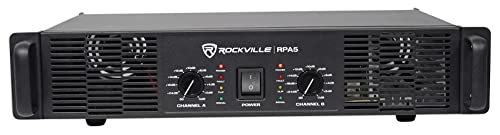
- 200 watts RMS per channel at 4 ohms
- Stereo, mono, and bridged operating modes
- Rack-mount design with extensive connectivity
Best For: DJ, professional, and high-output speaker systems
Best for Home Theater
Marantz MM7025 Stereo Power Amplifier

- 140 watts per channel at 8 ohms
- RCA and balanced XLR inputs
- Quiet cooling in a compact cabinet-friendly design
Best For: Home theater and dedicated two-channel systems
High-Output Choice

- Two-channel amplifier with 4500W peak power
- ATR Technology for punchy bass response
- Rack-mount design with flexible connections
Best For: DJs, PA systems, and high-output passive speakers
Efficient Pro Pick
Crown XLS1002 Class D Amplifier

- Lightweight Class D design under 11 pounds
- DSP, PureBand crossover, and Peakx Limiters
- 350W per channel at 4 ohms
Best For: Flexible home, studio, and professional audio systems
Reliable Stage Option
Crown XLi800 600W Bridged Amplifier

- 300W continuous per channel at 4 ohms
- Up to 600W bridged at 8 ohms
- Forced-air cooling and flexible I/O
Best For: DJ, PA, and conventional passive-speaker systems
Flexible Compact Power – Fosi Audio ZA3
For listeners seeking power amplifiers for floorstanding speakers without a large chassis, the Fosi Audio ZA3 offers a flexible two-channel design with stereo and mono modes. It delivers up to 180W in stereo or 235W in mono, and its 48V power supply supports a compact home audio setup.
Best For: Desktop, home theater, bookshelf, tower, and floorstanding passive speaker systems that benefit from flexible stereo or mono operation.
Pros:
- Switches between stereo and mono operation for different system needs.
- Balanced XLR/1/4-inch TRS input and 12V trigger-in support cleaner integration.
- TPA3255 Class-D amplification, low noise, and upgraded cooling support stable operation.
- Swappable op-amps allow sound-system customization.
Cons:
- Its 235W maximum output is specified for mono operation, not standard stereo use.
- Op-amp rolling requires compatible components and additional setup.
The ZA3 is a strong choice when compact size, balanced connectivity, and upgrade flexibility matter more than a traditional full-size receiver layout.
Reference-Class Rack Power – Behringer A800
The Behringer A800 is a rack-style option for buyers comparing power amplifiers for floorstanding speakers in larger home audio, studio, or live-sound systems. It provides two channels at 400W into 4 ohms and can deliver 800W in bridged mono into 8 ohms.
Best For: Passive floorstanding speakers, studio monitors, recording spaces, post-production, HiFi systems, and live sound installations.
Pros:
- High output for demanding passive speaker systems.
- Supports stereo operation or bridged mono configuration.
- Convection cooling provides quiet operation without cooling fans.
- Level meters and clip indicators help monitor performance.
Cons:
- The full-size chassis is less suitable for compact desktop setups.
- Its power output may be more than needed for smaller rooms or efficient speakers.
Choose the A800 when you need substantial, monitored amplification and quiet cooling in a conventional professional rack-format component.
Connected Stereo System – Yamaha A-S301BL Integrated Amplifier
The Yamaha A-S301BL takes a traditional integrated-amplifier approach for shoppers considering power amplifiers for floorstanding speakers. Along with speaker outputs, it includes digital coaxial and optical inputs, analog inputs, and a subwoofer output for a broader home audio system.
Best For: Home stereo systems using floorstanding speakers, digital sources, analog components, and an optional subwoofer.
Pros:
- Includes digital coaxial and optical inputs for compatible source devices.
- Offers multiple analog inputs for conventional audio components.
- Speaker A, B, and A+B selections support flexible speaker connections.
- Dedicated subwoofer output simplifies adding bass support.
Cons:
- The supplied notes do not specify a wattage rating.
- It is an integrated amplifier rather than a dedicated power amplifier.
The A-S301BL is a practical fit when source connectivity and speaker-management options are as important as driving a pair of floorstanding speakers.
High-Output DJ Amplification – Rockville D12 Class D Power Amplifier
The Rockville D12 is a rack-mount Class D option for buyers who need high-output power amplifiers for floorstanding speakers in demanding systems. It provides 700W RMS at 8 ohms and 1,400W RMS at 4 ohms, with stereo, parallel, and bridged modes.
Best For: DJ setups, live events, passive floorstanding speakers, subwoofers, and mixed systems requiring rack mounting and crossover control.
Pros:
- High stated output of 1,400W RMS at 4 ohms and 700W RMS at 8 ohms.
- Stereo, parallel, and bridged modes suit varied system configurations.
- Switchable bypass, 80Hz, and 160Hz crossover settings support full-range or subwoofer use.
- LCD monitoring, limiter, XLR/1/4-inch inputs, and SpeakON/binding-post outputs add practical control.
Cons:
- Its pro-audio feature set may be excessive for a simple home stereo.
- Cooling uses dual fans, so it may not be as quiet as a fanless design.
- The supplied warranty is one year.
The D12 makes the most sense when output headroom, rack-ready construction, and crossover flexibility take priority over a minimalist living-room amplifier.
Best Value – Dayton Audio APA150
The Dayton Audio APA150 is a practical choice for listeners seeking power amplifiers for floorstanding speakers in a compact, two-channel format. Its 150-watt output, Class A/B design, low-noise operation, and wide 10 Hz–40 kHz frequency response suit stereo listening and high-resolution playback.
Best For: Stereo systems and near-field setups that need clean, reliable amplification with adjustable low-pass control.
Pros:
- 150 watts of two-channel output with a Class A/B topology
- Virtually noise-free fan operation for near-field use
- Adjustable 50–150 Hz low-pass crossover
- Wide 10 Hz–40 kHz frequency response
Cons:
- Its 150-watt output may be less suitable for especially demanding systems
- Surface-mount construction may not suit buyers seeking rack-mount installation
The APA150 balances useful power, quiet operation, and straightforward control. It is a sensible option when you want a simple stereo amplifier rather than a feature-heavy professional installation unit.
Best for High Output – Rockville RPA5 Professional Amplifier
The Rockville RPA5 is built for buyers who want power amplifiers for floorstanding speakers with professional-style connectivity and flexible operating modes. It delivers 200 watts RMS per channel at 4 ohms, supports bridged operation, and includes a crossover for full-range speakers or subwoofer setups.
Best For: High-output stereo or DJ systems that need rack mounting, flexible inputs, and stereo/bridged configuration.
Pros:
- 200 watts RMS per channel at 4 ohms or 400 watts bridged at 8 ohms
- Stereo/mono switch and built-in crossover support varied system layouts
- Combo XLR/1/4-inch and RCA inputs with Speakon, banana, and XLR outputs
- 2U rack-mountable design with cooling fans and protection circuitry
Cons:
- Dual cooling fans may be less appropriate for very quiet listening rooms
- The professional rack-mount design may be oversized for a simple home stereo
The RPA5 stands out when system flexibility and output capacity matter more than a minimalist home-audio format. Its protection features, crossover, and broad connector selection make it adaptable to more demanding installations.
Best for Home Theater – Marantz MM7025 Stereo Power Amplifier
The Marantz MM7025 is a polished two-channel option for shoppers comparing power amplifiers for floorstanding speakers in a home theater or dedicated stereo system. It provides 140 watts per channel at 8 ohms, substantial current capability, and both single-ended RCA and balanced XLR inputs.
Best For: Home theater systems, dedicated two-channel listening, or two-zone setups that prioritize quiet cooling and flexible placement.
Pros:
- 140 watts per channel at 8 ohms
- RCA and balanced XLR inputs accommodate different source components
- Can serve a dedicated two-channel setup or two zones
- Quiet cooling fan and a depth of less than 14 inches help with cabinet placement
Cons:
- It offers less rated output than the Rockville RPA5
- The two-channel design is not intended to power a complete multichannel theater by itself
The MM7025 is a strong fit for a refined home-audio installation where clean power, quiet operation, and compact shelf placement are priorities. Its RCA/XLR input choices also make it easier to integrate with varied preamp and theater components.
High-Output Choice – MUSYSIC SYS-4500
The MUSYSIC SYS-4500 is a two-channel rack-mount option for shoppers comparing power amplifiers for floorstanding speakers and other passive-speaker setups. Its substantial peak-power rating, wide stated frequency response, and multiple connection options make it suited to demanding home, DJ, PA, and live-audio environments.
Best For: DJs, musicians, PA systems, and listeners who need a high-output amplifier for passive speakers.
Pros:
- Two-channel design with up to 4500W peak power.
- ATR Technology is designed for fast, punchy bass transients.
- Offers stereo XLR and 1/4-inch inputs plus multiple input/output configurations.
- Rack-mount aluminum chassis with a 10Hz–50kHz stated frequency response and less than 0.1% THD.
Cons:
- The 18-pound rack-mount design is more substantial than lightweight Class D alternatives.
- Its professional PA-oriented feature set may be more than needed for a simple home stereo system.
- Peak power is emphasized, so buyers should verify their speakers’ power and impedance requirements before connecting.
The SYS-4500 stands out when maximum output and flexible connectivity matter more than compact size. It is a strong fit for larger passive-speaker systems, provided the amplifier’s power capabilities are matched carefully to the speakers.
Efficient Pro Pick – Crown XLS1002 Class D Amplifier
The Crown XLS1002 is a lightweight two-channel Class D amplifier for shoppers seeking power amplifiers for floorstanding speakers in a home, studio, or professional setup. Its DriveCore design, DSP features, selectable sensitivity, and broad range of input options prioritize efficient operation and system flexibility.
Best For: Users who want a lightweight professional amplifier with DSP, crossover control, and multiple input options.
Pros:
- Class D DriveCore design weighs less than 11 pounds.
- Provides 350W per channel at 4 ohms and up to 1100W bridged at 4 ohms.
- Includes Peakx Limiters, PureBand crossover, DSP, and forced-air cooling.
- Accepts balanced XLR, 1/4-inch TRS, and RCA inputs.
Cons:
- Its professional rack-mount format may require additional equipment in a basic living-room system.
- Fan cooling and DSP controls may be unnecessary for buyers seeking a simple power amplifier.
- Actual output depends on speaker impedance and whether the amplifier is used in stereo or bridged mode.
The XLS1002 is a practical choice when low weight, efficiency, and speaker-protection features are priorities. Its output flexibility makes it easier to integrate into different systems, but matching the selected mode to the speakers remains essential.
Reliable Stage Option – Crown XLi800 600W Bridged Amplifier
Crown XLi800 Two-channel, 600-Watt Bridged 8Ω Power Amplifier. Professional DJ, PA, Stage Amp. Black
Check Price On AmazonThe Crown XLi800 is a straightforward two-channel amplifier for shoppers comparing power amplifiers for floorstanding speakers, DJ systems, and PA applications. It provides 300W per channel at 4 ohms, can deliver up to 600W when bridged at 8 ohms, and uses forced-air cooling for sustained operation.
Best For: DJs, small PA systems, and passive-speaker users who prefer a conventional two-channel rack-style amplifier.
Pros:
- Delivers 300W continuous per channel at 4 ohms.
- Supports bridged operation up to 600W at 8 ohms.
- Selectable input voltage and flexible I/O support installation versatility.
- Forced-air cooling is intended to support reliable operation during use.
Cons:
- At 25.1 pounds, it is considerably heavier than the Crown XLS1002.
- The supplied notes provide fewer signal-processing features than the XLS1002.
- Its 120V specification may require attention to local power compatibility.
The XLi800 favors dependable, uncomplicated amplification over extensive onboard processing. It makes sense for users who need solid two-channel or bridged power for passive speakers and do not require a lightweight Class D chassis.
How We Picked the Best Power Amplifiers for Floorstanding Speakers
We focused on amplifiers that can realistically serve demanding home stereo and home theater setups, while also including flexible models for desktop systems, installations, and larger listening spaces. Our comparison considers published power ratings, channel configuration, amplifier class, input options, size, controls, and practical system-matching concerns.
Power ratings are not directly comparable across every model because manufacturers may specify different impedance loads, distortion levels, and measurement standards. Treat wattage as a starting point rather than the sole measure of performance.
Quick Comparison
| Best For | Look For | Typical Advantage |
|---|---|---|
| Two-channel home listening | Stereo output and clean RCA or balanced inputs | Simple, focused music playback |
| Large rooms or inefficient speakers | Higher continuous power and strong headroom | Better dynamics at louder levels |
| Compact systems | Small Class D chassis | Easy placement and low heat |
| Custom installations | Rack mounting, XLR inputs, and dependable cooling | Flexible system integration |
| Home theater expansion | Separate power amp with appropriate preamp outputs | More output without replacing the processor |
Key Buying Factors for Power Amplifiers for Floorstanding Speakers
Power, Impedance, and Headroom
Check your speakers’ nominal and minimum impedance before buying. An amplifier should be stable at the load your speakers present, especially if you listen loudly or use a large room. Extra headroom helps reduce clipping during musical peaks, but excessive power is not automatically better if the speakers cannot handle it.
Inputs and System Compatibility
Confirm whether you need RCA, XLR, or both. A power amplifier requires a compatible preamp, receiver, streamer, or processor with volume control. Integrated amplifiers are more convenient because they combine amplification with source selection and, often, a built-in volume control.
Cooling, Noise, and Placement
Class D amplifiers are often compact and efficient, while larger professional models may use fans and need ventilation. Consider fan noise in a quiet living room, available rack space, and clearance around the chassis before choosing a high-output unit.
Features That Matter
Protection circuits, level controls, bridge capability, DSP, limiters, and trigger connections can be valuable in specialized systems. Avoid paying for professional features you will not use, but prioritize reliable protection and straightforward controls for everyday listening.
Who Should Buy Which Power Amplifiers for Floorstanding Speakers?
Choose a compact stereo amplifier if you want an unobtrusive upgrade for a smaller room or efficient floorstanding speakers. An integrated stereo model is the better choice when you need a complete, easy-to-operate music system with source inputs and volume control. For larger rooms, low-sensitivity speakers, or sustained high-volume listening, consider a higher-powered rack-mount amplifier with suitable cooling and headroom.
Professional Class D models are a strong fit for installations, home theaters, and users who value efficient operation, DSP, or flexible connectivity. If you are unsure, match the amplifier to the speaker manufacturer’s recommended power range, confirm the impedance requirements, and prioritize clean gain structure over the largest advertised wattage.