The best power amplifier depends on more than its headline wattage. Speaker impedance, channel count, portability, connectivity, and cooling all affect whether an amp performs reliably in your system.
This roundup compares 10 power amplifiers across professional PA, DJ, home audio, desktop, and installation applications, including compact Class-D models and rack-mount designs.
Best 10 Power Amplifiers Picks for 2026
High-Output Workhorse

- 2 x 2,000W at 2 ohms
- 4,000W bridged at 4 ohms
- Limiters and monitoring LEDs
Best For: High-output DJ, PA, and stage systems
Portable Pro Flexibility
Rockville D12 Class D Amplifier

- 1,400W RMS at 4 ohms
- Stereo, parallel, and bridge modes
- LCD monitoring and selectable crossover
Best For: Portable DJ and live-event rack systems
Compact Hi-Fi Choice
AIYIMA A07 Premium Stereo Amplifier

- Compact Class D stereo design
- Up to 300W x 2 with upgraded supply
- AUX pre-out and swappable op-amp
Best For: Desktop and bookshelf-speaker audio systems
Trusted Stage Essential
Crown XLi800 Two-Channel Amplifier

- 300W per channel at 4 ohms
- 600W bridged at 8 ohms
- Forced-air cooling and flexible I/O
Best For: Small professional DJ, PA, and stage systems
High-Output Install Pick

- Four channels with up to 4 x 1150W at 4Ω
- Stereo, parallel, and bridge modes
- 1U chassis with LPF and protection features
Best For: Multi-channel PA, DJ, and conference installations
Quiet Reference Choice

- 2 x 400W at 4Ω in stereo operation
- 800W bridged mono output at 8Ω
- Fanless convection cooling with clip indicators
Best For: Studios, passive speakers, HiFi, and live sound
Compact Home Audio Pick

- Stereo mode up to 180W and mono mode up to 235W
- Balanced XLR/TRS input and 12V trigger
- Compact design with op-amp rolling support
Best For: Desktop, bookshelf, and home theater audio
Professional Powerhouse

- 1400W RMS and 5000W peak output
- Bridgeable stereo, parallel, and bridged modes
- Crossover, limiter, LCD, and rack-mount chassis
Best For: Large PA systems, DJs, and live events
Compact Wireless Value
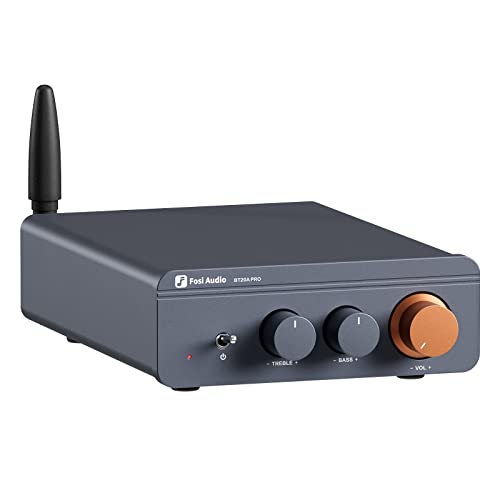
- Bluetooth 5.0 with pairing memory
- Up to 300W x 2 for passive speakers
- Bass, treble, and replaceable op-amp options
Best For: Home, desktop, and outdoor stereo listening
Touring Workhorse
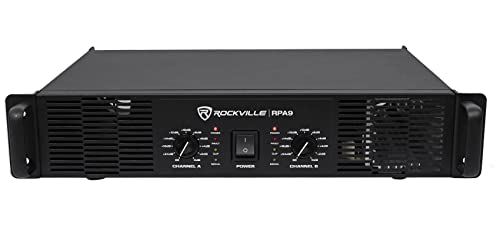
- 800W RMS and 3000W peak output
- XLR, 1/4-inch, RCA, SpeakON, and banana connections
- Dual fans with stereo and bridged modes
Best For: DJs, mobile entertainers, and live venues
High-Output Workhorse – Behringer EUROPOWER EP4000
The Behringer EUROPOWER EP4000 is a rack-style choice for buyers who need substantial output from professional power amplifiers. It delivers up to 2,000 watts per channel into 2 ohms and supports 4,000 watts in bridged mode at 4 ohms, while switchable limiters and monitoring LEDs add practical protection and visibility.
Best For: DJ, PA, and stage systems requiring high output and flexible impedance options.
Pros:
- High output: 2 x 2,000 watts at 2 ohms and 2 x 1,400 watts at 4 ohms
- Bridged mode supports up to 4,000 watts at 4 ohms
- Switchable limiters help provide overload protection
- Detented gain controls and status LEDs support precise setup and monitoring
Cons:
- At 38.4 pounds, it is substantially heavier than compact Class D alternatives
- The 15.94 x 19.02 x 3.54-inch chassis requires suitable rack or installation space
The EP4000 is a strong fit when maximum output and configuration flexibility matter more than portability. Its rack-friendly professional design and monitoring features make it practical for demanding installations and live sound rigs.
Portable Pro Flexibility – Rockville D12 Class D Amplifier
The Rockville D12 is a lightweight two-channel option among power amplifiers, combining rack mounting with stereo, parallel, and bridged operation. Its LCD monitoring, selectable crossover, limiter, and support for passive speakers or subwoofers make it adaptable to different sound-system layouts.
Best For: DJs, live-event setups, and compact rack systems needing flexible speaker and subwoofer control.
Pros:
- Provides 1,400 watts RMS at 4 ohms and 700 watts RMS at 8 ohms
- Supports stereo, parallel, and bridge modes with 4- and 8-ohm stability
- LCD shows channel volume in dB and operating temperature
- Lightweight 9.7-pound, 1.5U rack-mountable chassis with quiet cooling fans
Cons:
- Its peak rating is much higher than its listed RMS output, so system matching should use RMS figures
- The one-year warranty is shorter than some competing options may offer
The D12 stands out for combining useful signal-routing features with a portable rack format. The crossover and display are particularly helpful when one amplifier must serve full-range speakers, subwoofers, or changing event configurations.
Compact Hi-Fi Choice – AIYIMA A07 Premium Stereo Amplifier
The AIYIMA A07 Premium is a compact desktop amplifier for home audio buyers who want capable power amplifiers without a full-size rack chassis. Its TPA3255 Class D design supports passive speakers rated from 2 to 8 ohms, while the AUX pre-out can feed active speakers or a powered subwoofer.
Best For: Desktop and bookshelf-speaker systems where compact size, upgradeability, and a pre-out are priorities.
Pros:
- Compact 6.06 x 3.94 x 1.57-inch metal housing
- Up to 300 watts x 2 output with an appropriate upgraded power supply
- 3.5mm AUX pre-out supports active devices and powered subwoofers
- Swappable NE5532 op-amps allow component experimentation
Cons:
- The included 32V 5A adapter does not provide the maximum advertised 300W x 2 output
- It requires a separate power supply and is not Wi-Fi enabled
- It is designed for passive home speakers rather than professional rack systems
The A07 Premium is best viewed as a flexible mini integrated amplifier rather than a conventional venue amp. Its small footprint, pre-out, and replaceable op-amp design make it appealing for customized desktop or bookshelf audio systems.
Trusted Stage Essential – Crown XLi800 Two-Channel Amplifier
Crown XLi800 Two-channel, 600-Watt Bridged 8Ω Power Amplifier. Professional DJ, PA, Stage Amp. Black
Check Price On AmazonThe Crown XLi800 is a straightforward two-channel option for buyers comparing professional power amplifiers for DJ, PA, and stage use. It provides 300 watts per channel at 4 ohms and can deliver 600 watts bridged at 8 ohms, with forced-air cooling and flexible I/O for practical system integration.
Best For: Small-to-medium professional audio systems that need a conventional two-channel rack-style amplifier.
Pros:
- Delivers 300 watts continuously per channel at 4 ohms
- Supports 600 watts bridged at 8 ohms
- Selectable input voltage supports setup flexibility
- Forced-air cooling and flexible I/O suit installed or live systems
Cons:
- At 25.1 pounds, it is less portable than lightweight Class D designs
- Its 600-watt maximum output is lower than the higher-powered amplifiers in this roundup
- It is a 12.4 x 19 x 3.5-inch full-size unit, so it needs suitable installation space
The XLi800 favors familiar professional operation and manageable output over extreme power density. It is a sensible choice for users who want Crown branding, forced-air cooling, and a conventional two-channel format for PA or stage systems.
High-Output Install Pick – Sound Town UPDM-Q3
For demanding PA, DJ, and conference installations, the Sound Town UPDM-Q3 is a power amplifier built around high output in a compact 1U rack chassis. Its four channels, flexible routing modes, integrated low-pass filter, and built-in protection make it practical for multi-speaker and subwoofer setups.
Best For: Multi-channel PA systems, DJ rigs, conference installations, and rack-mounted subwoofer applications.
Pros:
- Delivers 4 x 1150W RMS at 4Ω or 4 x 600W RMS at 8Ω.
- Offers stereo, parallel, and bridge signal-routing options.
- Includes an LPF, limiter, overload protection, overheating protection, and short-circuit protection.
- Fits a space-saving 1U metal rack-mount chassis.
Cons:
- Its very high output may be more than needed for small home or desktop systems.
- The four-channel installation-oriented design may be less suitable for simple two-channel setups.
The UPDM-Q3 stands out when system expansion and substantial output matter more than minimal size or home-audio simplicity. Confirm your speakers’ impedance and power requirements before pairing them with this amplifier.
Quiet Reference Choice – Behringer A800
The Behringer A800 is a two-channel power amplifier for recording studios, post-production, live sound, and HiFi systems. Its reference-class design combines 2 x 400W output at 4Ω with convection cooling, level meters, and clip indicators for straightforward monitoring.
Best For: Studio monitors, passive speakers, post-production systems, live sound, and HiFi applications.
Pros:
- Provides 2 x 400W at 4Ω and up to 800W in bridged mono at 8Ω.
- Ultra-low impedance design can drive a wide range of passive speakers.
- Convection cooling supports quiet operation without cooling fans.
- Level meters and clip indicators aid performance monitoring.
Cons:
- It has two channels rather than the four channels offered by some installation amplifiers.
- Its 19-inch-wide chassis is less compact than a mini desktop amplifier.
The A800 is a sensible choice for buyers who want substantial two-channel power with quiet, fanless operation. Its bridged-mono capability also gives the system flexibility when a single higher-power output is preferred.
Compact Home Audio Pick – Fosi Audio ZA3
The Fosi Audio ZA3 is a compact two-channel power amplifier for desktop, bookshelf, home theater, and passive floorstanding speaker systems. Its selectable stereo or mono operation, balanced input, 12V trigger, and included 48V power supply make it a flexible option for smaller home audio setups.
Best For: Desktop audio, bookshelf speakers, home theater, passive tower speakers, and subwoofer-focused systems.
Pros:
- Switches between stereo output up to 180W and mono output up to 235W.
- Balanced combo input accepts XLR and 1/4-inch TRS connections.
- Includes a 12V trigger for synchronized system power control.
- Supports op-amp rolling and includes a 48V, 5A power adapter.
Cons:
- Its 235W maximum output is substantially lower than large PA power amplifiers.
- Op-amp rolling requires compatible components and user experimentation.
- Mono expansion with two units adds cost and system complexity.
The ZA3 is best suited to listeners who want power-amplifier flexibility in a small home-audio component. Stereo and mono modes allow it to adapt as the system changes, while balanced connectivity can help minimize interference in compatible setups.
Professional Powerhouse – Rockville RPA12
The Rockville RPA12 is a high-output choice among power amplifiers for concerts, clubs, events, and other demanding PA setups. Its rack-mount design, bridgeable channels, crossover options, and speaker-protection limiter make it suited to flexible professional systems.
Best For: Large PA systems, DJs, live events, and installations requiring substantial output and flexible operating modes.
Pros:
- 1400W RMS and 5000W peak output for robust system power.
- Stereo, parallel, and bridged modes support varied configurations.
- Built-in crossover and limiter add setup flexibility and speaker protection.
- Steel 2U chassis, cooling fans, LCD, and professional inputs and outputs.
Cons:
- Its 26-pound rack-mount design is less convenient for compact or portable setups.
- The high-power feature set may be more than small home systems require.
Choose the RPA12 when output headroom and installation flexibility matter most. It is a practical fit for users building a serious professional audio rack rather than a minimalist stereo system.
Compact Wireless Value – Fosi Audio BT20A Pro
The Fosi Audio BT20A Pro is a compact power amplifier for passive speakers, combining Bluetooth 5.0 convenience with up to 300 watts per channel. Bass and treble controls, efficient Class D operation, and replaceable op-amps make it a flexible option for home, desktop, and outdoor stereo listening.
Best For: Home audio, desktop systems, and outdoor stereo setups using passive speakers and wireless playback.
Pros:
- Bluetooth 5.0 provides convenient wireless connectivity and pairing memory.
- Up to 300W x 2 output supports a range of passive-speaker systems.
- Bass and treble controls allow straightforward sound adjustment.
- Replaceable op-amps offer an option for experimentation with different components.
Cons:
- It is designed for passive speakers and does not provide the rack-oriented connections of a professional PA amplifier.
- Its compact format may not suit large venue applications requiring extensive system connectivity.
The BT20A Pro is a strong fit when convenience and a small footprint are priorities. Bluetooth, tone controls, and upgradeable op-amps give it more flexibility than a basic mini amplifier.
Touring Workhorse – Rockville RPA9
The Rockville RPA9 is a rack-mount power amplifier built for DJs, live events, and professional audio systems. With 800W RMS output, stereo and bridged modes, broad input compatibility, and dual-fan cooling, it is designed for sustained use with demanding speaker setups.
Best For: DJs, mobile entertainers, live venues, and professional racks needing strong output and multiple connection options.
Pros:
- 800W RMS and 3000W peak output provide substantial power for larger systems.
- XLR, 1/4-inch, and RCA inputs accommodate varied source equipment.
- SpeakON and banana outputs support common professional speaker connections.
- Dual fans, heat-sink cooling, LED indicators, and front controls support extended operation.
Cons:
- The 2U rack-mount format is less suitable for small, casual listening spaces.
- It lacks the Bluetooth-focused convenience of a compact home amplifier.
The RPA9 makes sense for buyers who need a rugged, adaptable amplifier for live sound or DJ work. Its connectivity and cooling features are especially useful when reliability during longer sessions is a priority.
How We Picked the Best Power Amplifiers
We focused on the specifications that matter in real systems: rated output, supported speaker loads, channel configuration, amplifier class, physical design, connectivity, and intended use. The selection includes stereo, bridged, multi-channel, rack-mount, and compact desktop options so you can match an amplifier to your speakers rather than choosing by wattage alone.
We also considered practical features such as built-in filters, Bluetooth or auxiliary inputs, balanced connections, cooling, rack compatibility, and whether an amp is better suited to home listening, mobile DJ work, PA reinforcement, or permanent installation.
Quick Comparison
| Best For | What to Look For | Recommended Type |
|---|---|---|
| Home stereo or desktop audio | Compact size, low noise, simple inputs | Mini Class-D amplifier |
| Subwoofer systems | High current, mono or bridged operation, suitable filters | Power amp with subwoofer flexibility |
| DJ and mobile PA | Rack mounting, rugged cooling, dependable output | Two-channel professional amp |
| Large PA systems | Higher output, speaker protection, load compatibility | Professional rack-mount amplifier |
| Installed audio | Multiple channels, compact rack space, filtering | Multi-channel Class-D amplifier |
Key Buying Factors for Power Amplifiers
Power and Speaker Impedance
Match the amplifier’s output to the speaker’s continuous power rating and impedance. A model rated at 4 ohms may deliver substantially different power than it does at 8 ohms. Avoid assuming that a larger peak-watt number automatically means better performance; stable operation and clean output are more important.
Channels and Bridging
Two channels are useful for stereo speakers or a pair of PA cabinets. Bridging can increase output for a single speaker or subwoofer, but it usually requires a higher minimum impedance. Verify the manual’s load requirements before using bridged mode.
Inputs, Outputs, and System Compatibility
Professional systems often benefit from balanced XLR or TRS connections, while home setups may need RCA, 3.5mm, Bluetooth, or preamp outputs. Check connector types, gain controls, and whether the amplifier includes a low-pass filter or other crossover functions.
Cooling, Noise, and Installation
Fans and rack hardware are valuable for demanding PA use but may be audible in a quiet listening room. Compact Class-D designs generally save space and weight, while larger rack amps may offer more robust thermal management for sustained high output.
Who Should Buy Which Power Amplifiers?
Choose a compact Class-D model for desktop systems, bookshelf speakers, outdoor listening, or a simple home setup. Models with Bluetooth are convenient when wireless playback matters, while balanced or pre-out connections are better for more flexible component systems.
For DJs, live performers, and PA owners, a rack-mount two-channel amplifier is the practical choice. Prioritize dependable cooling, professional connectors, protection circuitry, and output ratings that match your cabinets. For venues or conference installations needing several zones, a four-channel amplifier can reduce rack space and simplify wiring.
Finally, buyers building a subwoofer or home-theater system should look for suitable bridging, mono operation, filtering, and enough headroom for the subwoofer’s impedance. Whichever model you choose, set gain conservatively, use correctly rated speaker cables, and confirm the load before powering up.