The best hard drive duplicators for Windows make it easier to clone, upgrade, back up, or access drives without installing them inside a computer. The right model depends on your drive type, connection speed, capacity needs, and whether you want software-free offline copying.
We compared 10 options ranging from straightforward dual-bay SATA docks to versatile NVMe, multi-bay, and standalone duplicators. Use the guide below to narrow the list by compatibility, workflow, and budget.
Best 10 Hard Drive Duplicators for Windows Picks for 2026
Best Value Dual-Bay Dock

- Supports 2.5-inch and 3.5-inch SATA drives
- Offline cloning with no drivers required
- USB 3.0 and up to 10TB drive support
Best For: Simple home drive cloning and SATA access
Best for IT Workflows
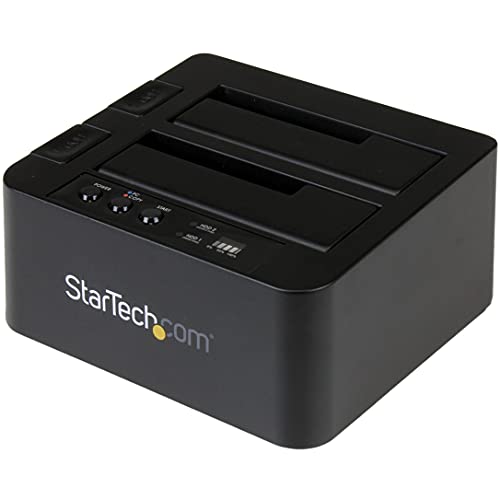
- Sector-by-sector standalone cloning
- Supports 4Kn, TRIM, and SATA drives of any capacity
- USB 3.2 Gen 2 with USB-C and USB-A cables
Best For: Professional drive duplication and recovery tasks
Best High-Capacity Option

- Supports up to 44TB across two bays
- Offline cloning with a dedicated clone button
- Works with Windows, Mac, Linux, and more
Best For: Large-capacity SATA drive cloning and access
Best Type-C Connectivity

- Includes USB-C-to-C and USB-C-to-A cables
- Offline cloning without a computer
- Supports Windows, Mac OS, and Linux
Best For: USB-C users needing flexible SATA drive access
Best SATA Hub Cloner
MAIWO Dual-Bay Hard Drive Duplicator

- Offline cloning without a computer or drivers
- Supports 2.5- and 3.5-inch SATA HDDs and SSDs
- Three USB 3.0 hub ports with up to 5Gbps transfer
Best For: Windows users working with SATA drives and USB peripherals
Best NVMe Versatility
FIDECO 3-Bay SSD and SATA Cloner

- Supports NVMe and 2.5-/3.5-inch SATA drives
- Offline cloning between supported drive types
- 10Gbps USB 3.2 Gen 2 and foldable cooling fan
Best For: Mixed NVMe and SATA drive workflows
Best Simple SATA Clone Dock
WAVLINK Dual-Bay Hard Drive Dock

- Offline cloning with a dedicated five-second-start button
- Supports 2.5- and 3.5-inch SATA drives up to 2x20TB
- Tool-free Windows operation with USB 3.0 and UASP
Best For: Straightforward SATA backups and drive duplication
Best Overall Flexibility
ICY BOX Triple-Bay NVMe/SATA Cloner

- One-touch offline cloning
- Supports M.2 NVMe and 2.5/3.5-inch SATA drives
- USB 3.2 Gen 2 up to 10 Gbps
Best For: Mixed-drive Windows setups and frequent drive access
Best for IT-Style Drive Management
StarTech.com 4-Bay Duplicator and Eraser

- Standalone 1:3 SATA cloning
- Quick and Secure Erase modes
- Four bays with LCD controls
Best For: IT workflows involving duplication and drive sanitization
Best Compact Alternative
Rosewill Triple-Bay NVMe/SATA Cloner

- Offline cloning without a host computer
- Three bays for NVMe and SATA drives
- Compact tool-free design with 10 Gbps USB
Best For: Portable Windows cloning and drive-access tasks
Best Value Dual-Bay Dock – Sabrent EC-HD2B
For shoppers comparing hard drive duplicators for windows, the Sabrent EC-HD2B is a straightforward dual-bay dock for cloning or accessing 2.5-inch and 3.5-inch SATA hard drives and SSDs. It supports offline cloning without drivers and connects to a computer over USB 3.0.
Best For: Home users who want an easy SATA drive dock with offline cloning and support for drives up to 10TB.
Pros:
- Supports both 2.5-inch and 3.5-inch SATA HDDs and SSDs.
- Offline cloning requires no computer or drivers.
- Supports up to 10TB drives and USB 3.0 transfer speeds up to 5Gbps.
- Includes a power supply, USB 3.0 cable, and one-year warranty, extendable to two years with registration.
Cons:
- Offline cloning speeds are listed at up to 60Mbps.
- Cloning is limited to compatible SATA drives.
The EC-HD2B emphasizes simple operation and broad SATA compatibility rather than advanced duplication features. It is a practical choice for routine drive upgrades, backups, and disk access on a Windows setup.
Best for IT Workflows – StarTech SDOCK2U313R
The StarTech SDOCK2U313R is a professional-oriented option among hard drive duplicators for windows, combining standalone cloning with a dual-bay SATA docking station. It performs sector-by-sector copies without a computer, supports 4Kn and TRIM, and can also connect drives over USB 3.2 Gen 2.
Best For: IT professionals and advanced users who need sector-by-sector duplication and broad 2.5-inch/3.5-inch SATA compatibility.
Pros:
- Standalone cloning works without a computer or operating system.
- Sector-by-sector copying supports any file format and includes empty sectors.
- Supports SATA I/II/III drives of any capacity, plus 4Kn and TRIM.
- Includes USB-C and USB-A cables, a universal power adapter, and a two-year warranty.
Cons:
- The target disk must be equal to or larger than the source disk.
- Sector-by-sector copying duplicates empty sectors, which may take longer than file-level copying.
- An IDE adapter is sold separately.
With its tool-less design, drive doors, eject buttons, and status LEDs, this StarTech dock is built for repeatable technical work. Its 28GB/min listed duplication rate and OS-independent operation make it the most feature-focused choice in this group.
Best High-Capacity Option – ORICO DD28U3-C
The ORICO DD28U3-C is a high-capacity dual-bay choice for hard drive duplicators for windows, supporting up to 44TB across two drives. Its offline clone button allows direct duplication without a computer, while USB 3.0 provides access for backups, disk imaging, and file transfers.
Best For: Users working with large SATA drive collections who want a compact dock that also supports PCs, laptops, routers, TVs, and game consoles.
Pros:
- Supports up to 44TB total capacity with two drives up to 22TB each.
- Works with 2.5-inch and 3.5-inch SATA I/II/III HDDs and SSDs.
- Offline cloning starts with a dedicated button and does not require a computer.
- Includes UASP, TRIM, tool-less drive access, and automatic sleep after 10 minutes of inactivity.
Cons:
- The target disk must be larger than the source disk.
- The dock will not power on without a hard drive inserted.
- It uses USB 3.0 rather than a newer USB 3.x generation interface.
The DD28U3-C stands out for its stated capacity and broad device compatibility. Its dust cover, anti-skid pad, and LED status indicators add practical convenience for occasional cloning and everyday drive access.
Best Type-C Connectivity – FIDECO YPZ220C
The FIDECO YPZ220C is a flexible option for hard drive duplicators for windows, pairing offline cloning with USB-C connectivity. It supports 2.5-inch and 3.5-inch SATA drives, includes both USB-C-to-USB-C and USB-C-to-USB-A cables, and works with Windows, macOS, and Linux.
Best For: Users who want a dual-bay SATA dock with convenient USB-C connection options for modern laptops and desktops.
Pros:
- Includes both USB-C-to-USB-C and USB-C-to-USB-A cables.
- Supports USB 3.2 Gen 1 transfer speeds up to 5Gbps and UASP.
- Offline cloning works without a computer when the target drive is equal to or larger than the source.
- Compatible with Windows, Mac OS, and Linux with no driver installation required.
Cons:
- Supports only 2.5-inch and 3.5-inch SATA HDDs and SSDs.
- The target drive must be equal to or larger than the source drive.
- Storage support is listed at up to 20TB.
The YPZ220C is a practical fit for mixed-device households and USB-C-equipped computers. Its included cables reduce adapter shopping, while the dual-bay layout keeps cloning and drive access straightforward.
Best SATA Hub Cloner – MAIWO Dual-Bay Hard Drive Duplicator
If you need hard drive duplicators for Windows that also function as everyday storage docks, the MAIWO dual-bay model is a practical SATA option. It supports 2.5- and 3.5-inch SATA HDDs and SSDs, offers offline cloning without a computer, and adds three USB 3.0 hub ports.
Best For: Windows users cloning or accessing multiple SATA drives while keeping USB peripherals connected.
Pros:
- Supports both 2.5- and 3.5-inch SATA HDDs and SSDs, with up to 24TB per bay.
- Offline cloning requires no computer, drivers, or tools.
- USB 3.0 provides up to 5Gbps transfer bandwidth and includes three Type-A hub ports.
- Includes a 12V/3A power adapter and clone-progress LED indicators.
Cons:
- Designed for SATA drives rather than M.2 NVMe SSDs.
- The listed total capacity and supported-device details vary across the supplied specifications, so verify requirements before purchase.
The MAIWO is a flexible choice for SATA-based backups, drive recovery, and file transfers. Its offline cloning and built-in USB hub make it especially useful at a Windows workstation, though users needing NVMe support should consider a different dock.
Best NVMe Versatility – FIDECO 3-Bay SSD and SATA Cloner
For Windows users seeking hard drive duplicators for Windows with broader drive support, the FIDECO 3-bay dock handles M.2 NVMe SSDs alongside 2.5- and 3.5-inch SATA drives. It supports offline cloning, USB 3.2 Gen 2 transfers, and active cooling for demanding workloads.
Best For: Professionals and enthusiasts who need to clone or access NVMe and SATA storage from one dock.
Pros:
- Supports M.2 PCIe NVMe SSDs with M-Key or M+B Key plus 2.5- and 3.5-inch SATA drives.
- Can access two NVMe SSDs and one SATA drive simultaneously.
- Offers offline NVMe-to-NVMe and SATA-to-NVMe cloning without software.
- USB 3.2 Gen 2 reaches up to 10Gbps, and the foldable fan helps manage heat.
Cons:
- Offline cloning requires the target drive to be equal to or larger than the source.
- New drives may need initialization in Windows Disk Management before recognition.
- Cloning is limited to the supported NVMe-to-NVMe and SATA-to-NVMe paths described by the manufacturer.
The FIDECO offers the widest format flexibility in this group and is a strong fit for mixed-drive environments. Its cooling fan and 10Gbps interface add practical value for frequent transfers, but users should check drive capacity and initialization requirements before cloning.
Best Simple SATA Clone Dock – WAVLINK Dual-Bay Hard Drive Dock
The WAVLINK dual-bay dock is a straightforward option for Windows users comparing hard drive duplicators for Windows. It supports 2.5- and 3.5-inch SATA HDDs and SSDs, performs offline disk-to-disk cloning, and uses a fixed bezel design to help keep inserted drives stable.
Best For: Home users who want a simple SATA backup and cloning station for Windows.
Pros:
- Supports SATA I, II, and III 2.5- and 3.5-inch HDDs and SSDs, up to 2x20TB.
- Offline cloning starts by holding the Clone button for about five seconds.
- Tool-free, plug-and-play operation with no driver required.
- UASP support and USB 3.0 provide up to 5Gbps transfer rates.
Cons:
- Supports SATA drives only and does not provide M.2 NVMe compatibility.
- The target disk must have capacity equal to or greater than the source for offline cloning.
- The supplied warranty detail is limited to the SATA interface.
WAVLINK keeps the setup simple for routine SATA backups, storage expansion, and disk duplication. Its fixed bezel and included power adapter are useful for desktop use, while buyers with NVMe drives or more advanced cloning requirements will need another solution.
Best Overall Flexibility – ICY BOX Triple-Bay NVMe/SATA Cloner
For shoppers comparing hard drive duplicators for windows, the ICY BOX stands out for its flexible support of M.2 NVMe, 2.5-inch SATA, and 3.5-inch SATA drives. Its three-bay, tool-free design also works as a practical multi-drive docking station.
Best For: Windows users who need to clone or access different NVMe and SATA drive types in one compact station.
Pros:
- One-touch offline cloning without software installation.
- Supports NVMe-to-NVMe, SATA-to-NVMe, and other mixed drive cloning setups.
- USB 3.2 Gen 2 offers transfer speeds up to 10 Gbps, with USB-C and USB-A cable options.
- Three independent bays allow multiple drives to be connected simultaneously.
Cons:
- Its plastic enclosure may be less rugged than a metal-bodied dock.
- The 24-month warranty is shorter than some professional-oriented alternatives may offer.
The ICY BOX is a strong all-purpose choice when drive-format flexibility matters. It combines offline cloning with fast computer connectivity and broad Windows and macOS compatibility.
Best for IT-Style Drive Management – StarTech.com 4-Bay Duplicator and Eraser
Among hard drive duplicators for windows, the StarTech.com SATDOCK4U3RE is aimed at more demanding drive-management work. It can clone or erase SATA drives independently of an operating system and provides four bays for simultaneous drive handling.
Best For: IT professionals who need standalone duplication, drive wiping, and SATA docking in one device.
Pros:
- Supports standalone 1:3 cloning of 2.5-inch and 3.5-inch SATA drives.
- Includes Quick Erase and Secure Erase modes, including NIST SP 800-88 Rev. 1 Purge support.
- Four bays, an LCD menu, drive information display, and push-button controls support organized workflows.
- Works with SATA and IDE drives using the included adapters and cables.
Cons:
- The target drive must be equal to or larger than the source for duplication.
- USB 3.2 Gen 1 and eSATA connections are slower than newer 10 Gbps USB 3.2 Gen 2 docks.
- Its 1:3 cloning and erasing features may be more than casual home users need.
This is the most specialized option in the group. Its erase functions, IDE support, and four-bay layout make it particularly useful for technicians managing backups, migrations, and drive sanitization.
Best Compact Alternative – Rosewill Triple-Bay NVMe/SATA Cloner
The Rosewill RS-N2S-CL is a compact option for shoppers seeking hard drive duplicators for windows without a complicated computer-based setup. It combines offline cloning, tool-free drive installation, and docking support for NVMe, SATA SSD, and hard disk formats.
Best For: Windows users who want a lightweight three-bay dock for occasional cloning and multi-device storage access.
Pros:
- Performs offline HDD and SSD cloning without a host computer.
- Supports M.2 NVMe, 2.5-inch drives, and 3.5-inch HDDs.
- USB 3.2 Gen 2×1 provides transfer speeds up to 10 Gbps.
- Tool-free operation and a compact, lightweight design simplify setup and transport.
Cons:
- The one-year warranty is shorter than the ICY BOX and StarTech.com coverage.
- Its plastic construction may not suit users seeking a highly rugged enclosure.
The Rosewill delivers a useful balance of portability and format support. It is a sensible pick for home users and mobile technicians who want offline cloning plus fast USB connectivity in a small footprint.
How We Picked the Best Hard Drive Duplicators for Windows
We focused on the features that matter when cloning or accessing storage on a Windows PC: drive compatibility, bay layout, interface speed, offline-copy support, capacity limits, and ease of use. The selection includes SATA-only docks for common 2.5-inch and 3.5-inch drives, as well as newer models that support M.2 NVMe SSDs. We also included multi-bay and standalone duplicators for users who need to copy several drives or work without cloning software.
Because performance depends on the source drive, destination drive, file system, and connection, advertised transfer rates should be treated as maximums rather than guaranteed real-world speeds.
Quick Comparison
- Basic SATA cloning: Choose a dual-bay dock such as the SABRENT, ORICO, WAVLINK, FIDECO, or MAIWO models.
- Faster host connections: Look for USB 3.2 Gen 2 or USB-C models, including the ICY BOX and Rosewill docks.
- NVMe support: Select a model specifically designed for M.2 NVMe drives, such as the FIDECO, ICY BOX, or Rosewill options.
- Multiple-drive workflows: A triple-bay dock can combine SATA and NVMe access, while the four-bay StarTech duplicator suits heavier duplication tasks.
- Software-free copying: Confirm that both the source and target drives meet the device’s offline-cloning requirements.
Key Buying Factors for Hard Drive Duplicators for Windows
Drive Type and Physical Size
Check whether you need 2.5-inch SATA, 3.5-inch SATA, M.2 NVMe, or a combination. SATA and NVMe are different interfaces, so a SATA dock cannot read an NVMe SSD unless it explicitly supports it. Also verify that the bays accommodate your drive thickness and connector layout.
Cloning Method
Some docks clone directly between inserted drives, while others are primarily readers that require Windows software. Offline cloning is convenient for drive upgrades, but the target drive generally must be equal to or larger than the source. For selective file transfers, a Windows-based workflow may offer more control.
Speed, Ports, and Power
USB 3.0 is sufficient for many hard drives, but USB 3.2 Gen 2 or USB-C can reduce bottlenecks with fast SSDs. A 3.5-inch desktop drive normally requires the included AC adapter. If you plan to connect several drives simultaneously, prioritize stable power and adequate cooling.
Who Should Buy Which Hard Drive Duplicators for Windows?
Choose a simple dual-bay SATA dock if you mainly clone older laptop or desktop drives. Pick an NVMe-capable triple-bay model if your upgrades involve both modern M.2 SSDs and conventional SATA storage. A high-capacity multi-bay unit makes more sense for technicians, IT departments, and frequent drive migrations. For occasional backups or drive access, prioritize dependable Windows compatibility and straightforward controls over maximum bay count or headline transfer speed.