Carrying a heavy DSLR or mirrorless setup all day can strain your neck, restrict movement, and leave your camera vulnerable to bumps. The right chest harness spreads the load across your torso while keeping your camera accessible.
We compared these 10 camera chest harnesses for fit, camera security, accessibility, adjustability, and practical carrying features so you can choose a system suited to events, travel, outdoor work, or hands-free shooting.
Best 10 Camera Chest Harnesses for Heavy Cameras Picks for 2026
Lightweight Comfort

- Padded, adjustable neoprene fit
- Quick-release camera buckles
- Accessory storage pockets
Best For: Casual, hiking, and walking photographers using compatible cameras
Adventure-Ready Support
Cotton Carrier CCS G3 Camera Harness

- Twist-and-lock camera mount
- Torso-focused weight distribution
- Rain cover included
Best For: Wildlife and outdoor photographers carrying one camera
Pack-Integrated Protection

- Attaches to Osprey pack harnesses
- Molded EVA foam protection
- Rain cover and adjustable dividers
Best For: Hikers with compatible Osprey packs
Compact Sling Access
Cotton Carrier Skout G2 Harness
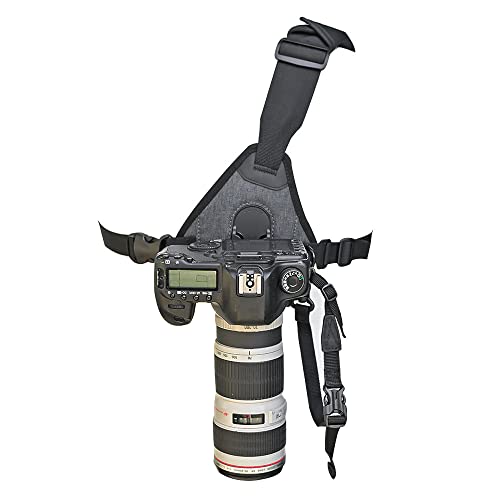
- Close-fitting sling design
- Padded, ventilated support
- Safety tether and weather cover
Best For: Travel and active photographers carrying one camera
Versatile Carrying Vest
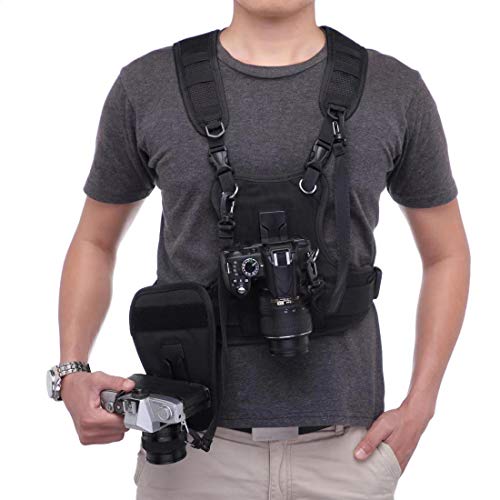
- Locking system with instant release
- Backup safety strap included
- Carries one or two camera setups
Best For: Wedding, sports, nature, studio, and hiking photography
Weather-Ready Comfort
J1 Rotating-Lock Camera Harness

- Rotating camera lock for secure carrying
- Waterproof nylon load-distributing design
- Includes lens strap and rain cover
Best For: Active outdoor photography with one camera
Cinematic POV Rig

- Supports cameras up to 3 pounds
- Includes 3-foot, 180-degree pole extension
- Designed for wide-angle cinematic footage
Best For: Third-person POV filming and action-oriented video
FOMITO Dual-Camera Stability

- Dual-camera carrying design
- Includes a side holster
- Mesh fabric helps limit camera swing
Best For: Event and field assignments requiring two DSLR or mirrorless cameras
Lightweight Comfort – USA Gear DSLR Chest Harness
For photographers seeking camera chest harnesses for heavy cameras, the USA Gear DSLR Chest Harness focuses on padded comfort, adjustable fit, and hands-free carrying. Its neoprene design helps distribute weight across the neck, back, and shoulders, while quick-release buckles simplify camera removal.
Best For: DSLR, mirrorless, and point-and-shoot users who want a lightweight harness with accessory storage for hiking, walking, or everyday photography.
Pros:
- Adjustable padded design supports hands-free carrying.
- Neoprene construction helps distribute camera weight.
- Quick-release buckles make setup and removal simple.
- Built-in pockets hold memory cards, batteries, lens caps, and small accessories.
Cons:
- Its 6.4-ounce construction may be better suited to lighter camera setups than the heaviest professional rigs.
- The standard size may not provide the same tailored fit as a size-specific system.
This is a practical, budget-friendly option when comfort and storage matter more than a highly reinforced mounting platform. Check your camera and lens weight before choosing it for heavy professional equipment.
Adventure-Ready Support – Cotton Carrier CCS G3 Camera Harness
The Cotton Carrier CCS G3 is a strong candidate among camera chest harnesses for heavy cameras, using an ergonomic vest design to transfer weight from the neck to the torso. Its patented twist-and-lock mount secures one camera while allowing quick one-handed release.
Best For: Wildlife, field, and outdoor photographers who need a rugged one-camera harness with a rain cover and reinforced construction.
Pros:
- Twist-and-lock mount secures the camera and releases with one hand.
- Vest design helps distribute weight across the torso.
- Includes a rain cover for changing weather.
- Weather-resistant materials and reinforced seams are suited to demanding outdoor use.
Cons:
- At 0.66 kg, it is substantially heavier than a simple camera strap.
- The system is designed for one camera rather than multiple-camera carrying.
With its vest-style support, dedicated mounting hub, tether, and rain cover, this is the most adventure-focused option in the group. It is worth considering when secure access and weight distribution take priority over minimal bulk.
Pack-Integrated Protection – Osprey Camera Chest Rig
The Osprey Camera Chest Rig takes a different approach to camera chest harnesses for heavy cameras by attaching to an Osprey pack harness. Its molded EVA foam structure protects and stabilizes the camera, while adjustable dividers and a rain cover add practical outdoor protection.
Best For: Hikers and outdoor photographers who already use an Osprey pack with load lifters and want an organized, weather-conscious chest-mounted camera compartment.
Pros:
- Attaches to compatible Osprey packs to create a photo-carrying setup.
- Molded EVA foam helps protect and stabilize camera bodies.
- Adjustable dividers help organize the compartment.
- Includes side pockets and a rain cover.
Cons:
- It is pack-dependent rather than a standalone universal chest harness.
- At 1.3 pounds, it adds noticeable weight to a hiking setup.
- The single-compartment design may limit organization for larger kits.
This rig is best viewed as a protective, pack-integrated camera carrier rather than a traditional strap harness. Confirm that your backpack has the required harness and load-lifter features before buying.
Compact Sling Access – Cotton Carrier Skout G2 Harness
The Cotton Carrier Skout G2 offers a compact sling-style alternative for photographers comparing camera chest harnesses for heavy cameras. It holds one camera close to the body with a padded shoulder, ventilated back, adjustable fit, and a safety tether for added carrying security.
Best For: Travelers and active photographers who want quick, quiet access to one camera without the bulk of a full vest.
Pros:
- Sling-style design keeps the camera close to the body.
- Padded shoulder and ventilated back improve carrying comfort.
- Camera can be deployed quickly and quietly.
- Includes a safety tether, weather cover, and mounting hardware.
Cons:
- It is intended for one camera, not a multi-camera loadout.
- The compact sling format may provide less weight distribution than a full vest for especially heavy setups.
- One-size construction may require careful adjustment for the best fit.
The Skout G2 is a sensible choice when accessibility and compactness matter most. For genuinely heavy camera-and-lens combinations, compare its sling support with a full vest-style harness before deciding.
Versatile Carrying Vest – Nicama NC-VEST Chest Harness
For photographers comparing camera chest harnesses for heavy cameras, the Nicama NC-VEST offers a two-camera carrying design with a locking system and backup safety strap. Its one-size format is intended to accommodate different camera and lens combinations for mobile shooting.
Best For: Wedding, sports, nature, studio, and hiking photographers who want to carry one or two cameras.
Pros:
- Secure camera locking system with instant release.
- Backup safety camera strap adds extra retention.
- Designed to carry various camera and lens combinations.
- One-size design works with Canon, Nikon, Sony, Panasonic, and Olympus cameras.
Cons:
- The screw is not compatible with camera monopods or tripods.
- Plastic material may be less appealing to buyers seeking an all-metal harness system.
With its dual-camera capacity and backup strap, the NC-VEST is a practical option for photographers who need quick access during active assignments. Check the mounting limitation if you also use a monopod or tripod.
Weather-Ready Comfort – J1 Rotating-Lock Camera Harness
Among camera chest harnesses for heavy cameras, the J1 emphasizes load distribution, retention, and outdoor protection. Its waterproof nylon construction, rotating lock, lens-fixing strap, and included rain cover are useful for photographers moving through changing conditions.
Best For: Hiking, climbing, weddings, travel, and other active outdoor photography with one camera.
Pros:
- Rotating locking design helps secure the camera with the lens facing down.
- Waterproof nylon harness distributes load across the body.
- Lens-fixing strap provides an additional layer of protection.
- Separate lens rain cover helps protect against sudden rain.
Cons:
- Designed for carrying one camera rather than a two-camera setup.
- The supplied notes do not specify a maximum camera weight.
The J1 is a strong fit when stability and weather preparedness matter more than carrying multiple bodies. Its adjustable design and dual-retention approach make it particularly suitable for active movement.
Cinematic POV Rig – Glide Gear SNC 100 Snorricam
The Glide Gear SNC 100 is more than a standard carrying harness: it is a body-mounted POV stabilizer for DSLR and mirrorless cameras. For shoppers considering camera chest harnesses for heavy cameras, its 3-pound maximum recommendation is important, as is its focus on cinematic walking shots and wide-angle footage.
Best For: Filmmakers creating third-person POV footage, music videos, action sequences, and cinematic walking shots.
Pros:
- Supports cameras up to 3 pounds.
- 3-foot pole extension offers 180-degree articulation.
- Updated groove joints and removable shoulder straps provide an adjustable setup.
- 6061 aluminum construction is described as lightweight and durable.
Cons:
- Not water resistant.
- Limited to cameras within the 3-pound maximum recommendation.
- Optimized for wide lenses from 8mm to 24mm full-frame equivalent.
The SNC 100 is best treated as a specialized filming rig rather than a simple camera-carrying harness. Its articulated extension and wide-lens optimization make it a compelling choice for creative movement shots, provided your camera setup stays within its weight limit.
Nicama Single-Camera Security – S-VEST Harness
For photographers comparing camera chest harnesses for heavy cameras, the Nicama S-VEST focuses on carrying one camera-and-lens combination with a secure locking system and backup strap. Its mesh-and-nylon, one-size design is suited to active shooting situations where quick access matters.
Best For: Wedding, sports, nature, and studio photographers carrying one camera.
Pros:
- Supports one camera and lens combination of various types and sizes.
- Secure locking system includes instant release.
- Backup safety camera strap adds an extra retention point.
- One-size design with mesh and nylon construction.
Cons:
- It does not work directly with camera tripods.
- Nicama’s RL1 Camera Tripod Adapter Plate is required for tripod compatibility.
- Designed for one camera rather than a dual-camera setup.
The S-VEST is a practical single-camera option when quick access and added retention are more important than direct tripod use or carrying two bodies.
Nicama Dual-Body Access – Two-Camera Chest Vest
Among camera chest harnesses for heavy cameras, this Nicama vest is built for photographers who want to carry one or two camera-and-lens combinations while keeping both bodies accessible. The one-size carrier includes secure locking hardware and backup safety straps for active assignments.
Best For: Photographers covering weddings, hiking, climbing, travel, sports, nature, or studio work with one or two cameras.
Pros:
- Supports one or two cameras and lens combinations.
- Secure camera locking system provides instant release.
- Includes backup safety camera straps.
- Compatible with the listed Canon, Nikon, Sony, Sigma, and Olympus camera examples.
Cons:
- The shoulder straps need to be positioned at an angle to avoid touching the neck.
- One-size fit may require careful strap adjustment for comfort.
- Its listed item weight is 0.64 kg.
This is the more flexible Nicama choice for photographers who need dual-camera carrying capacity, provided they take time to adjust the shoulder straps correctly.
FOMITO Dual-Camera Stability – Side-Holster Vest
The FOMITO multi-camera vest is a strong candidate among camera chest harnesses for heavy cameras when you want dual-camera capacity and a side holster. Its denier polypropylene and mesh construction is designed to reduce neck and shoulder strain while helping prevent camera swing.
Best For: Wedding, graduation, extreme-sports, public-relations, and journalism assignments requiring two cameras.
Pros:
- Dual-camera strap design supports DSLR and mirrorless cameras.
- Side holster offers an additional carrying position.
- Denier polypropylene and mesh fabric are intended to reduce neck and shoulder strain.
- Secure locking system is designed for easy release.
Cons:
- The supplied details specify a dual-camera setup rather than a single-camera configuration.
- One-size sizing may require adjustment for individual comfort.
- Compatibility is described for DSLR and mirrorless cameras, not every camera type.
Choose the FOMITO when carrying two cameras and limiting camera swing are priorities, especially for fast-moving professional assignments.
How We Picked the Best Camera Chest Harnesses for Heavy Cameras
We focused on the features that matter most when a harness must support a substantial camera body and lens. Our comparison considers strap width and padding, the security of attachment points, quick-release design, adjustment range, stability during movement, and whether the system leaves room for bags or accessories. We also distinguished conventional carrying harnesses from chest rigs designed primarily for stabilized point-of-view footage.
Because camera sizes and shooting styles vary, no single design is ideal for everyone. A compact sling may be convenient for occasional use, while a structured vest is generally better for heavier equipment or long sessions.
Quick Comparison
| Best For | Look For | Most Suitable Design |
|---|---|---|
| Daily event or travel shooting | Fast access and balanced support | Single-camera harness |
| Long outdoor sessions | Wide padding and secure retention | Structured chest vest |
| Carrying two camera bodies | Separate attachment points and load balance | Dual-camera vest |
| Hands-free movement | Stable straps and quick release | Chest harness system |
| POV video capture | Rigid mounting and adjustability | Snorricam-style chest rig |
Key Buying Factors
Load Support and Comfort
Heavy cameras should sit close to your torso rather than pull away from it. Look for broad shoulder straps, a supportive chest or waist connection, and enough padding to prevent pressure points. A vest-style design usually distributes weight better than a narrow strap system during all-day use.
Attachment Security
Check how the camera connects to the harness and whether the system includes a secondary safety strap or locking mechanism. The attachment should resist twisting and accidental release, especially when walking, climbing, or working in crowds. Confirm that the mounting hardware is compatible with your camera plate or tripod setup.
Fit and Adjustability
A harness must remain snug without restricting breathing or arm movement. Prioritize adjustable shoulder, chest, and waist straps, particularly if the harness will be shared or worn over jackets. Before carrying a heavy setup, test the fit with the camera attached and make sure the lens does not strike your body while moving.
Storage and Flexibility
Accessory pockets can reduce the need for a separate bag, but they may add bulk. Consider whether you need space for batteries, memory cards, a phone, or a second lens. Also check whether the harness works with a backpack, belt, or tripod.
Who Should Buy Which Camera Chest Harnesses for Heavy Cameras?
Choose a padded single-camera harness if you primarily carry one DSLR or mirrorless body and want quick access without a full vest. A structured camera vest is the better choice for heavier lenses, long walks, or demanding outdoor and event assignments. If you regularly switch between two bodies, select a multi-camera system with independently secured attachment points and balanced positioning.
For photographers who want a lightweight, low-profile option, a sling-style harness can be easier to pack and put on. For action videographers and creators recording body-mounted footage, a dedicated POV chest rig is more appropriate than a standard carrying harness. Whichever style you choose, verify the stated camera compatibility, inspect all buckles and connectors regularly, and use any included safety tether when carrying expensive equipment.