The right viewfinder can make framing easier, especially when bright sunlight, demanding focus work, or a shoulder-mounted setup makes a camera’s built-in screen difficult to use.
This roundup compares 10 camera viewfinders for cinema cameras, from dedicated electronic viewfinders to optical framing tools and LCD magnifiers. Use the buying guide below to match the design, compatibility, and monitoring features to your workflow.
Best 10 Camera Viewfinders for Cinema Cameras Picks for 2026
Dedicated EVF
Blackmagic Pocket Cinema Camera Pro EVF
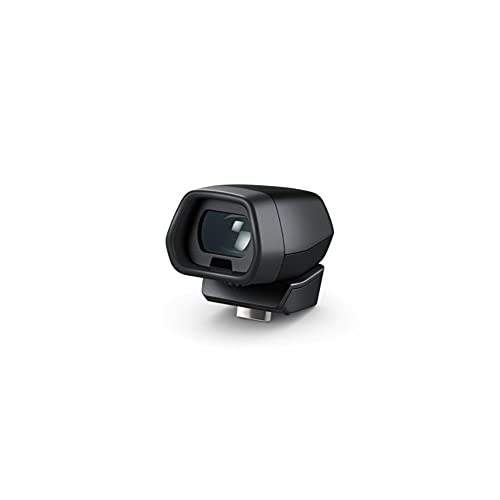
- Purpose-built for the Pocket Cinema Camera 6K Pro
- -4 to +4 dioptre compensation
- Proximity sensor and status information
Best For: Pocket Cinema Camera 6K Pro owners
Sunlight Magnifier

- Fits many 3.0-inch and 3.2-inch 16:9 screens
- 3x focusable magnification
- Blocks light for clearer outdoor viewing
Best For: Bright-light LCD monitoring
RED-Control EVF
OEYE-RED 4K SDI/HDMI Viewfinder

- 1920x1080, 0.71-inch OLED display
- 3G-SDI and HDMI with loop-through
- RED menu control and monitoring tools
Best For: RED camera production workflows
Optical Framing Aid
SmallRig 35mm External Optical Viewfinder

- 35mm-equivalent view with 3:2 frame lines
- Five optical-glass groups with up to 93% transmission
- Lightweight cold-shoe mounting design
Best For: Retro-style optical framing
Best Electronic Match
Z CAM EVF Electronic Viewfinder

- Electronic viewfinder designed for Z CAM cameras
- Purpose-built for cinema-camera viewing
- Check compatibility with your exact Z CAM setup
Best For: Z CAM users wanting a dedicated electronic viewfinder
Best Optical Director's Viewer
VD 11X Micro Director's HD Viewfinder

- 11X magnification with multi-coated optical glass
- Supports numerous film and TV aspect ratios
- Includes a 37mm filter thread and telescoping design
Best For: Directors planning framing across multiple cinema formats
Best Compact Frameline Viewer

- 28mm, 35mm, and 50mm framelines
- Adjustable hot- or cold-shoe mounting
- Purely optical with no metering or camera interaction
Best For: Simple lens-based framing on a compact camera rig
Outdoor LCD Control

- Reduces glare on outdoor LCD screens
- 3x glass magnification with ±3 diopter adjustment
- Fits LCD screens up to 3.2 inches
Best For: Outdoor camera monitoring with compatible LCD screens
Director’s Framing Tool

- Supports multiple cinema aspect ratios
- Covers focal lengths from 3.9mm to 400mm
- HD multicoated glass and rotating framing function
Best For: On-set composition planning across formats and focal lengths
Flexible LCD Magnification

- 3x optical-glass magnification for daylight viewing
- Adjustable diopter and soft rubber eye interface
- Mounts via 1/4-inch or 3/8-inch screw holes
Best For: 3.0- or 3.2-inch LCD monitoring on SLR and mirrorless cameras
Dedicated EVF – Blackmagic Pocket Cinema Camera Pro EVF
For owners of the Blackmagic Pocket Cinema Camera 6K Pro, this dedicated electronic viewfinder is a purpose-built option among camera viewfinders for cinema cameras. It combines a proximity sensor, adjustable diopter compensation, and integrated status information to support more controlled shooting.
Best For: Blackmagic Pocket Cinema Camera 6K Pro users who want an integrated electronic viewing solution.
Pros:
- Designed specifically for the Blackmagic Pocket Cinema Camera 6K Pro.
- Includes a proximity sensor and a four-part glass diopter.
- Offers dioptre compensation from -4 to +4.
- Displays integrated status information and includes a digital test chart.
Cons:
- Compatibility is limited to the specified Blackmagic camera.
- It is not water resistant.
This is the most camera-specific choice in the group, making it appealing when seamless compatibility matters more than broad system flexibility.
Sunlight Magnifier – Kamerar CVF-2 LCD Viewfinder
The Kamerar CVF-2 is a practical choice for filmmakers who need clearer LCD viewing in bright conditions. As one of the more adaptable camera viewfinders for cinema cameras, it fits most 3.0-inch and 3.2-inch 16:9 screens and adds 3x focusable magnification.
Best For: Shooters using compatible 3.0-inch or 3.2-inch 16:9 LCD screens outdoors or in bright light.
Pros:
- Blocks excess light for improved contrast in bright sunlight.
- Provides 3x, or 300%, magnification with edge-to-edge sharpness.
- Eyecup works with either eye and can accommodate eyeglasses.
- Adjustable rubber bands allow simple, mark-free installation.
Cons:
- Compatibility is limited to 3.0-inch and 3.2-inch 16:9 LCD screens.
- It magnifies the camera LCD rather than providing an electronic display.
Choose the CVF-2 when your main problem is glare and small on-screen detail, especially if you want a lightweight viewing aid without a permanent camera modification.
RED-Control EVF – OEYE-RED 4K SDI/HDMI Viewfinder
The OEYE-RED is a professional-style electronic viewfinder for setups that require both detailed monitoring and flexible signal connections. Its 1920×1080, 0.71-inch OLED display works with 3G-SDI and HDMI, while built-in tools support focus and exposure decisions.
Best For: RED camera operators who need SDI/HDMI connectivity, monitoring tools, and direct camera menu control.
Pros:
- Uses a 1920×1080 OLED display for critical focus and exposure monitoring.
- Supports 3G-SDI and HDMI input/output with loop-through functionality.
- Includes waveform, false color, focus peaking, and aspect-ratio controls.
- Provides direct RED camera menu control through the included cable.
Cons:
- Its 14.1-ounce weight is substantial compared with compact viewing aids.
- Requires one nonstandard battery.
This is the feature-rich option for production workflows where signal flexibility and image-analysis tools are more important than minimal weight.
Optical Framing Aid – SmallRig 35mm External Optical Viewfinder
The SmallRig 6172 takes a different approach to camera viewfinders for cinema cameras: it is a fixed optical framing accessory rather than an electronic monitor. Its cold-shoe mount, 35mm-equivalent view, and 3:2 frame lines are suited to photographers and hybrid shooters who prefer an immediate optical composition reference.
Best For: Compatible camera users seeking a lightweight optical framing aid for street photography and retro-style shooting.
Pros:
- Uses five groups of optical glass with up to 93% light transmission.
- Includes 3:2 frame lines and a 35mm-equivalent full-frame view.
- Mounts to a cold shoe and includes a silicone pad to help protect contacts.
- Compatible with selected Fujifilm, Nikon, Canon, Sony, Ricoh, and Leica cameras.
Cons:
- It has a fixed -0.52D diopter with no listed adjustment range.
- Compatibility depends on the specific camera and cold-shoe setup.
- It is an optical framing viewfinder, not an electronic display or recording monitor.
Consider this accessory when framing speed, low weight, and an optical shooting experience take priority over camera status data or electronic exposure tools.
Best Electronic Match – Z CAM EVF Electronic Viewfinder
The Z CAM EVF Electronic Viewfinder is a straightforward option to consider when comparing camera viewfinders for cinema cameras. The supplied information identifies it as an electronic viewfinder designed for Z CAM use, making it a focused choice for compatible cinema-camera setups.
Best For: Z CAM users seeking an electronic viewfinder for their camera rig.
Pros:
- Designed as an electronic viewfinder for Z CAM cameras.
- Purpose-built for cinema-camera viewing workflows.
Cons:
- Compatibility details beyond Z CAM use are not provided.
- The supplied information does not specify display, resolution, or mounting features.
This is best evaluated as a dedicated Z CAM accessory rather than a universal viewfinder. Confirm compatibility with your exact camera and rig before buying.
Best Optical Director's Viewer – VD 11X Micro Director's HD Viewfinder
The VD 11X Micro Director’s HD Viewfinder is a practical optical choice among camera viewfinders for cinema cameras. Its multi-coated optical glass, telescoping design, aspect-ratio support, and 37mm filter thread make it useful for planning composition across a range of film and television formats.
Best For: Directors and camera operators who need a portable optical framing tool with broad format support.
Pros:
- Supports common formats and aspect ratios, including 16:9, 1.85, 2.2, and 2.4.
- 11X magnification and multi-coated optical glass help inspect framing and focus.
- Telescoping body and locking eyecup support flexible use.
- 37mm filter thread accepts compatible wide-angle converters.
Cons:
- It is an optical scene viewer, not an electronic display or camera-connected monitor.
- Not water resistant.
- The compact 1.62-inch dimensions may require careful handling in production environments.
With extensive aspect-ratio coverage and a built-in sunshade function, this viewer is well suited to previsualizing shots in bright conditions. It is a strong fit when optical framing is more important than live electronic camera data.
Best Compact Frameline Viewer – 17° Mini Optical Viewfinder
The 17° Mini Optical Viewfinder is a compact, camera-mounted option for photographers comparing camera viewfinders for cinema cameras. It provides bright framelines for 28mm, 35mm, and 50mm lenses and attaches through an adjustable cold shoe mount, but it remains a purely optical accessory without metering or camera communication.
Best For: Shooters who want simple optical framing for 28mm, 35mm, and 50mm lenses.
Pros:
- Displays framelines for 28mm, 35mm, and 50mm lenses.
- Adjustable cold shoe mount fits a camera hot or cold shoe.
- Works independently through optical principles without electronic controls.
Cons:
- Provides no metering information and does not interact with digital or film cameras.
- All frame lines appear simultaneously rather than being isolated individually.
- Framelines may be harder to see in high-contrast or challenging light.
This viewfinder favors simplicity and quick visual composition over camera integration. Adjusting eye position can help reveal the framelines when lighting makes them less visible.
Outdoor LCD Control – HoodLoupe 3.2 Viewfinder
For filmmakers comparing camera viewfinders for cinema cameras, the Hoodman H32MB is a practical LCD loupe for improving screen visibility outdoors. Its sun-shading design, glass lens, 3x magnification, and adjustable diopter help you monitor framing in bright conditions.
Best For: Shooters who need a glare-reduced view of compatible camera LCD screens outdoors.
Pros:
- Helps make LCD screens glare free outdoors.
- Fits screens up to 3.2 inches.
- Offers 3x magnification and ±3 diopter adjustment.
- Optical module can swap between different-size bases.
Cons:
- Limited to LCD screens up to 3.2 inches.
- Its 3x magnification may be more than needed for simple screen monitoring.
The H32MB is a focused solution for outdoor monitoring rather than a general-purpose director’s viewfinder. Confirm your LCD size and mounting setup before choosing it.
Director’s Framing Tool – 11x M Director Viewfinder
For filmmakers evaluating camera viewfinders for cinema cameras, this 11x M director viewfinder is built for planning compositions across multiple aspect ratios and focal lengths. Its HD multicoated glass, rotating function, and 52mm ONT thread support flexible on-set framing.
Best For: Directors and cinematographers exploring composition across different screen formats and lens perspectives.
Pros:
- Supports aspect ratios including 4:3, 0.66, 16:9, 1.85, 2.2, 2.4, and 2.55.
- Uses HD multicoated glass for clarity and reduced reflections.
- Accommodates focal lengths from 3.9mm to 400mm.
- Rotating function enables quick framing adjustments.
Cons:
- Its director-viewfinder design is intended for composition planning, not LCD magnification.
- The product information does not specify a camera or lens mounting adapter beyond the 52mm ONT thread.
This model stands out when format and focal-length flexibility matter more than compact LCD viewing. Its detachable eyepiece cover and non-slip grip also support comfortable handling on set.
Flexible LCD Magnification – 3x Camera Viewfinder
For filmmakers seeking camera viewfinders for cinema cameras and compatible SLR or mirrorless bodies, this 3x LCD magnifier combines a sunshade with adjustable viewing. Optical glass, a soft rubber eye interface, and tripod or shoulder-bracket mounting options make it useful for daylight screen monitoring.
Best For: Users with 3.0- or 3.2-inch camera screens who want magnified daylight viewing and flexible mounting.
Pros:
- Provides 3x magnification for a clearer daylight view.
- Uses optical glass designed to preserve the original image without deformation.
- Includes adjustable diopter and an adjustable rubber eye setting.
- Offers 1/4-inch and 3/8-inch screw holes for tripod or shoulder-bracket mounting.
Cons:
- Compatibility is focused on 3.0- and 3.2-inch LCD screens.
- Requires attaching the bottom plate and securing it with screws before use.
This is a versatile LCD-focused option for users who want more mounting flexibility than a basic handheld loupe. Check your screen dimensions and available mounting hardware before purchase.
How We Picked These Camera Viewfinders for Cinema Cameras
We selected options across the main categories used in production: electronic viewfinders, optical viewfinders, director’s viewfinders, and LCD loupe magnifiers. We considered camera and display compatibility, connection standards, mounting options, magnification, framing support, portability, and suitability for daylight or on-set monitoring.
Compatibility matters most. A dedicated EVF may require a specific camera body, proprietary connector, SDI, or HDMI output, while an optical finder or loupe generally works through a lens, screen, or cold-shoe mount. Always confirm dimensions, ports, thread sizes, and supported camera models before ordering.
Quick Comparison
| Type | Best for | Main advantage | Watch for |
|---|---|---|---|
| Electronic viewfinder | Professional monitoring | Accurate image and camera controls | Power, cable, and camera compatibility |
| Optical viewfinder | Framing and lens planning | Low weight and no battery required | Limited exposure or focus information |
| Director’s viewfinder | Previsualization | Useful field-of-view and composition reference | Not a substitute for an on-camera monitor |
| LCD loupe | Bright outdoor shooting | Shades and enlarges the camera screen | Screen size and mounting fit |
Key Buying Factors for Camera Viewfinders for Cinema Cameras
Camera and Signal Compatibility
Check whether the finder is designed for your exact camera or accepts an HDMI or SDI feed. A viewfinder with menu control can be especially useful, but only when its control protocol and connector match the camera.
Display Quality and Viewing Conditions
For electronic models, prioritize resolution, contrast, latency, viewing angle, and available overlays. For optical models, look at glass quality, frame-line accuracy, field-of-view markings, and diopter adjustment. A loupe should fit the LCD closely and block stray light without obscuring controls.
Mounting and Operating Position
Consider cold-shoe compatibility, articulated arms, mounting threads, eye relief, and whether you will shoot handheld, on a rig, or from a tripod. A secure mount prevents alignment changes during takes.
Size, Power, and Durability
Small optical finders are convenient for scouting and framing, while electronic units add monitoring capability but may need batteries or camera power. For frequent production use, favor robust construction, protected connectors, and replaceable or standard accessories.
Who Should Buy Which Camera Viewfinders for Cinema Cameras?
Choose a dedicated electronic viewfinder if you need reliable on-camera monitoring, image overlays, or access to camera menus. Choose an optical viewfinder for lightweight framing, lens selection, and fast previsualization without batteries. A director’s viewfinder is best for planning shots and communicating composition, not for judging final focus or exposure. If your main problem is glare on a built-in LCD, a compatible 3x loupe or HoodLoupe-style accessory is usually the simplest solution.