Optical camera viewfinders offer a bright, distraction-free way to frame images when your camera screen is difficult to see or you want a more traditional shooting experience.
This roundup compares 10 external finders, including dedicated Ricoh and Leica-compatible options, fixed focal-length models, and multi-frameline designs for film and digital cameras.
Best 10 Optical Camera Viewfinders Picks for 2026
Versatile Framelines

- Bright 28mm, 35mm, and 50mm framelines
- Glass optics and aluminum construction
- Adjustable standard cold-shoe mount
Best For: Multi-focal-length rangefinder and mirrorless shooting
Dedicated 28mm Option
Ricoh GV-2 External Mini Viewfinder

- Made for the Ricoh GXR system
- Lag-free 28mm-equivalent optical view
- Includes 1:1 framing marks and case
Best For: Ricoh GXR photographers using a 28mm perspective
Comfortable 35mm Framing

- Precise dedicated 35mm framelines
- Multi-coated four-element optical design
- Soft eyecup and 25g aluminum body
Best For: Standard cold-shoe cameras used at 35mm
Replacement Side-Axis Viewfinder
CHICHIYANG Mini Optical Viewfinder

- Compact replacement for damaged finders
- Bright transparent design
- Simple hot- or cold-shoe installation
Best For: Compatible Ricoh GR and Leica X-style cameras
Compact 35mm Framing Aid

- Bright frame lines for manual-focus composition
- Standard hot-shoe mount for broad compatibility
- Lightweight metal construction
Best For: Portable 35mm-equivalent shooting
High-Transmission 28mm Finder
28mm External Optical Viewfinder
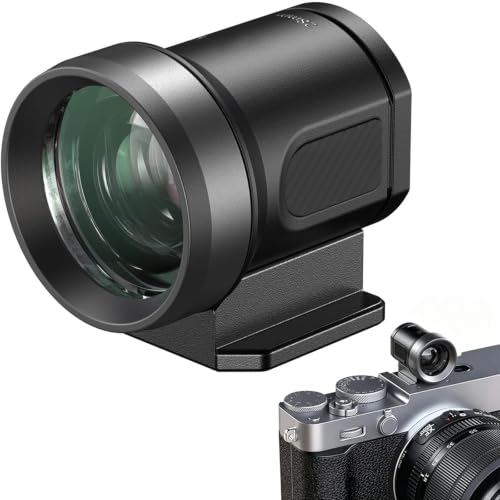
- Up to 98% light transmittance
- 28mm view with 4:3 frame lines
- Aluminum body with protective silicone pad
Best For: Retro-style 28mm street and portrait framing
Versatile 35mm Street Finder
SmallRig 35mm External Optical Viewfinder

- Broad compatibility across multiple camera brands
- 35mm view with 3:2 frame lines
- 93% light transmission and cold-shoe protection
Best For: Street photography with supported cameras
Versatile Framing Pick
17° Multi-Focal Mini Viewfinder

- 28mm, 35mm, and 50mm framelines
- Bright five-piece optical glass design
- Lightweight aluminum body with cold shoe mount
Best For: Photographers using several common focal lengths
Best Compatibility Range
SmallRig 28mm Optical Viewfinder

- 28mm full-frame equivalent field of view
- Up to 98% light transmission
- Listed compatibility with many popular cameras
Best For: Users seeking a dedicated 28mm finder for supported cameras
Simple Independent Design

- 28mm, 35mm, and 50mm framelines
- Displays all framelines simultaneously
- Standard cold shoe attachment
Best For: Shooters wanting simple optical-only composition assistance
Versatile Framelines – LightMate OV-X2
The LightMate OV-X2 is a flexible choice for photographers comparing optical camera viewfinders across several focal lengths. Its bright 28mm, 35mm, and 50mm framelines, compact aluminum body, and adjustable cold-shoe positions make it practical for compatible rangefinder and mirrorless cameras.
Best For: Photographers who want multiple focal-length framelines in one lightweight external viewfinder.
Pros:
- Built-in bright 28mm, 35mm, and 50mm full-frame lines support quick composition.
- Six high-transmittance optical glass lenses provide a clear view without resin-lens yellowing.
- Lightweight aluminum construction weighs approximately 21g.
- Adjustable cold-shoe positions help accommodate different camera shoe locations.
Cons:
- The standard cold-shoe mount is not compatible with special mounts such as the Canon R50V.
- Its approximately 0.5x magnification may not suit photographers seeking a highly magnified view.
With its broad frameline selection and bright optical design, the OV-X2 is a useful all-purpose option. Check your camera’s shoe compatibility before buying, especially if it uses a nonstandard mount.
Dedicated 28mm Option – Ricoh GV-2 External Mini Viewfinder
The Ricoh GV-2 is a dedicated optical camera viewfinder for the Ricoh GXR system. It mounts to the hot shoe and provides a lag-free 28mm-equivalent framing view, with 1:1 aspect-ratio marks for photographers who prefer a simple, purpose-built accessory.
Best For: Ricoh GXR users who primarily shoot with a 28mm-equivalent field of view.
Pros:
- Designed specifically for the Ricoh GXR camera system.
- Provides a 28mm-equivalent optical view without electronic-viewfinder lag.
- Built-in 1:1 aspect-ratio alignment marks assist square composition.
- Includes a protective case and weighs 23g.
Cons:
- Compatibility is limited to the Ricoh GXR hot shoe.
- It offers only a 28mm framing view rather than multiple focal-length options.
- It provides no image stabilization, autofocus, or electronic exposure controls.
The GV-2 makes the most sense when its dedicated Ricoh compatibility and 28mm framing match your setup. It is less suitable for photographers who need interchangeable framelines or broader camera compatibility.
Comfortable 35mm Framing – TTArtisan 35mm Viewfinder
The TTArtisan 35mm Viewfinder is a straightforward option for photographers comparing optical camera viewfinders for standard focal-length composition. Its precise 35mm framelines, four-element multi-coated optics, soft rubber eyecup, and universal cold-shoe design emphasize comfortable manual framing.
Best For: Shooters who want a dedicated 35mm frameline view on cameras with a standard cold shoe.
Pros:
- Dedicated 35mm framelines provide a clear, familiar composition perspective.
- Four-element optics with multi-coating support high light transmission.
- Soft rubber eyecup improves comfort while viewing.
- Anodized aviation aluminum construction keeps the unit compact at 25g.
Cons:
- It provides a single 35mm frameline rather than multiple focal-length choices.
- Its universal mounting depends on the camera having a compatible standard cold shoe.
This TTArtisan model is a focused, lightweight pick for photographers who consistently compose at 35mm. The rubber eyecup and multi-coated optics add practical comfort without making the accessory bulky.
Replacement Side-Axis Viewfinder – CHICHIYANG Mini Optical Viewfinder
The CHICHIYANG Mini Optical Side Axis Viewfinder is aimed at owners replacing an old, broken, or non-working accessory on compatible Ricoh GR or Leica X-style cameras. As optical camera viewfinders go, it prioritizes a small, bright design and simple hot- or cold-shoe installation.
Best For: Users seeking a compact replacement viewfinder for compatible side-axis cameras.
Pros:
- Designed as a replacement for an old, broken, or non-working viewfinder.
- Small, transparent, and bright design coordinates with side-axis cameras.
- Installs and removes easily through the camera’s hot or cold shoe.
- Made from high-quality material described as durable and wear-resistant.
Cons:
- The supplied notes do not specify focal-length framelines or detailed optical specifications.
- High-profile SLR-style bodies are not recommended because parallax may be large.
- Compatibility should be checked carefully for the specific Ricoh GR or Leica X camera.
This is primarily a practical replacement accessory rather than a feature-rich multi-frameline finder. Confirm the camera body and shoe arrangement before ordering, and avoid setups where the manufacturer warns of excessive parallax.
Compact 35mm Framing Aid – TTARTISAN 35mm Viewfinder
For photographers comparing optical camera viewfinders, the TTARTISAN 35mm Viewfinder offers a simple way to compose through bright, clear frame lines instead of relying on an LCD screen. Its standard hot-shoe connection and lightweight metal construction make it a practical accessory for compatible mirrorless and rangefinder setups.
Best For: Manual-focus shooting with 35mm-equivalent lenses, especially when portability and straightforward framing matter.
Pros:
- Bright, clear frame lines support accurate composition.
- Standard hot-shoe mount works with most mirrorless and rangefinder cameras.
- Lightweight metal design adds only 1.76 ounces to the setup.
- Helps frame scenes without depending on the camera’s LCD screen.
Cons:
- Designed primarily for a 35mm-equivalent field of view.
- As an optical accessory, it does not provide electronic shooting information.
This TTARTISAN model is a focused choice for photographers who want a compact, durable external finder for 35mm-style composition and manual-focus work.
High-Transmission 28mm Finder – 28mm External Optical Viewfinder
This 28mm external optical viewfinder is aimed at photographers who want a natural, retro-style composing experience. Its five-element optical glass reaches up to 98% light transmittance, while the 28mm field of view and 4:3 frame lines help guide precise framing on a full-frame camera.
Best For: Street, landscape, and portrait photographers using a 28mm-equivalent perspective.
Pros:
- Five-element optical glass provides up to 98% light transmittance.
- 28mm full-frame-equivalent view includes 4:3 frame lines.
- Aluminum body offers a compact, polished design.
- Silicone bottom pad helps protect hot-shoe contacts from scratches.
Cons:
- Its framing guidance is tailored to a 28mm focal length.
- The supplied notes do not specify a list of compatible camera models.
With its high-transmission optics and protective mounting pad, this finder is a strong option for users prioritizing a bright viewing experience and classic external composition.
Versatile 35mm Street Finder – SmallRig 35mm External Optical Viewfinder
The SmallRig 6172 is a useful choice for photographers comparing optical camera viewfinders across a wide range of supported cameras. It combines a 35mm full-frame-equivalent view, 3:2 frame lines, five groups of optical glass, and a cold-shoe mount for a more natural, retro-inspired framing process.
Best For: Street photographers using one of the listed Fujifilm, Nikon, Canon, Sony, Ricoh, or Leica cameras.
Pros:
- Broad compatibility list covers many popular camera models.
- 35mm field of view with built-in 3:2 frame lines supports precise composition.
- Five groups of optical glass provide up to 93% light transmission.
- Silicone mounting pad helps protect the camera’s hot-shoe contacts.
Cons:
- Compatibility should be checked against the specific camera model before purchase.
- Fixed nominal -0.52D diopter may not suit every user’s eyesight.
- Optimal clarity requires a close, centered viewing position.
The 6172 stands out for its unusually broad stated compatibility and street-friendly 35mm framing, though users should pay close attention to the fixed diopter and recommended eye position.
Versatile Framing Pick – 17° Multi-Focal Mini Viewfinder
For photographers comparing optical camera viewfinders, this compact external finder stands out for its bright 28mm, 35mm, and 50mm framelines. Its independent optical design is useful when you want a simple composition aid for film or digital cameras.
Best For: Shooters who use several common full-frame focal lengths and want a lightweight external framing tool.
Pros:
- Displays bright framelines for 28mm, 35mm, and 50mm lenses.
- Five-piece high-transmittance glass and 0.5x magnification provide a bright viewing window.
- Compact aluminum-alloy body with a standard cold shoe mount.
- Two adjustable mounting positions help with alignment.
Cons:
- Provides framing only and does not control focus, metering, exposure, or image capture.
- Its framelines are designed around the listed focal lengths rather than a broad range of lenses.
This is a practical choice for composition-focused shooting, especially if you value a retro-style metal build and quick mounting over electronic camera integration.
Best Compatibility Range – SmallRig 28mm Optical Viewfinder
The SmallRig 5873 is one of the more broadly compatible optical camera viewfinders in this group. It uses a fixed 28mm full-frame field of view, five groups of optical glass, and built-in 3:2 frame lines for straightforward composition.
Best For: Camera owners who want a dedicated 28mm framing experience and need a finder listed for many Fujifilm, Nikon, Canon, Sony, Ricoh, and Leica models.
Pros:
- Designed for a 28mm full-frame equivalent view, with an 18mm lens recommended for matching APS-C framing.
- Five groups of optical glass offer up to 98% light transmission.
- Built-in 3:2 frame lines support composition.
- Cold shoe mounting includes a silicone pad to help protect hot shoe contacts.
Cons:
- Fixed -0.52D diopter may not suit every user’s eyesight.
- Viewing clarity and field coverage depend on keeping the eye close to the eyepiece and centered.
- It is limited to a 28mm framing perspective.
Choose this model when compatibility and a defined wide-angle perspective matter most. Its fixed optical setup is simple, but users should check the camera list and viewing requirements before buying.
Simple Independent Design – 17° All-Frameline Finder
This external optical finder gives photographers a direct way to preview 28mm, 35mm, and 50mm compositions. Among optical camera viewfinders, its pure optical approach suits users who want framing assistance without electronic communication or camera-system controls.
Best For: Film and digital shooters who prefer an independent finder that shows multiple focal-length framelines at once.
Pros:
- Provides framelines for 28mm, 35mm, and 50mm lenses.
- Shows all listed framelines simultaneously for composition comparison.
- Uses a standard cold shoe mount for quick attachment.
- Pure optical operation avoids metering and electronic communication.
Cons:
- It does not provide metering or electronic camera functions.
- Frameline visibility can vary in low light or high-contrast scenes.
- Eye position may need adjustment to confirm the frame clearly.
This finder is appealing for a straightforward, battery-free-style shooting workflow centered on composition. Its simultaneous framelines are convenient, though lighting and eye placement can affect how easily they are seen.
How We Picked the Best Optical Camera Viewfinders
We focused on practical differences that affect everyday use: focal-length coverage, frameline visibility, optical construction, mounting style, compatibility, size, and ease of carrying. The selection includes dedicated finders for specific camera systems as well as universal cold-shoe models.
Because external finders do not communicate electronically with the camera, fit and framing accuracy matter more than extra features. We gave preference to products that clearly identify their supported focal lengths, offer useful framelines, and use a secure standard shoe mount.
Quick Comparison
| Finder Type | Best For | What to Check |
|---|---|---|
| Multi-frameline | Photographers using several focal lengths | Frameline range and parallax behavior |
| Fixed 28mm or 35mm | Street, travel, and documentary shooting | Lens focal length and camera sensor format |
| Dedicated Ricoh or Leica-style finder | Specific compatible cameras | Mount fit and listed camera models |
| Universal cold-shoe model | Film cameras and compact cameras | Shoe dimensions and finder alignment |
Key Buying Factors for Optical Camera Viewfinders
Focal Length and Framelines
Choose a finder that matches the lens or focal lengths you use most. A 28mm finder suits wider street and travel compositions, while 35mm is a versatile everyday choice. Multi-frameline models are more flexible, but their extra markings can make the view less minimal.
Compatibility and Mounting
Check whether the finder is designed for a particular camera or attaches through a standard cold shoe. Dedicated models may align more naturally with compatible bodies, while universal versions can work across many cameras but require careful positioning.
Optical Clarity and Brightness
Look for clear glass optics, high light transmission, and an uncluttered view. Bright framelines are especially useful in dim interiors or overcast conditions. A finder should remain readable without forcing you to move your eye into an awkward position.
Size, Build, and Parallax
Compact aluminum finders are convenient for travel, but construction quality still matters because the accessory may remain mounted in a camera bag. At close distances, the viewfinder frame will not perfectly match the lens perspective; this parallax error is normal, though some designs handle it better than others.
Who Should Buy Which Optical Camera Viewfinders?
Choose a multi-frameline finder if you regularly switch among 28mm, 35mm, and 50mm lenses. It provides the most flexibility in one accessory.
Choose a fixed 35mm finder for a simple, fast setup centered on a popular everyday focal length. A fixed 28mm model is better for photographers who favor wider compositions.
Choose a dedicated Ricoh or Leica-compatible option when exact camera compatibility and a clean, integrated fit are more important than universal use.
Choose a universal cold-shoe finder if you use several compact or film cameras. Confirm the camera’s shoe position, lens focal length, and whether the finder’s field of view suits the camera format before buying.