Music rooms need more than acoustic treatment on the walls. Footfall, pedal movement, drum impact, and instrument vibration can travel through floors and disturb nearby rooms or neighbors.
This roundup compares 10 soundproofing mats for music rooms, including interlocking felt tiles, dedicated drum and piano rugs, and larger sound-dampening barriers. The right choice depends on your instrument, floor type, coverage needs, and whether you are reducing airborne sound or mechanical vibration.
Best 10 Soundproofing Mats for Music Rooms Picks for 2026
Best Modular Floor Coverage
Interlocking Felt Sound Absorbing Mats

- 16 interlocking polyester-felt panels
- Helps reduce echo and floor vibration
- Portable, low-pile, and floor-protective
Best For: Compact studios, drum areas, and flexible floor coverage
Best Wall-Mounted Treatment

- 52 one-inch acoustic foam panels
- Targets echo, reverb, and flutter echo
- Includes 300 adhesive pieces
Best For: Recording studios, vocal booths, and control rooms
Best Premium Drum Isolation

- Large 4-by-6-foot coverage
- Reduces mechanical vibration and resonance
- Non-slip, one-inch vinyl construction
Best For: Drum and percussion setups needing dedicated isolation
Best Large Modular Coverage
High-Density Felt Carpet Tiles

- 24 tiles cover about 24 square feet
- Dampens noise and protects hard floors
- Tool-free, cuttable interlocking design
Best For: Larger practice areas, rentals, and multipurpose rooms
Instrument Floor Isolation

- Includes 24 puzzle-style felt pieces
- Covers up to about 20.5 square feet
- Helps cushion floors and dampen instrument vibration
Best For: Drums, pianos, studios, and hard indoor floors
Piano Performance Protection
Non-Slip Soundproof Rug for Piano

- Sized 160 by 70 centimeters for piano areas
- Helps reduce key and pedal-operation noise
- Non-slip, washable, and moisture resistant
Best For: Upright pianos and keyboard areas needing floor protection
Compact Studio Coverage
Black Interlocking Drum Rug Mats
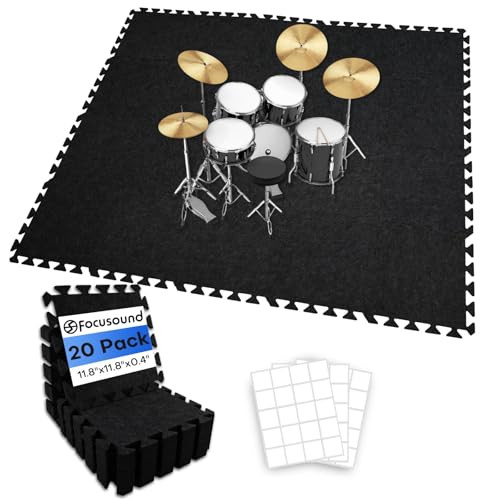
- 20 felt pieces cover up to 17 square feet
- Helps reduce echo and instrument vibration
- Flat interlocking surface supports stable equipment placement
Best For: Small studios and focused drum or piano practice areas
Expandable Floor Protection

- 20 pieces create up to 17 square feet of coverage
- High-density felt cushions floors and reduces room reverb
- Additional sets can expand the covered area
Best For: Growing studios and flexible hardwood-floor practice setups
Best Modular Floor Coverage – Interlocking Felt Sound Absorbing Mats
These interlocking felt mats are a flexible option when you need soundproofing mats for music rooms that can cover a defined practice area. Their dense polyester construction helps absorb room echo and vibration while protecting flooring beneath drums, pianos, and speakers.
Best For: Drum kits, pianos, speakers, and compact music studios needing customizable floor coverage.
Pros:
- Sixteen 11.8-by-11.8-inch panels create a 47.2-by-47.2-inch connected surface.
- Interlocking edges assemble and disassemble without messy installation.
- Thick polyester felt helps reduce echo, reverberation, and floor vibration.
- Non-slip, low-pile design supports stands and drum spurs while helping protect floors.
Cons:
- The included set covers a relatively limited area.
- It is not water resistant.
This is a practical pick for musicians who want portable, reconfigurable floor treatment rather than a permanently installed solution. Add panels or pair the mat with wall treatment when broader room control is needed.
Best Wall-Mounted Treatment – Acoustic Foam Wedge Panels
This 52-panel foam kit is suited to music rooms where unwanted reflections are the main concern. The grooved acoustic foam is designed to absorb echoes, reverb, and flutter echoes, making it a useful complement to floor-based soundproofing mats for music rooms.
Best For: Recording studios, vocal booths, control rooms, and home offices needing wall-mounted acoustic treatment.
Pros:
- Includes 52 one-inch-thick, 12-by-12-inch foam panels.
- Triangular grooves help absorb unwanted echoes, waves, and reverberation.
- Includes 300 pieces of double-sided adhesive for installation.
- Notes cite fire resistance, air permeability, and non-toxic materials.
Cons:
- These are wall panels rather than floor mats, so they do not directly protect floors or isolate equipment contact.
- Foam may require water soaking and 24 to 48 hours of air drying to recover its shape if compressed.
Choose this kit when room reflections are interfering with recording or listening. It is best viewed as wall treatment that works alongside, rather than replaces, vibration-control flooring.
Best Premium Drum Isolation – Auralex HOVERMAT Drum Mat
Auralex Acoustics HOVERMAT HoverMat Portable Acoustic Barrier Non-Slip Drum Mat, 48" x 72"
Check Price On AmazonThe Auralex HOVERMAT is a purpose-built barrier for drummers who need soundproofing mats for music rooms focused on mechanical vibration. Its one-inch vinyl construction separates the kit from the supporting surface to help limit structure-borne transmission and improve perceived drum clarity.
Best For: Drum kits and percussion setups where subfloor resonance and room-to-room vibration are concerns.
Pros:
- Large 4-by-6-foot mat provides dedicated coverage for a drum setup.
- Designed to reduce sympathetic resonance between drums, the subfloor, and building structure.
- Helps limit direct mechanical vibration and sound transmission between rooms.
- Non-slip surface and one-inch thickness support stable placement.
Cons:
- Its specialized drum-focused design is less versatile than modular tile systems.
- Spot-clean-only care and a non-water-resistant surface require attention.
- The supplied specifications list a 12-month manufacturer-defect replacement warranty.
This is the most targeted choice for isolating a drum kit from the floor. It costs flexibility in exchange for a broad, ready-to-use barrier designed specifically around percussion vibration.
Best Large Modular Coverage – High-Density Felt Carpet Tiles
With 24 interlocking tiles covering up to 24 square feet, this felt system is a practical choice for soundproofing mats for music rooms that need broader, customizable floor coverage. Its dense polyester surface helps dampen ambient noise and vibration while shielding hardwood or tile from equipment and furniture.
Best For: Larger music practice zones, home offices, light home gyms, and renters seeking removable floor protection.
Pros:
- Twenty-four tiles provide approximately 24 square feet of coverage.
- High-density polyester felt helps absorb ambient noise and dampen vibrations.
- Interlocking edges assemble without tools, glue, or permanent installation.
- Tiles can be cut with a utility knife for awkward corners and custom layouts.
Cons:
- Felt is intended for noise reduction and floor protection, not complete room sound isolation.
- The product is described for light home-gym use, so it may not suit heavy-impact training.
This set offers more coverage than smaller tile packs while remaining easy to remove or resize. It is a strong fit when you want a softer, warmer floor surface for a practice area without committing to permanent flooring.
Studio Blanket Coverage – Heavy-Duty Sound Dampening Blanket
For music rooms that need flexible wall, door, or window treatment, this 72-by-40-inch blanket is a practical alternative to permanently installed soundproofing mats for music rooms. Its dense construction is designed to help reduce echo and reverb while also blocking light.
Best For: Recording studios, podcast rooms, vocal booths, home theaters, and temporary acoustic treatment on doors, walls, or windows.
Pros:
- Large 72-by-40-inch coverage for walls, doors, windows, or room dividers
- Helps reduce echo, reverb, and unwanted noise in recording spaces
- Five grommets, reinforced stitching, hooks, and screws support convenient installation
- Also works as a blackout curtain, moving blanket, or equipment cover
Cons:
- It is a hanging blanket rather than a floor mat or rigid acoustic panel
- One blanket may not cover a large room or multiple surfaces
This is a versatile choice when you want movable acoustic coverage and light blocking in the same product. The included mounting hardware makes setup easier, while the 4.62-pound weight and reinforced construction support regular use.
Instrument Floor Isolation – Interlocking Felt Sound Mats
These interlocking felt mats are a floor-focused option among soundproofing mats for music rooms. The puzzle-style pieces cushion hard floors, help isolate instrument vibrations, and can be arranged to fit the available space beneath drums, pianos, or other equipment.
Best For: Drum kits, pianos, music studios, home gyms, offices, and rooms where floor protection and vibration dampening are priorities.
Pros:
- Twenty-four interlocking pieces can cover up to about 20.5 square feet
- High-density felt cushions floors and helps absorb foot-traffic shock, echo, and reverb
- Modular design lets you increase or decrease the covered area
- Removable double-sided tape is included for additional non-slip support
Cons:
- At 0.3 inches thick, the mats provide cushioning but are not heavy structural isolation
- They are intended for indoor use and are not water resistant
- Assembly is required to create the floor surface
This set makes sense when the main concern is vibration and impact at the floor rather than sound treatment on walls. Its modular layout is useful for fitting around instruments, although the total coverage should be measured against the room or equipment footprint.
Piano Performance Protection – Non-Slip Soundproof Rug for Piano
Designed specifically for piano placement, this 160-by-70-centimeter rug provides a dedicated surface for reducing impact and pedal-related noise. It is a focused alternative to general soundproofing mats for music rooms, with a non-slip backing and a washable polyester-blend construction.
Best For: Upright pianos and keyboard areas where floor protection, non-slip performance, and reduced pedal or key-impact noise are needed.
Pros:
- 160-by-70-centimeter size is shaped for piano use
- Designed to reduce keyboard percussion and pedal-operation noise
- Non-slip backing helps keep the rug in place during playing
- Machine-washable and described as moisture resistant and wear resistant
Cons:
- Its piano-specific size is less adaptable than interlocking modular mats
- It is a floor rug, so it does not treat wall or ceiling reflections
- Only one rug is included
This rug is a straightforward fit for an upright piano or similar keyboard setup. Choose it when you want a dedicated, washable floor layer with non-slip support; for broader room treatment, additional acoustic products may still be needed.
Apartment-Friendly Practice Pick – Interlocking Felt Noise Reduction Mats
For shoppers comparing soundproofing mats for music rooms, this 20-piece felt set combines vibration cushioning with a non-slip puzzle design. Its 0.4-inch high-density construction is intended to reduce impact transmission from drums, piano pedals, and other equipment while helping limit room echo.
Best For: Apartments, shared studios, music rooms, home gyms, and setups that need flexible floor protection.
Pros:
- High-density felt helps absorb drum, piano, and treadmill impacts.
- Interlocking pieces help keep instruments, chairs, and pedals stable.
- Can be trimmed, stacked for storage, and reinforced with included double-sided strips.
- Non-toxic, odorless, stain-resistant material suits multiple rooms.
Cons:
- The individual 11-inch pieces require assembly to create a larger practice area.
- The set may need trimming or additional pieces for irregular or expansive rooms.
This is a practical choice when you want portable floor coverage and vibration reduction without installing permanent flooring. The modular format is especially useful for renters and multipurpose rooms.
Compact Studio Coverage – Black Interlocking Drum Rug Mats
These black interlocking mats are a compact option among soundproofing mats for music rooms. The 20 polyester-felt pieces create up to 17 square feet of coverage and are designed to reduce reverberation, cushion vibration, and provide a flatter surface beneath drums or pianos.
Best For: Small music studios, drum and piano practice areas, hardwood floors, and compact home gym spaces.
Pros:
- 150 kg/m³ felt construction is designed for sound absorption and vibration reduction.
- Interlocking edges create a connected surface with fewer wrinkles.
- Non-slip design helps stabilize instruments and protect floors from scratches.
- Includes double-sided tape for added hold on suitable surfaces.
Cons:
- Coverage is limited to a maximum of about 17 square feet per set.
- The 11.8-inch puzzle pieces must be assembled before use.
Choose this set when a tidy, dedicated platform is more important than covering an entire room. Its black finish is understated, while the modular construction makes the layout easy to adapt around equipment.
Expandable Floor Protection – Modular Acoustic Puzzle Mats
If you need soundproofing mats for music rooms that can grow with your setup, this 20-piece high-density felt set offers a modular starting point. The interlocking tiles cushion hard floors, reduce reverb and echo, and can be combined with additional sets for broader coverage.
Best For: Expandable music studios, drum and piano areas, playrooms, gyms, and hardwood-floor protection.
Pros:
- 20 puzzle pieces provide up to 17 square feet of initial coverage.
- High-density felt helps dampen shock, foot traffic, and instrument vibration.
- Easy to connect, disassemble, and expand with additional sets.
- Includes 48 removable double-sided tape pieces for added slip resistance.
Cons:
- A single set may not cover a full music room or larger instrument footprint.
- Assembly is required, and the included tape may be needed for extra security.
This set stands out for buyers who want a customizable acoustic floor area rather than a fixed-size rug. It is a sensible foundation for a growing practice space, particularly where protecting hardwood floors is also a priority.
How We Picked These Soundproofing Mats for Music Rooms
We focused on products designed to sit beneath instruments, equipment, or high-traffic areas where vibration and impact noise are common. The selection includes compact drum and piano mats, modular interlocking tiles, acoustic foam panels, and a heavy-duty sound-dampening blanket for different room layouts and recording needs.
We also considered useful specifications such as material density, thickness, dimensions, non-slip construction, portability, coverage, and installation flexibility. Because a mat cannot fully soundproof a room by itself, products were evaluated primarily for vibration isolation, impact-noise reduction, floor protection, and localized acoustic control.
Quick Comparison
| Type | Best For | Main Advantage | Important Limitation |
|---|---|---|---|
| Interlocking felt or carpet tiles | Drums, keyboards, and modular coverage | Easy to expand and replace | Usually offers limited low-frequency isolation |
| Dedicated drum mats | Electronic or acoustic drum kits | Stable instrument placement | Coverage may be limited to the kit area |
| Piano rugs and pads | Upright pianos and pedals | Protects flooring while reducing contact noise | Not a substitute for structural isolation |
| Acoustic foam panels | Wall and room-reflection control | Helps manage mid- and high-frequency reflections | Does not replace a floor mat |
| Sound-dampening blankets | Temporary barriers and recording setups | Flexible placement and broad coverage | Requires suitable hanging or positioning |
Key Buying Factors for Soundproofing Mats for Music Rooms
Instrument and Vibration Type
Choose a dedicated drum mat for kick-drum movement and pedal stability, while a piano pad is better suited to caster pressure, bench movement, and floor protection. Modular tiles work well when several instruments share one area.
Thickness and Density
Thicker, denser materials generally provide better cushioning against impact and vibration than thin decorative rugs. However, thickness alone does not guarantee sound isolation. Look for a firm, resilient base that will not compress excessively under heavy equipment.
Size, Coverage, and Layout
Measure the full footprint of the instrument, including pedals, stands, benches, and expected movement. Interlocking tiles allow you to build a custom footprint, while a single large mat reduces seams and setup time.
Grip and Floor Compatibility
Non-slip surfaces are important for drum pedals, keyboard stands, and rolling benches. Confirm that the backing is suitable for hardwood, laminate, tile, or carpet, and check whether it could transfer color or leave residue on delicate flooring.
Acoustic Expectations
These products primarily address contact noise, vibration, and reflections near the source. They will not stop all airborne sound or bass transmission through walls and floors. For stronger isolation, combine a mat with wall treatment, door sealing, mass-loaded barriers, or a professionally designed floating floor.
Who Should Buy Which Soundproofing Mats for Music Rooms?
- Drummers: Choose a stable, non-slip drum mat or combine interlocking tiles for extra surrounding coverage.
- Piano owners: Use a piano-specific rug or dense floor pad sized for the instrument, pedals, and bench.
- Multi-instrument rooms: Pick modular interlocking mats that can be rearranged as the room changes.
- Home studios: Pair floor mats with acoustic foam or a sound-dampening blanket to address both floor contact and room reflections.
- Renters and temporary setups: Favor portable products that install without adhesives and can be removed without altering the floor.
Before buying, map the instrument footprint, identify the main noise path, and decide whether your priority is grip, floor protection, vibration reduction, or broader acoustic treatment. That approach will help you choose a mat that matches the room rather than relying on thickness or marketing claims alone.